Feeds:
Posts
Comments

Archive for the ‘Mark’ Category

We are continuing on in our series on the second coming of Jesus. Last week we began to look at Jesus’ Olivet Discourse in Mark 13, Jesus’ primary teaching on his return.

Here’s a recap: Jesus predicted that Herod’s temple would be destroyed. The disciples, who saw this as something that must be connected to the end of all things, asked Jesus – “When’s it gonna happen?”

This is a picture of a model of Herod’s Temple:
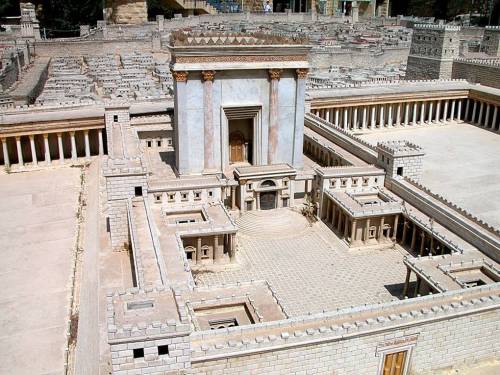
second temple

But instead of answering their question right away, in vs. 5-13 Jesus talked more generally about how we are to expect  false teachers and persecution as we wait for the end and his return.

Today, we look at Jesus’ answer to the disciple’s specific question of – “When will Herod’s temple be destroyed?” This is where Jesus presents, what I am calling his roadmap to the end.

Stage 1: The destruction of the temple

Jesus talks about four things here:

1. The abomination of desolation.

Mark 13:14a – “But when you see the abomination of desolation standing where it ought not to be (let the reader understand) . . ..”

Jesus is using prophetic – apocalyptic code language – “abomination of desolation.” This is emphasized when Mark invites the reader to understand what is being said. Its like saying – “Do you get it?”

Jesus is drawing on the book of Daniel here. Daniel portrays a pagan king who defiles the temple, most often associated with Antiochus Epiphanes and what he did in 168 BC.

By using this phrase, Jesus is saying that this will happen again (or perhaps he is even saying that this will be the true fulfillment of Daniel’s prophecy).

In Luke 21:20 (Luke’s account of the Olivet discourse) we are given the decoded version of what Jesus means: “When you see Jerusalem surrounded by armies, then know that its desolation has come near.”

This helps us to see that Jesus is talking about events that occurred not long after his death. In 66-70 AD the Roman armies came against Israel.

  • They laid siege to the city and eventually destroyed Jerusalem and the temple under General Titus, who later became emperor.
  • Then they offered up sacrifices to their idolatrous banners on the temple site

In these ways the pagan Roman empire, its armies and emperor, showed itself to be truly an “abomination of desolation.”

In answer to the question – “When will Herod’s temple be destroyed?” Jesus indicates that, it will happen sometime after you see the Roman armies coming ready to attack.

2. Flight to the mountains.

Mark 13:14b-18 – “. . .  then let those who are in Judea flee to the mountains. Let the one who is on the housetop not go down, nor enter his house, to take anything out, and let the one who is in the field not turn back to take his cloak. And alas for women who are pregnant and for those who are nursing infants in those days! Pray that it may not happen in winter.”

The recognition of the Roman armies coming against the city is the cue for the Jewish Christians in Judea to flee. Usually you would flee into a walled city in time of war. But not this time. This time God’s judgment is coming on Jerusalem and the temple. 

Jesus emphasizes the seriousness of the situation. Leave your possessions and extra clothes behind and run! Jesus also speaks to the practical difficulties of fleeing:

  • It will be very hard on women who are pregnant or with small children.
  • He also tells them to pray that it not be in winter, when the rivers are flooded and hard to cross and the mountains have snow.

According to one report the Christians in Jerusalem did in fact flee the city, sometime at the beginning of the war.

3. A great tribulation.

Mark 13:17-20 – “For in those days there will be such tribulation as has not been from the beginning of the creation that God created until now, and never will be. And if the Lord had not cut short the days, no human being would be saved. But for the sake of the elect, whom he chose, he shortened the days.” 

Luke’s version here shows us that this time of tribulation is still speaking of the destruction of Jerusalem and the temple. “For there will be great distress upon the earth and wrath against this people. They will fall by the edge of the sword and be led captive among all nations, and Jerusalem will be trampled underfoot by the Gentiles . . .”  – 21:23b-24.

This was a horrific time of suffering for the Jewish people:

  • They were subjected to the realities of seige warfare being stuck in Jerusalem. Some resorted to cannibalism when the food ran out.
  • Over a million were killed throughout Israel (which was a huge percentage of the population in that day). So many were crucified that it was said that there were few trees left in the region.
  • Almost a hundred thousand were taken away into slavery
  • Their temple was defiled and destroyed, the city of Jerusalem was burned, and their national-political identity was taken away

As Jesus said, if God did not cut short the days for the sake of his chosen ones, followers of Jesus – none would have survived.

Now, when Jesus speaks of suffering beyond what has ever occurred or will occur again:

  • He may be speaking figuratively, as the prophet Joel does in Joel 2:2. This would, then, simply be a prophetic way of describing suffering beyond imagination.
  • With regard to Jerusalem, he could be speaking literally. For it is true that it had never suffered this much before. And, if this is what he meant, then it will never suffer this much again.

4. A time of deception.

Mark 13:21-23 – “And then if anyone says to you, ‘Look, here is the Christ!’ or ‘Look, there he is!’ do not believe it. False christs and false prophets will arise and perform signs and wonders, to lead astray, if possible, the elect. But be on guard; I have told you all things beforehand.”

Jesus already warned of this, as we saw last week. Here he gives a specific warning. During this time of chaos and distress, don’t listen to false messiahs and false prophets. For they will seek to lead followers of Jesus astray through the use of signs and omens.

And this kind of activity – false prophets and talk of omens – did take place during and after the war that destroyed the temple.

This leads us to . . .

Stage 2: An undefined time of geo-political turmoil

Mark 13:24-25 – “But in those days, after that tribulation, the sun will be darkened, and the moon will not give its light, and the stars will be falling from heaven, and the powers in the heavens will be shaken.” 

This is a new section, for he says, “after that tribulation.” We are past the destruction of the temple and that awful time.

But what does all this cosmic language of sun, moon and stars mean? Is it literal? Well, when we look at the rest of Scripture, we find out that this is prophetic speech that was used to describe geo-political change as one empire rises and another falls at the hand of God:

Isaiah 13:10 uses the same cosmic language that Jesus does to speak of God’s judgment of Babylon. “For the stars of the heavens and their constellations will not give their light, the sun will be dark at its rising, and the moon will not shed its light.” As we know, it wasn’t literal here. It was a way of speaking of God’s judgment on this nation.

Isaiah 34:4 also uses some of the same language that Jesus does to speak of God’s judgment on Edom. “All the host of heaven shall rot away, and the skies roll up like a scroll. All their host shall fall . . ..”

The prophets Ezekiel, Joel & Amos  also use cosmic language to speak of judgment on nations.

Luke confirms this understanding. In Luke 21:24 the destruction of Jerusalem is followed by “the times of the Gentiles.” God will be dealing with the Gentile nations now.

Then in verses 25-26 comes the cosmic language with additional statements that help us see what is going on. Jesus speaks of “. . . distress of nations in perplexity because of the roaring of the sea and the wave, people fainting with fear and with foreboding of what is coming on the world.” Why are the nations distressed? Because of “the roaring of the sea and the wave.” And as we saw in our study of baptism this has to do with chaos, turmoil and judgment in the world (see Revelation 17:15).

Jesus here speaks in the most general terms possible about a time when nations will rise and fall in the world at the hand of God.

This section recalls Mark 13:8. “For nation will rise against nation, and kingdom against kingdom.” These are the birth pangs of the end expressed in cosmic language.

This brings us to the last stage . . .

Stage 3: The coming of the Son of Man

Mark 13:26 – “And then they will see the Son of Man coming in clouds with great power and glory.”

After this undefined period of Gentile geo-political turmoil, “then” Jesus will return as ruler and king.

We learn from Matthew’s version that a part of this is that the peoples of the earth will be judged. Matthew 24:30 says “all the tribes of the earth will mourn.” Jesus’ return will bring great woe upon the people of the earth. The book of Revelation expounds on this in some detail.

More hopefully this also involves the resurrection of the righteous.

Mark 13:27 – “And then he will send out the angels and gather his elect from the four winds, from the ends of the earth to the ends of heaven.”

Jesus will send out his angels to gather together his followers. Again, this is a common way of talking about the resurrection of the righteous.

Next we see the connection between . . .

The temple destruction and Jesus’ return

Mark 13:28-31 – “From the fig tree learn its lesson: as soon as its branch becomes tender and puts out its leaves, you know that summer is near. So also, when you see these things taking place, you know that he is near, at the very gates. Truly, I say to you, this generation will not pass away until all these things take place. Heaven and earth will pass away, but my words will not pass away.”

Now notice, the phrase, “these things” in this passage cannot refer to the coming of the Son of Man, for “when you see these things taking place, you know that he is near, at the very gates.” The two are differentiated by Jesus. “These things” must take place first, then we know that “he is near.”

The phrase, “these things” connects back to the original question of 13:4 – “When will these things be and what will be the sign when all these things are going to be fulfilled?” In other words, the phrase “these things” refers to the temple destruction and the beginning of the times of the Gentiles.

Jesus gives us more information about “when” in this section:

1. “These things” will happen within the span of a generation. That is, the destruction of the temple through to the ushering in of the times of the Gentiles will occur in the lifetime of Jesus’ hearers. Jesus said, “Truly, I say to you, this generation will not pass away until all these things take place” – v. 30.

And Jesus stakes his prophetic authority on this prediction. He said, “heaven and earth will pass away, but my words will not pass away” – v. 31. And, in fact, “all these things” did happen by 70 AD, within a generation of Jesus’ words!

2. Once the temple is destroyed, Jesus’ return is imminent. That is, no other event must happen before he returns. Which means he could come at any time!

But, lets be clear as we end . . .

No one knows when Jesus will return

Mark 13:32-33 – “But concerning that day or that hour, no one knows, not even the angels in heaven, nor the Son, but only the Father. Be on guard, keep awake. For you do not know when the time will come.”

Although the other events will be fulfilled in the generation of Jesus’ listeners, no one knows when the Son will come in glory and power.

He could not emphasize this point more. Not even Jesus himself knows when! Only the Father knows.

So if anyone tells you that they know, ask them if they know more than Jesus! Then tell them what Jesus said, “you do not know when the time will come.”

We currently live somewhere in stage two – the times of the Gentiles. And Jesus could come at any time.

Since we don’t know when, as Jesus said, we should “be on guard” and “keep awake.” We should be ready at all times!

William Higgins

Read Full Post »

We have begun a series on Jesus’ second coming and today we start to look at the Olivet discourse of Mark 13. It’s called the “Olivet” discourse because Jesus spoke these words as he sat on the Mount of Olives.

This is Jesus’ primary teaching on his second coming.

  • There are other places where he talks about this, but not in as much detail.
  • And we have this same Olivet discourse in all three of the first Gospels, with slight differences. So we can use all three of them to help us make sense of what Jesus is saying, which is a real help.

Now, when I look at all the debates and discussions about the end times today, much of which revolve around trying to make sense of the book of Revelation, which is the hardest book to interpret because of its symbolism (because you can read into it pretty much whatever you want), when I look at all this . . .

  • My choice is to start with what Jesus said. And to look at his main teaching on this.
  • And then move from there to make sense out of other passages that speak of his second coming.

So, we start with Mark 13:1 and . . .

Jesus’ prediction of the destruction of the temple

Mark 13:1 – “And as Jesus came out of the temple, one of his disciples said to him, ‘Look, Teacher, what wonderful stones and what wonderful buildings!’”

The temple here is Herod’s temple. It is usually called the second Temple. The first temple was Solomon’s and it was destroyed by the Babylonians. So when the exiles returned to Jerusalem they built another, second temple.

And it was this temple that Herod had extensively remodeled and turned into a wonder of the ancient world. It was justly famous for its size and beauty. The stones were massive – 25’ x 8’ x 12.’ The disciples were certainly impressed by it.

Mark 13:2 – “And Jesus said to him, ‘Do you see these great buildings? There will not be left here one stone upon another that will not be thrown down.’”

He predicts its destruction. Now, this isn’t the only time that Jesus predicted impending doom for Jerusalem:

  • Jesus says in Matthew 23:34-38 that Jerusalem will be judged and its temple (or “house”) left desolate.
  • In Luke 19:43-44 Jesus talks about judgment on Jerusalem for rejecting him – “For the days will come upon you, when your enemies will set up a barricade around you and surround you and hem you in on every side and tear you down to the ground, you and your children within you. And they will not leave one stone upon another in you, because you did not know the time of your visitation.”

Mark 13:3a – “And as Jesus sat on the Mount of Olives opposite the temple . . ..”

After his prediction, Jesus and the disciples went out of Jerusalem and onto the Mount of Olives. It’s just across from Jerusalem and you could see the Temple from there.

The disciples must have been thinking about Jesus’ prediction and so when they got there, they ask Jesus –

When will it happen??

Mark 13:3b-4 – “. . . Peter and James and John and Andrew asked him privately, ‘Tell us, when will these things be, and what will be the sign when all these things are about to be accomplished?’”

The phrase – “these things” refers to the prediction of the destruction of Herod’s temple. They are asking, ‘When will Herod’s temple be destroyed?’ They want to know about the timing of this prediction by Jesus.

In Matthew 24:3 (Matthew’s version of the Olivet discourse) there is the additional phrase “ . . . and what will be the sign of your coming and of the end of the age?”

The disciples saw the destruction of the temple as an event connected in some way to the end of all things. This idea would have been understandable for any Jew. Today we just don’t understand how important the temple was for their faith. For it to go must mean the end of all things.

Well, Jesus does answer their question and he confirms that there is a connection between the destruction of Herod’s temple and the end.

As we will see In vs. 14-33 he tells them:

  • when this temple will be destroyed and
  • the connection of this to the end – his second coming

He gives them what I call – “Jesus’ Roadmap to the End.” But that’s for next week!

Today our focus is on vs. 5-13, which contain Jesus’ initial answer to them, before he answers their specific question. This initial response gives some general teaching on what to expect as we wait for Jesus’ return.  For an outline of Mark 13:5-13 click here: Two Parallel Warnings About The End

The first thing Jesus tells us is to –

Expect false teachers

Mark 13:5-8 – “And Jesus began to say to them, ‘See that no one leads you astray.  Many will come in my name, saying, ‘I am he!’ and they will lead many astray. And when you hear of wars and rumors of wars, do not be alarmed. This must take place, but the end is not yet. For nation will rise against nation, and kingdom against kingdom. There will be earthquakes in various places; there will be famines. These are but the beginning of the birth pains.’”

Jesus is giving us a warning, which we need to hear today. Deceivers, false messiahs will come:

  1. They will use troubling events in the world to alarm people – wars, earthquakes and famines
  2. They will say that the end is here – “Can’t you see it! All these events are taking place!”
  3. They will call people to follow them. And in this way they will lead people astray.

This has happened throughout history, from a Samaritan false prophet who gathered quite a following before the destruction of Jerusalem, all the way to the present and David Koresh and the Branch Davidians.

In contrast to all this – Jesus, the real Messiah tells us:

  1. These things must happen – there will be troubling events – but don’t be alarmed
  2. The end is not yet
  3. So don’t listen to them! They are deceivers who will lead you astray from your faith in him.

Just as a point of emphasis because we don’t always get it: These things (wars, earthquakes, famines) are not signs of the coming of the end. They are simply the beginning of the end. That yes, we are in the last days, (which began in New Testament times) but not that the last day is here, or even around the corner.

Christians today are often the first ones to be alarmed by events in the world. But we of all people should be calm, because we know this stuff must happen, but the end is not yet. Jesus has told us so. And he said “do not be alarmed.”

Jesus says of these in v. 8 – “these are but the beginning of the birth pains.” The metaphor is that of a new world being born out of the ashes of the old. And so the kinds of things we see in newspaper headlines are simply the first hints of labor. The full birth pains will come when Jesus returns.

The second thing Jesus highlights is that we should –

Expect persecution

Mark 13:9-13 – “But be on your guard. For they will deliver you over to councils, and you will be beaten in synagogues, and you will stand before governors and kings for my sake, to bear witness before them. And the gospel must first be proclaimed to all nations. And when they bring you to trial and deliver you over, do not be anxious beforehand what you are to say, but say whatever is given you in that hour, for it is not you who speak, but the Holy Spirit. And brother will deliver brother over to death, and the father his child, and children will rise against parents and have them put to death. And you will be hated by all for my name’s sake. But the one who endures to the end will be saved.”

Jesus gives us another warning: The world will oppose us. Christians will be handed over, betrayed even by relatives. They will be beaten, put on trial, and some will be killed. We will be hated by all people.

This has happened all throughout history since the coming of Jesus.

  • In the first century the Roman emperor Nero persecuted and killed Peter and Paul and many others in the city of Rome.
  • In the 1500’s the first Mennonites suffered one of the most devastating examples of persecution in all of church history.
  • Today there are more martyrs than ever, and persecution abounds in various parts of the world even as we speak.

But he not only told us it would happen, Jesus tells us how to respond:

  1. We must endure, for the one who endures to the end will be saved. He’s saying, don’t let persecution cause you to renounce your faith; to turn away from him.
  2. We must fulfill God’s purpose of spreading the gospel to all nations. Even turning our persecution into an opportunity to witness for him.
  3. We must rely upon the Spirit to help us. For the Spirit will give us the words to say when we are put on trial; when we are put on the spot; when we are afraid.

[Just a note here: Jesus says, “The gospel must first be proclaimed to all nations” and as Matthew’s versions says, “then the end will come.” What I want to say is that this doesn’t set a time for Jesus to return that can be measured, so that we can say, “Hey, its done Jesus has to return now. Lets go sit on a hill and wait for him.” How do you measure this? Is it geographical, is it political – to every nation state, is it social – to every specific tribe? Its unclear. Paul said in Colossians 1:23 that in his own day the gospel had “been proclaimed in all creation under heaven.” So it’s unclear.]

Alright, summing up Jesus’ initial response to the disciples –

What should we expect? The testing of our faith

Scripturally, the danger of living in the last days, like we do, is that we will lose our faith.

  • As Jesus says in Matthew 24:10 (Matthew’s version of the Olivet discourse) – “Many will fall away.”
  • As Paul says in I Timothy 4:1 – “Now the Spirit expressly says that in later times some will depart from the faith . . ..”

As our verses today have shown us:

  • We can lose our faith if false messiahs, prophets or teachers lead us astray, and
  • We can lose our faith if persecution causes us not to endure

So Jesus warns us and encourages us in these verses to:

 Resist false teachers who raise alarm

And remain true to share the gospel amidst persecution

Next week – the “when” question. When will the temple be destroyed, and what is the connection of this to the end and Jesus’ return.

William Higgins

Read Full Post »

The Kind of Leaders Jesus is Looking For

We are beginning a process of electing a new Elder in our congregation. And this is significant, because Elders are important leaders in a Christian congregation.

To help you as you think and pray about nominations for this, and to also help you more broadly on the topic of Christian leadership – I want us to focus in this morning on “The Kind of Leaders Jesus is Looking For.” 

Our Focus Text – Mark 10:42-45 

“And Jesus called them to him and said to them, ‘You know that those who are considered rulers of the Gentiles lord it over them and their great ones exercise authority over them. But it shall not be so among you. But whoever would be great among you must be your servant and whoever would be first among you must be slave of all. For even the Son of Man came not to be served but to serve, and to give his life as a ransom for many.’” 

(more…)

Read Full Post »

Jesus had a lot to say about children and we have looked at some of this – especially Jesus’ blessing of children. Today we look at Mark 9:33-37, a story that teaches us about the importance of ministering to children. Lets dig into this and see what we can learn from it.

Who is the greatest?

Our story begins with an argument – vs. 33-34 – “And they came to Capernaum. And when Jesus was in the house he asked them, ‘What were you discussing on the way?’ But they kept silent, for on the way they had argued with one another about who was the greatest.”

This was not just petty vanity, you know, saying, “I’m smarter than you,” or “I look better than you.” Jesus is preparing for the kingdom of God and the disciples rightly expected to have a big role in that kingdom.

Jesus himself talks about greatness in the kingdom in several places. He talks about:

  • Those who will be the greatest in the kingdom – Matthew 23:11
  • Twelve thrones and those who will sit on these to rule over others – Matthew 19:28
  • Some sitting at his right and left hand when he is on his throne in the kingdom – Mark 10:40

So the disciples did think about these things and, of course, we find them arguing about this in several places.

In our story, no doubt, the fact that Jesus had just picked Peter, James and John to witness the transfiguration not long before had something to do with this debate about greatness.

The nine might well say, “Hey, are they better than us now?” The three may well have said, “Obviously we will have a higher place in the kingdom than you guys!”

And then add to this that the nine had failed to cast out a demon while Jesus and the other three were gone on the mountain of transfiguration. You can see how there could be tension.

When Jesus calls them on debating about this our text says, “they kept silent.” They apparently knew better than to be so openly ambitious; each putting themselves forward as the greatest.

By way of background, what we are dealing with here is a contrast of social standings on an honor/power scale:

  • You have those who are the first – in charge, with power – who are honored
  • And then you have those who are last – the lowly, the powerless – who are not honored

At the top of the scale – you are served. At the bottom of the scale – you serve.

Although it is a bit different today (we are not so hierarchical) it is still true today, just like back then that no one wanted to be a servant; to wait on others; to be lowly; to be at the bottom of this scale.

If you ask, how do you get honor & power? Well, according to the world you exalt yourself, put yourself forward, accumulate power and if you need to, put others down in order to lift yourself up.

And this is what the disciples were doing arguing with each other about who was the greatest. Maybe one said, “I’m have more spiritual gifts than you!” And another would say, “Oh yea, I’m more faithful than you!”

The true path to greatness: lowly service

Jesus confronts all this in v. 35 – “And Jesus sat down and called the twelve. And he said to them, ‘If anyone would be first, he must be last of all and servant of all.’”

It says that Jesus “sat down.” In the culture of that day teachers sat to teach. He has something important to tell them.

The disciples were arguing about who would be the greatest, but Jesus says – “If anyone would be first, he must be last of all and servant of all.” (see also Mark 10:43-45 and Matthew 23:11-12).  Notice that Jesus doesn’t challenge looking for greatness, just how to find greatness. Although the world works one way, a different path is required if you want to be great in the kingdom.

What Jesus is saying is that:

  • To be great in the kingdom, you have to be lowly right now
  • To be first then, you have to be last now
  • To be honored then, you have to lower yourself before others now
  • To be powerful then, you have to learn to serve others now

Its a paradox: You find greatness in the kingdom by being the lowest here on earth. The kingdom turns things upside down, at least as with regards to how the world works.

So our first lesson from this scripture is – If you want to be great, lower yourself to serve others. To get to the top of the kingdom honor/power scale, you have to go the bottom of the world’s honor/power scale and serve others.

In the rest of this passage, Jesus fleshes this teaching out with . . .

An illustration: Ministering to children

v. 36 says, “And he took a child and put the child in the midst of them, and embracing the child, he said to them . . ..”
 Now the word “child” here refers to anyone between the age of an infant to a 12 year old. Basically below the age of adolescence or puberty. This is how the word is used in the gospels.

A little background here on children. Today, we think of childhood as an age of innocence and we give great value and honor to children, more so than other cultures today, and certainly more than what prevailed in the ancient world.

In biblical times children were way down the honor/power scale, if not at the very bottom. They were often seen as no more than slaves, until they grew up. You can see this in that the word “child” in Aramaic (the language of Jesus) is the same as that for “slave.” Also, in Galatians 4:1-2 – Paul talks about how, until a child grows up (even a rich heir), the child is not different than a slave.

Basically, children had no power, status or rights. They were non-persons being non-adults, and were under the complete authority of their parents.

So Jesus picks out a child, an example of lowliness and one who is a servant, and he says in the first part of v. 37, “’Whoever receives one such child in my name . . .’” “One such child” is a reference to the child next to Jesus (Luke 9:48), as well as other children.

What does it mean to receive a child?

  • The word “receive” means giving welcome. Jesus does this here by embracing the child.
  • Also, remembering that this is an example of v. 35, “receive” equals being a “servant of all,” which means taking care of their needs.
  • At least a part of this receiving is illustrated for us later in Mark 10:13-16. In contrast to the disciples who do not receive the children, Jesus receives them by giving kindness, attention, and ministering God’s blessing to them.

We do all of this serving “in Jesus’ name” as his representatives, doing what he would do in the situation.

Putting this all together, Jesus is saying more specifically, and this is our second lesson – If you want to be great – lower yourself even below children – and serve them. There are many lowly ones we can serve, but here he focuses on children.

The last part of v. 37 says, “’Whoever receives one such child in my name . . . receives me, and whoever receives me, receives not me but him who sent me.’” We have here the “shaliach principle,” a well known idea in Judaism – “a person’s representative is as the person them self.” So how you respond to the representative is how you respond to the one who sent him.

Jesus uses this principle several times to talk about how it works when he sends out the apostles as his representatives. For instance Luke 10:16 teaches, if you receive them, you receive Jesus, if you reject them, you reject Jesus.

What is amazing here is that not only apostles, but also children are Jesus’ representatives! The disciples saw ministering to children in worldly terms as serving nobodies, doing what is menial and insignificant.

But Jesus puts this in a new light, and this is our third lesson – When we minister to lowly children, we are doing what is truly great – serving Jesus and indeed the Father. When we receive them, care for them and bless them, we are really doing all this to God. But, when we do not receive them, or mistreat them, this is really how we are treating God.

This speaks to how important it is to care for children’s needs and also to the fact that this is how we can be great in the kingdom. There is nothing greater than ministering to God.

Some words of encouragement

We have lots of opportunities to interact with children and minister to their needs. As parents, grandparents, those who work with children in their careers, children’s Sunday School workers, children’s church and nursery workers, workers in our two girls’ clubs, and our vacation bible school workers this week – we have many opportunities.

In all of these situations, when the children are acting up, when they are impatient, when they are difficult and even worse – remember, when you are serving children in Jesus’ name you are doing something great, ministering to Jesus and the Father. And you are doing what it takes to be great in the kingdom. William Higgins

Read Full Post »

Jesus was very concerned that children be valued and ministered to by his people. I’m not sure there is anything more important than tending to the children among us – from our own families and from the community as well.

Yet among Christian groups there are different, even conflicting ways of approaching ministry to children. So we are called to discern how we will sort  through these issues; how we will minister to the children of this congregation.

As Elders we have been working on this, and we now invite you to enter into the process. That’s what this meeting is all about. I will give a presentation tonight on our understanding and our recommendations. It is our intention to move toward common understandings and practices on these issues – policies if you will.

We invite your feedback. Think of this as a Sunday School class. Stop me and ask questions or make comments. Some of this may be controversial or maybe not. I don’t know. What is important is that we let the Scriptures guide us in this.

The first thing I want us to look at, and what underlies much of what follows, is that Scripture teaches that

1. Children are a part of the kingdom of God

Jesus said, “Let the children come to me; do not hinder them, for to such belongs the kingdom of God” – Mark 10:14. This comes from the story of Jesus blessing the children. In the last part of this verse Jesus teaches that children “belong to the kingdom of God.” This teaches us that we do not need to worry about the destiny of children, at least in terms of their immediate status with God. They are a part of the kingdom of God; the realm of God’s blessing and salvation. Or to put it plainly they are saved; they are safe in God’s grace.

But what is the age of these children who are a part of the kingdom? The first clue comes from Luke’s version of this story. He specifically notes that “they were bringing even infants to him” – Luke 18:15. The second clue comes from the word that Jesus uses for “children” – “paidion.” Based on its use in the New Testament this word refers to children from birth (e.g. Luke 1:59 – 8 days old) to puberty (e.g. Mark 5:39-42 – 12 years old). So the reference here is roughly to any child 12 or below – preadolescent children.

This is cruical for what follows. Jesus teaches us here that we should not think of our children simply as small adults:

Unlike adults, who need conversion to enter the kingdom, and are thus baptized as a sign of their conversion, the kingdom already belongs to children.

2. Children are not mature

A child in Scripture means one who is not mature. Along these lines it is used figuratively to refer to adults who are not mature in some way (e.g. I Corinthians 3:1). Literal children are not mature in many ways, but the focus here is on their inability to discern and choose between right and wrong for themselves.

  • Deuteronomy 1:39 talks about “ . . . your little ones . . . and your children, who today have no knowledge of good or evil . . ..”
  • Isaiah 7:15 speaks of maturity in these terms: “when (the child) knows how to refuse the evil and choose the good.”
  • Hebrews 5:13-14 defines maturity in this way – “those who have their powers of discernment trained by constant practice to distinguish good from evil.”

3. Children are born with “fleshly desires”

Not only are children not mature in terms of being able to make moral and religious choices, they have an inborn tendency to resist righteousness. As we know, they often do not do what is right. Like all humans, no matter what age, children must struggle with the desires of the flesh; our natural desires that lead us to do what we want instead of what God wants.

  • As Jesus said, with regard to doing God’s will – “the flesh is weak” – Mark 14:38.
  • Paul said, “For the mind that is set on the flesh is hostile to God, for it does not submit to God’s law – Romans 8:7.

4. We are to train our children

Given the condition of children, the task of parents and the people of God is to train, shape and form them in the way of the Lord. Moses said to Israel in Deuteronomy 6:7 – “You shall teach my commandments diligently to your children, and shall talk of them when you sit in your house, and when you walk by the way, and when you lie down, and when you rise.” Paul says in Ephesians 6:4, Christian parents are to raise their children in “the discipline and instruction of the Lord.”

In practical terms this means teaching them:

  • what is right and wrong according to God
  • the contents of Scripture
  • about faith and helping them to learn to trust in God
  • about repentance and forgiveness when they do wrong
  • how to pray
  • how resist temptation

We are to teach them all this and more through both word and perhaps most importantly example – as they see us live out the Christian life.

The church also has a role in this training of children given its commission by Jesus to “make disciples” of all peoples (Matthew 28:19). We strive to do this through our various programming for children, especially Sunday school.

5. Childhood faith is good and should be honored

When we train our children in the way of the Lord they will most often come to have a childhood faith in God and Jesus. Even though the faith of children is different from adult faith (see below) it is loved by God and should be honored by the church.

  • Samuel served God as a child – 1 Samuel 3.
  • At age 12 Jesus knew God’s way better than the adults – Luke 2:42-50.
  • As Jesus said, God accepts and loves the praise of children – Matthew 21:15-16.

6. Adult faith is different and is the goal of our training

A child’s faith is dependent on what parents or others teach them. Since they are not fully able to discern and choose for themselves this is appropriate to their situation.

Adult faith, however, is different. It is a choice based on the person’s own discernment of what is right and wrong. And even though an adult’s faith will continue to grow and mature – the ability to discern for oneself and choose is what makes adult faith fundamentally different than the faith of a child.

So the goal of our training is that when our children are mature (past the age of childhood acceptance before God – see #1) they will be ready to begin to discern and choose to enter the kingdom of God for themselves. As Paul writes to Timothy– “from childhood you have been acquainted with the sacred writings, which are able to make you wise for salvation through faith in Christ Jesus” – 2 Timothy 3:14-15. Our training is meant to equip our children so that when they are ready and able they will choose salvation through faith in Christ Jesus. For those with childhood faith this may well be a smooth and seamless transition.

7. Children and baptism

That baptism is for adults can be seen in several ways:

The symbolic meaning of baptism involves, among other things, the choice to leave the world and sin behind in order to walk in Jesus’ way. Or, to use the similar imagery of Romans 6  – baptism has to do with dying to your old life of sin and being raised to a new life of righteousness. But children are still a part of the kingdom of God, not the world. They have not yet even entered this adult world of choosing and discerning for themselves – along with culpably sinning before God. To apply this symbol to them is inappropriate in that it doesn’t properly reflect their status before God. They aren’t leaving the world and sin behind. They are already in the kingdom.

In Scripture, baptism is uniformly connected with adult kinds of responses: hearing the gospel, understanding it, and choosing faith and repentance in response to the message. But by definition children are not able to discern and choose to have faith in Jesus for themselves. The faith that they have is dependent on what parents and others have taught them.

Finally, Jesus connects baptism with discipleship, or “teaching them to observe all that I have commanded you” in Matthew 28:19-20. But children are not able to make the serious, adult kinds of choices that Jesus requires of all disciples. Jesus calls us to obey his hard teachings, to submit to church discipline and to sacrifice our lives for the kingdom.

Given this, baptism should not be applied to preadolescent children – even those who have a childhood faith in Jesus. Baptism is meant to be the marker of adult faith in Jesus. It is the way that Jesus chose for adults to publicly identify with him as a Christian and as a disciple. So baptism should be reserved for those who are able to have adult-faith; for those who are (roughly) 13 or older.

For those with childhood faith, baptism should be looked forward to as the symbol of transition from childhood faith to adult faith.

What we need, and are proposing, is a ritual for those who come to childhood faith, to affirm and support their faith, allowing us to reserve baptism for its proper role with reference to adults.

When our child matures to the point of making adult choices in relation to God – they may well be ready for baptism, or their childhood faith may continue on for a while, or they may discern and choose not to follow Jesus. We should be careful in this transition time not to pressure them into baptism. To be genuine, it must come from their own initiative, discernment and choice, although it is always appropriate to invite them to make this decision.

8. Children and the Lord’s supper

Symbolically the Lord’s supper represents much of what baptism represents.

The bread, coming from the Passover meal, speaks to leaving behind our old lives of bondage and despair in the world (just as Israel left Egypt behind). As was noted above under baptism, this is not an appropriate symbolic statement about where children are in their status before God. The bread also assumes an adult type choice to leave behind the world and sin in order to follow God. Each time we partake we remind ourselves of this commitment that we made to God at the time of our baptism.

The cup, coming from the covenant ceremony of Exodus 24 (where Israel agreed to obey all that God commanded), has a covenant context. It assumes that we have covenanted with God through baptism and it calls us to remember this adult type commitment – to do all that Jesus has commanded (Matthew 28:19).

So the Lord’s supper is a meal for those who have made the adult kind of commitment that is required to be a disciple of Jesus – baptism. Those with childhood faith should be taught to look forward to their baptism, when they too will be able to take part in this discipleship meal.

9. The blessing of children

Jesus is very clear that we are to “receive” children in his name. Jesus said in Mark 9:37 – “Whoever receives one such child in my name receives me, and whoever receives me, receives not me but him who sent me.” Jesus is also very clear that we are to “let the children come” to him – Mark 10:14. We are not to be like the disciples who tried to hold back the children from Jesus; who made Jesus angry.

But if baptism and the Lord’s supper are not the way to do this as a church, what is? The Gospels answer this question by telling the story of Jesus blessing the children.

“And they were bringing children to him that he might touch them, and the disciples rebuked them. But when Jesus saw it, he was indignant and said to them, “Let the children come to me; do not hinder them, for to such belongs the kingdom of God.. . . And he took them in his arms and blessed them, laying his hands on them” – Mark 10:13-16.

So, to “let the children come” to Jesus (Mark 10:14) is defined in this story in verse 16. And what it means to receive children in Mark 9:37 is explained here in Mark 10:16.

When Jesus ministered to children he did not baptize them or give them the Lord’s supper. He took them, prayed for them and blessed them. He took the time to receive them and care for them and to minister God’s blessing into their lives. This is also what we should do.

10. A summary of practical outcomes

1. We should have a continued focus on training our children: Sunday school, bible school and girls’ clubs. And we should seek to equip and support our parents as teachers of their children.
2. We should continue to have a service of blessing for our babies upon their presentation to the church and we should be ready to pray for God’s blessing for children, whenever they or their parents seek it out.
3. We should reserve baptism for adolescent young people and older.
4. We should provide a public ceremony to affirm and support the expression of childhood faith in our children.
5. We should reserve the Lord’s supper for those who are baptized.
6. We should provide a special time of blessing for children each time we celebrate the Lord’s supper so that they are included and are able to be ministered to by Jesus.
7. For the preadolescent children among us who are already baptized, we would like to walk with them, invite them to catechism classes, as needed when they are ready, and in general encourage them to own their faith as young adults as well.

Read Full Post »

(more…)

Read Full Post »

Today I want to pick up a theme we touched on in January when we looked at the Shema. And we begin by looking at Mark 12:29-30:

“Hear, O Israel: The Lord our God, the Lord alone is God. And you shall love the Lord your God with all your heart and with all your soul and with all your mind and with all your strength.”

This is Jesus quoting Deuteronomy 6:4-5. Would you say it with me?

Alright, let me remind you of two things about this –

Call for commitment to God

1) God wants every part of us. We are to love God with our

  • heart
  • soul
  • mind
  • and strength

This covers every part of us, both our inner person and our strength or body. God claims all of us, not just part of us. Everything within us and everything else.

2) God wants all of every part of us

  • not just part of our heart – but all of our heart
  • not just piece of our soul – but all of our soul
  • not just a portion of our mind – but all of our mind
  • not just a percentage of our strength – but all of our strength

God wants every part of every part of you.

But . . . what we actually do is usually far short of what God demands. What we actually give God is, often, just a part of ourselves. We do this in different ways. We have what I call –

Strategies of commitment avoidance

These are ways in which we hold back on giving ourselves fully to God. We will look at several examples of these.

1. We give God the stuff that doesn’t require sacrifice. Honor my parents? Sure! That’s easy. They are good and noble people. But love my enemies – who harm me, slander me, threaten to kill me? No way!

God wants even what seems too difficult for you to give

2. We give God the stuff that makes us look good. Be honest? Well it’s hard, but sure, I’ll get a good reputation out of it. But when God asks me to share my faith with my coworkers? No way! That would embarrass me. They might disapprove of me or make fun of me.

God wants all of you, even if it causes you shame.

3. We give God the religious stuff and keep the rest for ourselves. Sure, I will go to church and say a prayer now and again. But order my private life according to God’s will? You know, let God control who I date, who I marry, my sex life, what career I have, how I run my business, what I do with my money. No way!

God wants control of your private life.

4. We give God the stuff that doesn’t take much faith. Yes, I will serve God here and there. But serve God when it means leaving my family, friends and home for a time overseas or somewhere else, or leave for ever? Not a chance!

God wants you to love him even when it stretches you to the breaking point – beyond what your faith can think or imagine.

5. We give stuff to God when the giving is easy. We give of ourselves when the circumstances are conducive. Sure, I will give some offerings. I’m doing pretty well now. But give sacrificially, when I have trouble paying my bills? No way. Or another example – sure, I will praise you when my life is easy and comfortable. But praise you when I am sick, disabled or poor? Certainly not!

God wants all of you all the time, not just when it is convenient or easy for you.

6. We give God the bad stuff in our lives – our problems, our crises, our needs. Sure God, take all this and fix it for me so that we can keep on living my comfortable life of complacence and half-hearted commitment, just like I always have. But give God my career, my resources, my creativity, my best time and focus. No way!

God wants our best, not our leftovers.

I said “strategies,” but really these are all one strategy. All of these have in common that we give a part instead of the whole. And we hope that that will be enough; and God will be happy with that! We think that we can appease God by giving him a part of us and not the whole of us. But God wants it all!

But you say, pastor . . .

Is God demanding too much?

Well think about it. God is only asking for what is rightfully his, for what God makes, God owns. Psalm 95:5 says, “The sea is his, for he made it, and his hands formed the dry land.” What God makes is rightfully God’s. And this applies to us. V. 6 goes on to say, “Oh come, let us worship and bow down; let us kneel before the Lord, our Maker!” God has made us and we are his. And so, as the verse says, we are to give ourselves fully in worship and submission to our Maker.

God made us and it is only right that we give ourselves fully to God.

Also, God is only asking from us, what he has already given to us in Jesus – everything. Romans 8:32 says, “God did not spare his own Son but gave him up for us all.” Thankfully God didn’t hold back with regard to us and leave us hanging. God’s commitment to us is complete. God gave us everything in Jesus. And we should give God everything in return.

Think about in from another perspective. If we are holding out on God we are still in control. If I set the terms, if I tell God what he can have and what he can’t have in my life, then I am still in control – even if I give over most of myself to God most of the time. I am still in control!

Half hearted commitment isn’t commitment. To be committed to God means to give God everything. That’s why he asks for it all.

Finally –

Let Jesus be your example in this

Jesus was like us in all things (except sin). Hebrews 4:15 tells us that he knew human weakness, limitations and temptations. But he gave every part of every part of himself to God.

  • Jesus held nothing back
  • Jesus loved God completely – heart, soul, mind and strength
  • Jesus gave himself fully to God

May God give you the strength and courage to overcome your fears, so that just like Jesus you give yourself fully to God.

William Higgins

Read Full Post »

I want to share this morning about “Two Essentials for Following Jesus” and I want to begin by pointing out something you already know . . .

Jesus’ way can be hard

Its not always easy to follow Jesus. Some people like to make it sound like being a Christian solves all your problems, (and it does solve a lot). But the reality is that following Jesus can actually make your life harder than it was before.

(more…)

Read Full Post »

« Newer Posts