Feeds:
Posts
Comments

We are seeking the Lord’s guidance as a congregation and will be coming together for a meeting next week after church. As a part of our preparation I shared last week on Listening for the Spirit – to help us know what this means and how to do it. We are continuing on with this theme today.

Last time I made the point that it’s normal for believers to be led by the Spirit of God. As Paul says in Romans 8:14, “For all who are led by the Spirit of God are sons (children) of God.” This is simply a part of being in relationship with God.

And we also looked at the most common way the Spirit leads us, which is the inward witness of the Spirit. This is when the Spirit doesn’t necessarily speak words, but gives us a deep inner sense of things that goes beyond words; an affirmation or a conviction that teaches and guides us in the way to go.

Today we want to go further on the topic of the Spirit’s leading, and first we look at –

How to receive God’s leading

That is, how do we get ourselves in a place to hear what God might want to say to us? Continue Reading »

As you know, we are seeking the Lord for guidance regarding our future as a congregation. And as a part of this I want to give some teaching this week and next on Listening for the Spirit – to help us know what this means and how to do it. Today, let me begin by saying that –

It’s normal to be led by the Spirit

That is, this isn’t just for certain people like leaders or “saints.” Or perhaps coming from a different direction, you might think that this is the language of those who have gone off the deep end and so you want to stay away from it. No. This is the privilege of all Christians. Continue Reading »

The literary structure of Psalm 13

Psalm 13 is really powerful; full of intense and honest struggle, but also faith. And I want to hold it up for you as a model for when you are being overwhelmed by difficult circumstances.

As we get started, a few words about –

Psalm 13

It is the shortest prayer for help in the book of Psalms. There are shorter Psalms, but these are not requests to God.

In terms of how it is put together, there are three obvious parts to this psalm.

  • In vs.  1-2 the Psalmist pours out his heart to God.
  • In vs. 3-4 he makes his request
  • And in vs. 5-6 he expresses his faith and hope in God

And each of these sections has the name of God or “Yahweh” in it, indicated in English by the capitalized “LORD.”

We don’t know the specifics of his situation, but it involves enemies and the threat of death. This is a Davidic Psalm (written by him or in honor of/about him) perhaps referring to his time in the wilderness hiding from King Saul, who was trying to kill him. Whatever the case may be he is facing a very serious situation and needs God’s help.

Let’s look at the first section, which is a cry of despair.

1How long, O LORD? Will you forget me forever? How long will you hide your face from me? 2How long must I take counsel in my soul and have sorrow in my heart all the day? How long shall my enemy be exalted over me?”

There is no indication in these verses that the Psalmist has sinned or has been unfaithful so that his difficulties are the result of this. He is simply in an overwhelming time of testing and trial.

Notice the phrase “How long?” This is used several times in scriptural prayers, but this is the only place where it is repeated four times, and in such a short space. There is an intensity in this prayer in asking this question of God. These questions also show us that it’s OK to ask God questions like this. God can take it. We don’t have to put on a smile, or fake it when we come into God’s presence. After all, he already knows what we are thinking and feeling. We only need be careful that we do this with proper respect for God.

You can feel the raw emotions and the brutal honesty of this prayer as you read these two verses.

  • In relation to God the Psalmist feels abandoned and ignored by God. God has hidden his face, that is it feels like God has turned away and is not looking out for him; he feels that God has forgotten him.
  • In relation to himself he feels greatly distressed within. “Taking counsel in his soul” perhaps has to do with trying to sort out what he should do, since God doesn’t seem to be acting for him; it has to do with anxious worrying. And he has sorrow in his heart.
  • In relation to his problem , his enemy, he feels defeated. His enemy has the upper hand and this means that his life is in danger.

Also notice the time indicators, the “how long?” questions, the word “forever” and the phrase “all the day.” The sense is that he is barely hanging on. He is worn down. He is at the breaking point. The test is so hard that he can’t take it anymore. So if God doesn’t act soon, it will overwhelm him and be too late.

Next we have his request to God.

3Consider and answer me, O LORD my God; light up my eyes, lest I sleep the sleep of death, 4lest my enemy say, ‘I have prevailed over him,’ lest my foes rejoice because I am shaken.”

In general, he wants God to consider him or take note of his situation to answer him. He’s saying, ‘God, don’t forget me or hide your face from me.’ He wants God to act to bring him help him in the midst of his difficulty.

Specifically, he wants God to “light up his eyes.” In Scripture to have dim eyes means that you are overwhelmed, weak and weary (Job 17:7; Deuteronomy 34:7). And to have eyes that are lit up has to do with being strong, full of life and vigor (Deuteronomy 34:7; Ezra 9:8; Proverbs 29:13). Even today we can tell how someone is doing by their eyes, right? We can tell whether they are full of energy and life or whether they are worn down and discouraged. You can see it.

So, being worn down by his trials, he is asking God to give him strength, new life, vigor, encouragement and hope.

And he doesn’t just make his request for help, he gives God three reasons to act:

  1. lest he die, because he is in danger of death.
  2. lest his enemy win
  3. lest they rejoice at his downfall

In this situation the Psalmist understands himself to be in the right; he is doing God’s will but is being persecuted by evildoers. And so, yes, he wants to be saved and vindicated, and have his enemies put down. But it is bigger than this. He is appealing to God in all this to act for your Name’s sake. Since he is representing God and the righteous, it’s not good that evildoers think that God doesn’t care about their evil, or about the well-being of his own. He needs to act for his Name’s sake and for the sake of righteousness.

In section one the writer is hanging by a thread. In section two he is asking God to give him strength. And then we have a tremendous change of tone in vs. 5-6 where the Psalmist speaks of his faith and hope.

5But I trust in your steadfast love; my heart shall rejoice in your salvation. 6I will sing to the LORD, because he has dealt bountifully with me.”

Two things are going on here:

1) He is given strength to trust in God. God has indeed begun to enlighten his eyes, even as he has been pouring out his heart and asking God for help. (It is healing to pour out our hearts to God.)

 Now, instead of seeing just his outward circumstances and choosing to give up, he sees God’s faithfulness; that is his “steadfast love” or “unfailing love.” This is God’s covenant love or commitment to him and his well-being. So he has his circumstances on the one hand and then God’s character and promises on the other and he chooses God. This  is called faith.

2) He now looks forward to God’s salvation; for deliverance from his trial and testing. We know he is not yet delivered because his salvation and rejoicing is spoken of as a future reality. But he can now move forward in faith and hope that God will save him, since his faith has been renewed.

  • Even though he may still have some “sorrow in (his) my heart,” – v. 2, now that his faith has been renewed he can look forward to when “(his) my heart shall rejoice” – v. 5.
  • Even though his enemies are exalted “over (him) me” – v. 2, now that his faith has been renewed he can look forward to when God will have dealt bountifully “with (him) me” – v. 6.
  • Even though his enemies are “exalted” – v. 2 over him and seek to “rejoice” – v. 4 at his demise, now that his faith has been renewed he can look forward to when he “shall rejoice – v. 6 in God’s salvation.

And this will not just be a minor thing. God will “bountifully” deliver and save him.

Finally, I want you to look at –

Psalm 13 as a model prayer

It is a model for when you find yourself in times of testing and are ready to give up. Follow the threefold pattern we find here:

1. Pour out your heart to God. Be honest with God. Express your emotions to God – about how distant he seems; about how you are in inner turmoil; about how your problem has the upper hand. And ask God questions, What’s going on? Why, God? Or as here, how long?God, I’m barely hanging on.

2. Ask God for strength. God, enlighten my eyes. Give me renewed life, vigor, vitality and encouragement. And tell him why; so you don’t give in and fail in time of trial and thus dishonor his Name; so that others will see and know that God is faithful to his own and upholds righteousness.

And then, 3. Receive renewed trust in God to make it through. Let God work a work in you as you pour out your heart and as you make your request known and as you think of his unfailing love for you and commitment to you.

Receive the strength to choose to trust in God and stand on his character and promises despite your difficult circumstances. And having been renewed, look forward to God’s salvation; deliverance from your trial when you will rejoice and sing praises to God.

I want to share with you briefly on Joy and Christmas-time. Joy is certainly central to the message the angel spoke to the Shepherds in the Christmas story.  Luke 2:10  says, “And the angel said to them, ‘Fear not, for behold, I bring you good news of a great joy that will be for all the people.’”

Christmas is a time of joy, right? Time off work; enjoying family; giving gifts; special meals; special events with friends; sentimental associations from childhood and a time to set aside one’s problems for a while. All we need to do is hear the Christmas music and  see the decorations to be joyful and happy.

Yet, as you know, for some, Christmas can be a time of real sadness. If many have time off work, some don’t have a job or are working several jobs with no time off. If many enjoy family, some have family brokenness or even no family. If many give and receive gifts, some don’t have the money to do this. If many have special meals, some can’t afford this either. If many go to special events with friends, some don’t have friends to go out with. If many have sentimental remembrances, some didn’t have a good childhood and so it can bring back bad memories. If many are able to set aside their problems – some are reminded of specific tragedies that have happened at this time of year, or losses from the past year.

So for one or more of these reasons, simply to hear the music and to see the decorations brings sadness or even depression. You can’t seem to enter in and be happy, and it makes you sadder when you see others experiencing joy, when you can’t.

So does this mean that we shouldn’t talk about Christmas joy since we might make someone feel worse? No. We simply need to remember again why we have joy at Christmas. And we learn this from the angel who spoke to the Shepherds in Luke 2:11 – “For unto you is born this day in the city of David a Savior, who is Christ the Lord.”

Notice, the angel said nothing about time off work; family; gift giving; meals; special events with friends; sentimental associations from childhood; or a special time to set aside problems for a while. This is the cultural part of Christmas; the human traditions that have accumulated around our celebration of Christmas.

Think of Mary and Joseph. They were obeying an imperial edict to be registered in a census. I’m sure they weren’t excited about having to do this at the very time when Mary was due to give birth. I don’t think it was fun to have to put Jesus in an animal feed-trough because there wasn’t enough room for them in a home or an inn. They certainly weren’t enjoying what we associate with celebrating Christmas.

Think of the Shepherds as well. They took a brief break from their work to go see the baby and then went back. They had none of the trappings of our cultural traditions.

The angel said we can have joy because of something else. We have to keep vs. 10 and 11 together. v. 10 speaks of “good news of a great joy.” v. 11 tells us why – “for unto you is born . . . a Savior”

Our Messiah and Lord has come someone who can save us. Someone who can help us in our difficulties, provide for our needs, and give us the promise of a better future. And this is what gives us both hope and joy.

This is a message precisely for those who are sad and who don’t have what they want at this time of year. And it’s for all of us who have problems. You don’t need a savior if you have nothing to be saved from, right?

The true meaning of Christmas can give us all joy precisely because we do have problems, pain and brokenness.

Jesus is the savior. He has come. And he can help us. And this is what we celebrate. So let’s celebrate with vigor and great joy! A joy that cannot be taken away no matter what our circumstances are.

As we celebrate advent this year we are looking at right and wrong responses to the birth of Jesus.

Wrong responses have to do with how we can get off track and distracted by other things, like getting caught up in consumerism – buying things, just to buy things. Because of the commercialization of Christmas, we now buy and give gifts that others don’t need and receive the same from them.

We can also be distracted by  cultural Christmas – various events, time with family and friends, giving gifts, meals. Or by being so stressed out from the busyness of the season   that we never quite get to celebrating the birth of Jesus. These are or can be wrong responses to the birth of Jesus.

Last time we looked at some right responses from the example of the shepherds in Luke 2. And today we look at some right responses from the example of the wise men.


Scripture Reading: Matthew 2:1-11. Please listen as I read this familiar story which takes place after the birth of Jesus.

2:1Now after Jesus was born in Bethlehem of Judea in the days of Herod the king, behold, wise men from the east came to Jerusalem, 2saying, “Where is he who has been born king of the Jews? For we saw his star when it rose and have come to worship him.” 3When Herod the king heard this, he was troubled, and all Jerusalem with him; 4and assembling all the chief priests and scribes of the people, he inquired of them where the Christ was to be born.

5They told him, “In Bethlehem of Judea, for so it is written by the prophet: 6‘And you, O Bethlehem, in the land of Judah, are by no means least among the rulers of Judah; for from you shall come a ruler who will shepherd my people Israel.'” 7Then Herod summoned the wise men secretly and ascertained from them what time the star had appeared. 8And he sent them to Bethlehem, saying, “Go and search diligently for the child, and when you have found him, bring me word, that I too may come and worship him.”

9After listening to the king, they went on their way. And behold, the star that they had seen when it rose went before them until it came to rest over the place where the child was. 10When they saw the star, they rejoiced exceedingly with great joy. 11And going into the house they saw the child with Mary his mother, and they fell down and worshiped him. Then, opening their treasures, they offered him gifts, gold and frankincense and myrrh.

By way of introduction let me share –


A few notes on this story

 It’s an interesting story, and it raises some questions. 1. Who are these “wise men”? They were most likely from Babylon or Persia. They would have been court figures, perhaps from a priestly class, who practiced a mixture of astronomy and astrology. They were considered to be very learned.

There was a certain mystique in the Roman world about wise men from the east. And there were various stories of them coming to speak of a new king.

 2. What’s with the star? In v. 2 the wise men said, “we saw his star when it rose and have come to worship him.” This seems straight forward enough, we have astrologers/ astronomers and then there’s a star. And there have been attempts to identify this star with various astronomical phenomena of the time.

But notice v. 9 – “the star that they had seen when it rose went before them until it came to rest over the place where the child was.” This was no ordinary star. It actually led them just five miles south to Bethlehem and then it stayed right over one specific house.

The answer, I think, comes from an understanding that stars and angels are sometimes connected in Scripture. So it is best to say that the star was an angel leading the wise men.

 This star is scripturally connected to Numbers 24:17 which was seen as a Messianic prediction among many Jews. It says, “a star shall come out of Jacob, and a scepter shall rise out of Israel”

  • Balaam who predicted this was a Gentile prophet from the time of Moses (although he is seen as a false prophet in other places, here it says, “The Spirit of God came upon him.”)
  • The wise men, then, are his successors. Gentile magi acknowledging the fulfillment of this prophecy.

 3. What’s with the gifts? They gave of their treasures gold, frankincense and myrrh. The last two are both fragrant spices, or perfumes made from different kinds of resin. These are gifts appropriate for royalty; in this case the king of Israel.

Along these lines no one knows how many wise men there were. Just because three gifts are mentioned doesn’t mean there were three of them. Scripture is silent on this.  

4. When did the wise men actually come? The answer is a year or two after Jesus’ birth. This comes out in v. 7 – “Herod summoned the wise men secretly and ascertained from them what time the star had appeared.” And then v. 16 – “Herod massacred the children – who were two years old or under, according to the time that he had ascertained from the wise men.”

To get more specific Jesus was born “in the days of Herod” (Matthew 2:1) and Herod died in 4 BC. So Jesus had to be born before 4 BC. So yes, our current calendars are wrong, that say Jesus was born in AD 1. And the whole BC AD system is off by several years.

Given the wise men came up to two years later, and Herod was still alive, this pushes the date back two years. Jesus was most likely born in 6 BC. So the wise men came between 5-4 BC, after Joseph and Mary had a house and were staying in it.

Now let’s look at –

The response of the wise men

 1. They sought Jesus out. v 1-2 – “Wise men from the east came to Jerusalem, saying, ‘Where is he who has been born king of the Jews?’”

In the same way we need to seek out Jesus this advent season. In the midst of many distractions: busyness, cultural Christmas, the stress of making sure the Christmas dinner is just right, and everyone has just the right gift – we need to ask, “where is he?”

The message this morning is this – make sure you seek Jesus out this advent. The wise men went to great effort and it might take some effort on our part as well. Focus on Jesus; give him your attention. It is, after all his birthday.

2. They rejoiced. v. 10 – “When they saw the star, they rejoiced exceedingly with great joy.”


As we think of Jesus’ birth this year we should rejoice exceedingly with great joy. I’m not talking about the joy we have when we see our family or experience familiar Christmas traditions.This is cultural Christmas. Now, this is all fine, but whether you have this or not the point of Christmas is not this.

The point of Christmas is to rejoice in the coming of Jesus, the fulfillment of God’s promises for our salvation and peace. Rejoice in him this Christmas season.

3. They honored Jesus. v. 2 – “we saw his star when it rose and have come to worship him.” v. 11 – “And going into the house they saw the child with Mary his mother, and they fell down and worshiped him. Then, opening their treasures, they offered him gifts, gold and frankincense and myrrh.”

 The word “worship” here can mean worship of God, or the honor one gives to a king or another important person. And it was customary to bow or kneel before a king. Here they are honoring Jesus as the king of Israel.

But for us, who know the fullness of Jesus’ identity we should honor Jesus with the worship due to the Son of God. We give to Jesus ourselves and all that we have. These are our gifts and we are to lay them before him.

We do this as we gather on Sunday mornings, in our own personal prayer times, and by how we live our lives, honoring him as our Lord and King – the promised Messiah.

We are in the season of Advent when we think about the coming of Jesus and his birth. And as Christians it is good to celebrate this and to honor him.

But as you know, there are many distractions that seek to take our attention away from him during this time. For instance “consumerism” – our culture’s tendency to focus on buying things at Christmas time, because buying more than we need makes us feel happy, at least for a little while.

There are other things that distract us from Jesus’ birth and focusing on honoring him:

  • There is the whole story and traditions connected to Santa Claus
  • Traditions of giving gifts, family meals, reunions, events with friends, etc.
  • And then there is the busyness of this season; so many things to do. It can be overwhelming.

Some of these things are good, but what I want to say is that none of them are necessary to celebrate the birth of Jesus. In fact you don’t have to have even the best of these – giving gifts, family events and so forth to celebrate advent and the birth of Jesus. These are just a part of cultural Christmas; cultural and family traditions that have grown up around our focus on Jesus. And being distracted from focusing on Jesus by any of these is a wrong response to the birth of Jesus.

So to help us today, we look at some right responses, as we see these in the example of the shepherds in the Gospel of Luke.

Scripture Reading: Luke 2:8-20. Please listen as I read this very familiar story which takes place just after the birth of Jesus.

8 And in the same region there were shepherds out in the field, keeping watch over their flock by night. 9 And an angel of the Lord appeared to them, and the glory of the Lord shone around them, and they were filled with fear. 10 And the angel said to them, “Fear not, for behold, I bring you good news of a great joy that will be for all the people. 11 For unto you is born this day in the city of David a Savior, who is Christ the Lord. 12 And this will be a sign for you: you will find a baby wrapped in swaddling cloths and lying in a manger.”

13 And suddenly there was with the angel a multitude of the heavenly host praising God and saying, 14 “Glory to God in the highest, and on earth peace among those with whom he is pleased!”

15 When the angels went away from them into heaven, the shepherds said to one another, “Let us go over to Bethlehem and see this thing that has happened, which the Lord has made known to us.” 16 And they went with haste and found Mary and Joseph, and the baby lying in a manger.

17 And when they saw it, they made known the saying that had been told them concerning this child. 18 And all who heard it wondered at what the shepherds told them. 19 But Mary treasured up all these things, pondering them in her heart. 20 And the shepherds returned, glorifying and praising God for all they had heard and seen, as it had been told them.

By way of introduction, here are –

A few notes on this story

First of all, the angel announcement. It speaks of “good news,” “a Savior,” “the Lord” and “peace.” The language of this announcement is Roman imperial language.

  • The phrase, “good news” was used, among other things, to refer to the birth of a future emperor.
  • The titles “Savior” and “Lord” were used of Roman emperors.
  • And “peace” was a word used to describe the results of Rome’s power after crushing her enemies.

Here, however, the angels speak of the “good news” of Isaiah 61:1 – talking about the coming of the kingdom of God, and the Savior and Lord who is the Messiah, who will bring God’s peace to the world.

The message of the angel to the Shepherds was that the Messiah is born and that they will know this is true through a sign – a baby in a feeding trough (or manger); a strange sight.

Now we have a very idealistic view of shepherds today, in part because of this story. But it was a very humble profession. They were a part of the lower class. And they were often seen as suspicious characters.

But as we see here, God shares this good news with the lowly – not the leaders in Jerusalem. As Mary said earlier in Luke 1:52, “God has brought down the mighty from their thrones and exalted those of humble estate.”

Remember also that David, the ancestor of the Messiah, was a shepherd.

  • Psalm 78:70-71 says, “He chose David his servant and took him from the sheepfolds; from following the nursing ewes he brought him to shepherd Jacob his people, Israel his inheritance.”
  • Micah 5:4 speaks of the Messiah, and says, “he shall stand and shepherd his flock in the strength of the Lord.”

So here we have a gathering of shepherds around the Shepherd, the descendant of David.

Now let’s look at –

The shepherds’ response to Jesus’ birth

1. They sought Jesus out. In vs. 15-16 the shepherds said, “Let us go over to Bethlehem and see this thing that has happened, which the Lord has made known to us.”

And they went with haste and found Mary and Joseph, and the baby lying in a manger. They went to see what was going on; to see the baby Jesus

We also need to seek out Jesus this advent. In the midst of the consumerism (buying, buying, buying), Santa stories, family and cultural traditions and busyness, we need to seek Jesus out and focus on him and honor him and be in awe of him.

Make sure you seek Jesus out and thank him for coming to be with us and for the blessings he has given us.

After they saw Jesus and the sign (that confirmed it was all as the angels said)

2. They proclaimed the good news. 17-19 – “And when they saw it, they made known the saying that had been told them concerning this child. And all who heard it wondered at what the shepherds told them. But Mary treasured up all these things, pondering them in her heart.”

 And all who heard it wondered. Even Mary was amazed by what they said.

What they said is what the angels had told them, v. 10 – “good news of a great joy that will be for all the people.” And v. 11, “For unto you is born this day in the city of David a Savior, who is Christ the Lord.”

We should also tell others the good news of Jesus as we sing hymns and worship in church, and as we are in family settings and as other opportunities arise. Having been in the presence of Jesus ourselves, we should share the amazing news that the Messiah is born, who is the Savior of the world.

Finally,

3. They glorified God. v. 20 – “And the shepherds returned, glorifying and praising God for all they had heard and seen, as it had been told them.”

 They had quite an experience seeing angels, a sign from God and seeing Jesus in person. And this led them to glorify God.

We should respond to Jesus’ birth by glorifying God as well. Thanking God that Jesus has come and has brought us peace. Just as the angels had said before to the shepherds in v. 14, “Glory to God in the highest, and on earth peace among those with whom he is pleased!”


(edited)

Anytime you are involved in the work of the Lord you can be overcome by fear.

  • Perhaps God speaks to us powerfully or calls us to do something special. This can make us afraid.
  • Perhaps God asks us to do something that is really hard or involves risks. This can make us fearful.
  • Or perhaps we are serving God and are going through trials and hard times. This can cause us to be afraid.

Fear isn’t good. It doesn’t help anything

  • When we are afraid we become reactive so that we make quick, impulsive decisions; we can’t think straight or hear God.
  • When we are afraid our mindset becomes distorted; we just see the problems around us.
  • When we are afraid we just want to retreat or give up.

In short, fear will keep us from doing what God wants us to do.

For all who are feeling fear this morning, God is calling us to faith, which is the opposite of fear. It’s not that there aren’t things to be afraid of, it’s that we are called to trust ourselves into the hands of the one who can lead us through anyway.

And so we have to release our fear into God’s hands, so that we can hear God and what he wants us to do, so that once we have heard from God – we can move forward in faith.

This threefold pattern of releasing fear, hearing from God and acting in faith shows up in three examples from the Christmas story in the Gospel of Luke. I want us to look at these, and the first one is –

The story of Zechariah: Luke 1:11-20

  • Something happened to him.  v. 11 says, “And there appeared to him an angel of the Lord standing on the right side of the altar of incense.” Gabriel, was his name (v. 19).
  • And this caused him to be afraid. v. 12 says, “And Zechariah was troubled when he saw him, and fear fell upon him.” Surely the presence of the angel could cause anyone to fear and maybe he even thought he was in trouble with God.

And what is the first word given to him from God? 1. “Do not be afraid” – v 13.  You can’t hear God or do what he wants when you are overwhelmed with fear. So step one is to set aside your fear.

What’s next? 2. He listened to what God had to say. Gabriel goes on to say that he and his wife Elizabeth will have a son, even though she has been unable to and they are older. And this son will play an important role in God’s plan; he will be a great prophet – John the Baptist.

And once the message is heard, 3. He was to act in faithNow, at this step, Zechariah doesn’t fully measure up. In v. 18 he asks several questions that reveal doubt in his heart. How can they have children? And because of this he is sentenced to not be able to speak until the baby is born.

And so here we have a warning that we should act in faith when God speaks to us, or at least with more faith than Zechariah demonstrates.

Next is –

The story of Mary: Luke 1:26-38

  • Something happened to her. v. 28 – Gabriel (the angel) greeted her and said, “Greetings, O favored one, the Lord is with you.”
  • And this caused her to be afraid.  v. 29 – “She was greatly troubled at the saying, and tried to discern what sort of greeting this might be.” There is an angel, and, given the greeting, it sounds like God is about to ask her to do something special. And so she is afraid.

What is God’s first word to her? 1. “Do not be afraid Mary” – v. 30.

What’s next? 2. She listened to what God had to say. Gabriel told her that she would have a son, even though she was a virgin. And that her child is the promised Messiah.

Once the message is heard, 3. She acted in faith.

Interestingly, in v. 34 she also asks questions, about a virgin birth. But these did not come from doubt. And her faith rings out loud and clear in v. 38 – “Behold I am the servant of the Lord; let it be to me according to your word.”

The final example is –


The story of the shepherds: Luke 2:8-20

  • Something happened to them. v. 9 says “An angel of the Lord appeared to them, and the glory of the Lord shown around them”
  • And this caused them to be afraid. v. 9 says, “And they were filled with fear.” What’s going on? What does God want from us?

And what is the first thing that the angels said to them? 1. “Fear not” – v. 10.

And then, 2. They listened to what God had to say. The messiah has been born and they are to go and see him; to be witnesses of this amazing event.

3. They acted in faith. 16 – “And they went with haste and found Mary and Joseph, and the baby lying in a manger.”

What about us?

  • Well, sometimes things happen to us, hardships and trials.
  • And like in all these examples, our temptation is to be afraid.

But what do you think God’s first word to us is? 1. Do not be afraid. Don’t let fear and anxiety overwhelm us so that we can’t hear God, so that all we see are the problems, so that we just want to give up.

We must release our fear to God and choose to trust God, knowing that whatever happens he will take care of us. Yes, we don’t have all the answers, we don’t know the future and there might be a basis for fear and concern. But despite all this, we choose to trust and to put ourselves in a place to be able to hear from God and then move forward with whatever he says.

And 2. We need to listen to what God wants to say. This involves praying and listening to God. It involves seeking wisdom for what God wants to say to your situation. What does he want for you? What is the path forward?

3. Then we must move forward in faith. Move forward based on what you hear God saying, with trust and boldness.


We have just come through the holiday season of “thanksgiving” and so I would like for us to think about giving thanks to God this morning. And specifically, giving thanks when we are suffering. We all know various ones who are going through hard times and perhaps we ourselves are. My goal today is to encourage us to give thanks to God, even in our difficult times.

Too often, I believe, our thanksgiving is based on our circumstances and our feelings about those circumstances. And so, if things are good we are thankful; but if things are bad, we are quiet, or worse – we complain or curse. This ought not be so sisters and brothers. For –

Scripture teaches us to give thanks in all circumstances

As Paul the apostle says in 1 Thessalonians 5:18 – “Give thanks in all circumstances; for this is the will of God in Christ Jesus for you.” And David said in Psalm 34:1 – “I will bless the Lord at all times; his praise shall continually be in my mouth.”

And we have many –

Scriptural examples of giving thanks in hard times

Let’s look at three this morning. The first is Habakkuk in Habakkuk 3.

What are his circumstances? Well, God has brought judgment on the nation of Judah. The Babylonians have come and have wreaked havoc and destruction. And they have carried off the rest of the people into exile. God had sent them to judge Judah, but they had gone way beyond what was necessary.

As the prophet surveys all that has happened, amazingly, he still rejoices in the Lord. v 17-18 – “Though the fig tree should not blossom, nor fruit be on the vines, the produce of the olive fail and the fields yield no food, the flock be cut off from the fold and there be no herd in the stalls, yet I will rejoice in the Lord; I will take joy in the God of my salvation.”

His rejoicing is definitely not based on his circumstances or his feelings.

Then we have the example of David in Psalm 57. 

What are his circumstances? His life is in danger. The superscription to the Psalm says that it is about when David fled and was hiding from king Saul in the cave.

Listen to his prayer in vs. 1-2 – “Be merciful to me, O God, be merciful to me, for in you my soul takes refuge; in the shadow of your wings I will take refuge, till the storms of destruction pass by. I cry out to God Most High, to God who fulfills his purpose for me.”

vs. 4, 6 – poetically describe his trouble -“My soul is in the midst of lions; I lie down amid fiery beasts – the children of man, whose teeth are spears and arrows, whose tongues are sharp swords. . .. They set a net for my steps; my soul was bowed down. They dug a pit in my way . . ..”

But even with his dire situation, he gives thanks to God. In both vs. 5, 11 he says, “Be exalted, O God, above the heavens! Let your glory be over all the earth!”

And finally we have the example of Paul in Philippians 1.

What are his circumstances? He is in jail for preaching the gospel. And even in jail some of his adversaries are trying to take advantage of his this to promote their influence at Paul’s expense.

But Paul rejoices. v. 18 – “What then? Only that in every way, whether in pretense or in truth, Christ is proclaimed, and in that I rejoice.”

His rejoicing comes in spite of his circumstances and his feelings.

What about us this morning? Can we be like Paul, David and Habakkuk?  Let’s look at –

Why we can give thanks in all circumstances

We can give thanks 1. Because of who God is. Apart from anything that God does, God is worthy of praise. God is glorious and awesome. God’s character and power are beyond anything we know. And so we should praise him for who he is.

Psalm 106:1 praises God’s character, “Oh give thanks to the Lord, for he is good, for his steadfast love endures forever!”

Whether things are good for us, or not – whatever our circumstances – God is still God, and is worthy of our praise.

We can give thanks 2. Because of what God has done. Even in times of trial, we can count our blessings and see what God has done.

James 1:17 says, “Every good and perfect gift is from above, coming down from the Father . . ..” We should give thanks for life and breath itself, for all the gifts that God has given us, for family – and on and on. Whatever good thing you are or have is from God.

And so despite whatever else may be going on, we can give thanks for God’s blessing to us.

We can give thanks 3. Because in God we have hope and a future. God allows us to go through hard times. Sometime really, really hard times. This is a fact. But whatever happens to us in this life, we have a hope for something better. This life is not all that there is. In fact, we are to live for the life that is to come, not this one.

In 1 Peter 1:6 Peter tells his readers that “now for a little while . . . you have been grieved by various trials.” Just before this he said, “in this you rejoice.” Why do they rejoice in their trials? It’s because of what he had just mentioned in vs. 4-5. They have “an inheritance that is imperishable, undefiled, and unfading, kept in heaven . . . a salvation ready to be revealed in the last time.”

This hope puts things in perspective for us as Christians. Yes, we will go through difficult times. But we will be blessed in the world to come.

We can give thanks 4. Because God can use difficulties to bless us. God is able to bring good out of pain, suffering and tears. This doesn’t mean that God causes the pain, only that God is greater than whatever harm befalls us.

Paul makes this point in Romans 8:28. “And we know that for those who love God all things work together for good, for those who are called according to his purpose.” God is able to work in and through all that happens to us to bring some good to us. God cares for us in this way in the midst of our difficulties.

We can give thanks 5. Because God gives us the strength to do so. As Jesus said, “the flesh is weak” and so when we suffer we easily give in to despair and want to give up. But as Jesus goes on to say, “the Spirit is willing” (Mark 14:38). The Spirit can strengthen us to give thanks in our difficult times.

In Habakkuk 3:19, after rejoicing in difficulties, the prophet says, “God, the Lord, is my strength; he makes my feet like the deer’s; he makes me tread on my high places.” It is the Lord who enables us to rejoice in hard times.

So for all of these reasons –

We can give thanks this morning as a congregation

1. Because God is awesome

2. Because God has blessed this congregation is so many ways

3. Because in God we each have hope and a future no matter what we go through

4. Because God can use these hard times to work good in our lives

5. Because God gives us the strength to do so

May he strengthen us even this week.


Last week we looked at what the Lord’s supper means. Here’s a bit of review as we get started today.

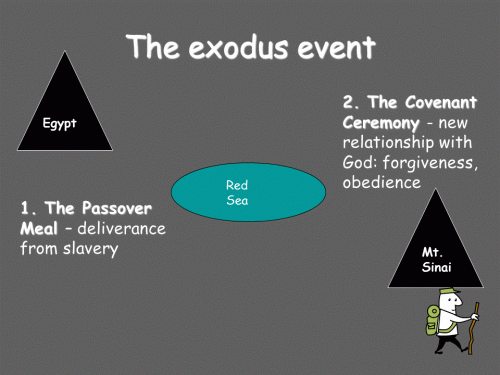
  • The bread is a figurative way of speaking of Jesus’ broken body on the cross. It also points back to the Passover deliverance from slavery. The bread, then, teaches and reminds us that Jesus’ death delivers us from slavery to Sin, Satan and Death.
  • The cup is a figurative way of speaking of Jesus’ blood poured out on the cross. It also points back to the covenant ceremony at Sinai when Israel entered into a new relationship with God, when God forgave their sins and they committed to obey God. The cup, then, teaches and reminds us that Jesus’ death brings us into a new relationship with God. God forgives our sins and we commit to obey God.

So this is the symbolism of the meal.

But the Lord’s supper invites our participation. Think about it, Jesus didn’t say to the disciples look here are tokens of my death on the cross. Put this on a table in front and look at it.

  • Jesus said of the bread, “Take, eat.”
  • And he said of the cup, “Take, drink of it all of you.”

But what are we doing when we accept Jesus’ invitation and participate in the meal? Let’s look briefly at this, this morning, to help prepare us to share in communion together.

1. We remember Jesus

In speaking of his meal, Jesus said twice, “Do this in remembrance of me” – 1 Corinthians 11:24/25. This remembering command is similar to the one from the Passover meal. Exodus 12:14 says, “This day (Passover) shall be a day of remembrance for you. You shall celebrate it as a festival to the Lord.” Just as Israel was told to remember their salvation, so Jesus tells us to remember him – his death for us and the salvation we have through him.

Now, this is not a funeral like remembrance, you know, Jesus is gone and we miss him, and it’s grim and somber. No, Jesus is alive having been raised from the dead and is present with us as we celebrate! He is the true host of his meal.

So, this is a joyful remembrance as we think of his sacrificial love for us, our salvation through him and as we enjoy his presence with us.

2. We renew our baptismal testimony and commitments

In taking the bread we are reaffirming the testimony we made when we were baptized, we have been delivered from our sin, Satan and death, through the death of Jesus on the cross. And as well, in taking the cup we are reaffirming the testimony we gave when we were baptized, we have entered into a new relationship with God.

Also, we are reaffirming the commitments we made to God in baptism. In taking the bread, we are recommitting to leave behind sin and the world; that is we are re-expressing our repentance. And in taking the cup, we are recommitting to “obey everything” that Jesus has commanded us – Matthew 28:20; that is we are re-expressing our commitment to live a new life in Christ.

You see here that the Lord’s supper assumes that you have been baptized (which is why the church has always held that baptism was necessary to receive the bread and cup.) But also take note of this: baptism happens only once, but every time we continue to partake of the Lord’s supper, we renew our original baptismal testimony and commitment. It’s like our baptism once again.

3. We proclaim Jesus’ death

1 Corinthians 11:26 says, “For as often as you eat this bread and drink the cup, you proclaim the Lord’s death until he comes.”

As we go through the meal, and the meaning is made clear, it is a presentation of the gospel. We communicate that:

  • Jesus has died for us
  • He didn’t have to die, but freely gave himself in love for us
  • His death brings us salvation – deliverance and new relationship with God
  • If we want this salvation, we have to respond by receiving his body and blood, the benefits of his death on the cross
  • He is still alive, having been raised from the dead and is with us
  • He will return one day with blessing for those who wait for him

As we partake, we proclaim the gospel of Jesus.

4. We publicly show our covenant connection to Jesus

1 Corinthians 10:16 says, “The cup of blessing that we bless, is it not a partnering with the blood of Christ? The bread that we break, is it not a partnering with the body of Christ?”

In the ancient world, to eat with someone was a big deal. And to eat with a god in an idol sacrifice was a big deal. It spoke to a bond with the person or the god. This is the context of our verse in 1 Corinthians 10:16.

What I have translated “partnering with” is a difficult word to translate here. The word is Koinonia. It means sharing in, or fellowshipping with. It’s where we get the word “communion.” Here it has the sense of showing your connection or covenant bond with someone.

Paul is saying, instead of publicly identifying with and connecting with demons through idol meals, we are to show forth our public connection or covenant bond with Jesus through the Lord’s Supper. When we partake, we declare for all to see that Jesus is our Lord and Savior. It is a declaration of allegiance.

5. We publicly show our covenant connection to each other

1 Corinthians 10:17 says, “Because there is one bread, we who are many are one body, for we all partake of the one bread.”

Because we are all connected to Jesus, through him we are all connected to each other! And partaking of the bread symbolizes this, that we are one body of Christ.

This is why it is important to make sure our relationships with each other are in good order. Not that there can’t be disagreements or conflict, but that we are doing everything we can, from our end, to live in peace with everyone. Paul talks about this in Romans 12:18 – “If possible, so far as it depends on you, live peaceably with all.”

And Jesus gives us this general principle of worship in Matthew 5:23-24 – “So if you are offering your gift at the altar and there remember that your brother or sister has something against you, leave your gift there before the altar and go. First be reconciled to your brother or sister, and then come and offer your gift.”

6. We offer up a sacrifice of praise to God

One word that is used to speak of the Lord’s Supper is “Eucharist” which means thanksgiving. The Lord’s Supper was often called this in the early church. And that’s because there is thanksgiving to God involved in the Lord’s Supper.

When Jesus took the bread and the cup, he gave thanks for them – Luke 22:19. This thanksgiving is rooted in a simple table blessing of food, but it is more – because Jesus says this bread and cup are not simply food. They represent his death for us. So Jesus teaches us here to give thanks for what this food and drink represent. We give thanks for his death on the cross for us.

Also, just after the Lord’s supper we are told – “when they had sung the hymn, they went out to the Mount of Olives” – Matthew 26:30. During Passover it was traditional to sing from Psalms 113-118. These are praises, or hymns to God for, among other things, deliverance from Egypt, God’s steadfast love, and in Psalm 118:26 the Messiah. So after the meal they were praising God for salvation.

Scripture talks in several places about our praises as a sacrifice that we offer up to God. For instance Psalm 50:14 says, “Offer to God a sacrifice of thanksgiving.” As we partake and give thanks, we offer up to God a sacrifice of praise. (See Hebrews 13:15, which I take as a Lord’s supper reference.)

7. We look forward to the Messianic banquet

This refers to a time of feasting and celebration at the end of the age when God’s victory is established through Jesus and the kingdom of God has come in its fullness. Here are a couple of Scriptures that talk about this:

Isaiah 25:6-8 says, “On this mountain the Lord of hosts will make for all people a feast of rich food, a feast of well-aged wine, of rich food full of marrow, of aged wine well refined. And he will swallow up on this mountain the covering that is cast over all peoples, the veil that is spread over all nations. He will swallow up death forever; and the Lord God will wipe away tears from all faces, and the reproach of his people he will take away from all the earth, for the Lord has spoken.”

Revelation 19:9 talks about this meal as “the marriage supper of the Lamb.”

Jesus makes the connection between the Lord’s supper and the Messianic banquet in Matthew 26:29. He said, “I tell you I will not drink again of this fruit of the vine until that day when I drink it new with you in my Father’s kingdom.” So every time we partake, we anticipate the day when we will feast with Jesus in the kingdom of God.

We are going to be sharing together in the Lord’s Supper next Sunday, Lord willing, and so I want us to look at the Scriptures and remind ourselves what this meal of Jesus means. Today we look at the symbolic meaning of the bread and the cup, and next week I would like for us to look at what it means for us to receive these elements.

 Let’s begin by reading Matthew 26:26-28 –

Now as they were eating, Jesus took bread, and after blessing it broke it and gave it to the disciples, and said, “Take, eat; this is my body.” And he took a cup, and when he had given thanks he gave it to them, saying, “Drink of it, all of you, for this is my blood of the covenant, which is poured out for many for the forgiveness of sins.

The first thing we need to note, is that –

The supper symbolically portrays Jesus’ death on the cross

  • He says of the bread – “this is my body” (v. 26). The bread is connected to his body
  • He says of the cup – “this is my blood” (v. 28). The cup is connected to his blood

Now, some Christians take this too literally. They say that the bread and wine turn into Jesus’ real body and blood in one way or another. But Jesus is using figurative language. And the reason we know this, is that Jesus’ body and blood were still a part of him, with the disciples in the room as he spoke. What Jesus is saying is that this bread is a symbol of my body, and this cup is a symbol of my blood.

But the point is not just that these elements represent him, the bread and cup represent his death on the cross. 

  • That the bread is broken as it was distributed to be eaten shows that his body is broken – an image of his death on the cross
  • That the cup is poured out when they drank it shows that his blood is poured out – an image of his death on the cross.

These two elements signify Jesus’ death on the cross.

But there is another layer of meaning that helps us to understand the meaning of the bread and the cup, and thus Jesus’ death on the cross. This comes to us from –


The Exodus event

– and how God delivered Israel from Egypt. Jesus himself makes this connection. He intentionally uses the bread and the cup to connect his meal to the Exodus story. Let’s look at how this is so.

First, the bread comes from the Passover meal. Jesus makes it clear that the Last Supper is a Passover meal when he says, “I have earnestly desired to eat this Passover with you before I suffer” – Luke 22:15. The Passover was the event that set Israel free, the meal celebrates that deliverance [Mishnah mPes 10.5]

And then the cup is identified by a phrase that comes from the covenant ceremony, from Exodus 24, when Israel entered into covenant with God. Jesus calls the cup the “blood of the covenant” – Matthew 26:28.

So there is a clear connection.

  • The bread not only points us to Jesus on the cross, it also points back to the Passover
  • The cup not only points us to Jesus on the cross, it also points back to the covenant ceremony at Sinai

Let’s look at this in more detail.

When the Exodus story begins, Israel was in slavery without God, afflicted and miserable. But God heard their cries for help and acted to deliver them.

One of the ways he saved them was the the Passover – Exodus 12:6b-7; 11-13  

 . . . the whole assembly of the congregation of Israel shall kill their lambs at twilight. Then they shall take some of the blood and put it on the two doorposts and the lintel of the houses in which they eat it . . .. In this manner you shall eat it: with your belt fastened, your sandals on your feet, and your staff in your hand. And you shall eat it in haste. It is the Lord’s Passover. For I will pass through the land of Egypt that night, and I will strike all the firstborn in the land of Egypt, both man and beast; and on all the gods of Egypt I will execute judgments: I am the Lord. The blood shall be a sign for you, on the houses where you are. And when I see the blood, I will pass over you, and no plague will befall you to destroy you, when I strike the land of Egypt.

 What do we learn from the Passover meal? 1) There is a sacrificial death. They were to “kill their lambs” and put the blood on their door frames – 6b. 2) This death brings salvation to Israel. Not only are they not killed by the plague, they are delivered from slavery, misery and death in Egypt. v. 11 says, they are to eat it “with your belt fastened, your sandals on your feet, and your staff in your hand” because they will be leaving just after this.

And then we have the covenant ceremonyExodus 24:5-8. This is when Israel entered into covenant with God at Mt Sinai.

And Moses sent young men of the people of Israel, who offered burnt offerings and sacrificed peace offerings of oxen to the Lord. And Moses took half of the blood and put it in basins, and half of the blood he threw against the altar. Then he took the Book of the Covenant and read it in the hearing of the people. And they said, “All that the Lord has spoken we will do, and we will be obedient.” And Moses took the blood and threw it on the people and said, “Behold the blood of the covenant that the Lord has made with you in accordance with all these words.”

What do we learn from this covenant ceremony? 1) There is a sacrificial death. They “offered burnt offerings and sacrificed peace offerings of oxen” – v. 5. 2) This death brings Israel into a new relationship (or covenant) with God. They received from God forgiveness for their sins (Moses took the blood and threw it on the people. Also, Hebrews 9:20-22; and Exodus Targum). And they committed to obey God. “All that the Lord has spoken we will do, and we will be obedient” v. 7.  Even though they knew of Yahweh before, they were not in this kind of relationship with him. So this really is a new.


meaning-of-the-lords-supper-graphics

Bringing this all together

 When the Exodus story is brought in as a background to the event of Jesus’ death on the cross, we learn several things. First, just as the Israelites were slaves in Egypt, so we are enslaved to Sin, Satan and Death; without Christ we are slaves to these hostile powers, lost in the world. There is a parallel here.

Second, just as they were delivered from slavery, so are we through Christ.

  • In the Passover, there was a sacrificial death (a Passover lamb) and this death brought salvation from slavery.
  • So, Jesus’ death is sacrificial (he is our Passover lamb) and it brings us salvation from slavery to Sin, Satan and Death.

The bread reminds us of this. It points back to the Passover deliverance and forward to Jesus’ death on the cross and makes the connection between the two.

Finally, just as they entered into a relationship with God, so we enter into a new covenant relationship with God.

  • In the covenant ceremony there was a sacrificial death which brought them into a new relationship with God, through the forgiveness of their sins and their commitment to obey God.
  • So, Jesus’ death is sacrificial and it brings us into a new covenant relationship with God in the same way. We are forgiven, as Jesus said, “for this is my blood of the covenant, which is poured out for many for the forgiveness of sins” – Matthew 26:28. And we commit to obey God in baptism, to quote Jesus from Matthew 28:20, “to obey all that I have commanded you.”

The cup reminds us of this. It points back to the covenant ceremony and forward to Jesus’ death on the cross and makes the connection between the two.

meaning-of-the-lords-supper-graphic-2