Feeds:
Posts
Comments

Why we reach out

Series on Witness

I’ve set three goals to challenge us this year. The first is to work at simplifying our lives from so much busyness, so that God and the church aren’t crowded out. The second is to work at our relationships so that we become a more loving, caring and connected community. The third is to be more outwardly focused as a congregation so that we move from being comfortable, to where we are willing to take risks to reach out; to move from a focus on what we get out of church, to a focus on what we can give to others as we reach out.

We are working at this third goal today as we begin a sermon series on witness, that will continue to challenge us along these lines for several weeks.

We have been talking in Sunday school about reaching out and I want to be clear about two things, First, each of us already have areas where we can share our faith, whether it’s family, job, school, social gathering places, our neighborhoods, and so forth. These are places that God has put us providentially, so that we can do his work. So when I encourage us to reach out I mean all of these.

Now, as a congregation, that is, as a whole, we are placed providentially in the South West Chambersburg area also to do God’s work. And so this is a part of our corporate outreach focus. And we have worked at this a lot recently with VBS, follow up visits with the kids that came to VBS, and with more interaction to come, as we brainstormed in Sunday school last Sunday. And also our block party just yesterday.

But my second point is that you can engage in ministry in SW Chambersburg in many different ways, according the gifts and callings God has given you. So no, not everyone will be knocking on doors. But you can pray for, encourage and support those who do. You can help out with events that are geared toward this ministry. You can pray for this area of town.You can be involved in other ministries connected to the people in this area.

So when I talk about witness don’t think I mean if you’re not doing door to door evangelism in SW Chambersburg you aren’t a witness. Not at all! I want to affirm and bless how God has opened all kinds of opportunities for you in various areas of your life to share – as you gather at a gun-shop wood carving group to talk, as you work in a restaurant, as you volunteer in your neighborhood. All of these are what we’re focusing on. All of these are open doors to share your life and faith with others.

If we ask, why do we share? One reason is certainly that we love the Lord and want to do what he says. Right? Jesus told us, “You will be my witnesses” – Acts 1:8. He said, “You are the light of the world” – Matthew 5:14. And he also said, “Go therefore and make disciples of all nations” – Matthew 28:19. All of these are Jesus’ instructions to us, and we want to do what he says.

But what I would have you focus on this morning is this –

Our motivation for reaching out is Christ’s love for people  

This comes out in two key passages. The first is Matthew 9:35-38. Here we see how Jesus’ love for people was his motivation.

35And Jesus went throughout all the cities and villages, teaching in their synagogues and proclaiming the gospel of the kingdom and healing every disease and every affliction.” So Jesus is out sharing the gospel.

 36When he saw the crowds, he had compassion for them, because they were harassed and helpless, like sheep without a shepherd.” Jesus did what he did because he loved the lost. He came, he shared, he ministered and more – because of love. He saw the lost as harassed and helpless, like sheep without a shepherd. Jesus felt for them and cared about them. You can see Jesus’ heart here.

In this immediate context, his compassion leads him to do two things. First, he asked for pray for more workers. 37Then he said to his disciples, ‘The harvest is plentiful, but the laborers are few; 38therefore pray earnestly to the Lord of the harvest to send out laborers into his harvest.’” He called on his disciples to pray earnestly for people to go out on his behalf to share his love.

And then second, he sent those very disciples out into the harvest. Mathew 10:5 – “these twelve Jesus sent out.” They became the instruments of his love to others.

The second passage is 2 Corinthians 5:14-15. Here we see how Christ’s love for the lost is not just the reason for Jesus’ sharing, it is the reason that we share.

 Paul says, 14For the love of Christ controls us, because we have concluded this: that one has died for all, therefore all have died; 15and he died for all, that those who live might no longer live for themselves but for him who for their sake died and was raised.”

In this passage Paul talks about Christ’s love for people – Christ “has died for all”; and he died “for their sake.” In love, he laid down his life for all. We also see what Christ wants for everyone – new life; that they would “no longer live for themselves” but live a new resurrection life as he does.

Paul goes on to say how this love of Christ affects him. He said, it “controls us.” That is, it directs his actions to be in accordance with this love; Christ’s love leads him to minister to others like Jesus did. This word can also be translated as “compels” in the sense of Christ’s love for others urges him on to minister to them, even Christ did.

The point here is that each one of us is to be like Paul. We are to be controlled by the love of Christ so that we share the gospel with all people.

Why do we share?

Jesus’ love was why he reached out. And Jesus’ love was the reason the 12 shared. And Jesus’ love was the reason Paul ministered. And Jesus’ love is the reason we are to share our faith. 

Like the 12, like Paul, we are to be Jesus’ hands and feet that minister his love to the lost. But to be his hands and feet, we must first have his heart.

How do you view the lost?

Where is your heart? What about the young person listening to loud, profane music? Do you see them through the eyes of the flesh – this person is annoying and rude so that you avoid or rebuke them in disgust? Or do you see them through the eyes of Jesus’ love – this person is helpless and harassed and needs Jesus?

What about the person who is swearing up a storm? Do you see them through the eyes of the flesh – this person is vulgar and should shut up? Or do you see them through the eyes of Jesus’ love – this person is like a sheep without a shepherd; they don’t know Jesus and so they need to be touched by the love of Jesus? Of course they are doing wrong, they aren’t following the Shepherd and he is what they need.

What about the popular person who seems to have everything going their way? Do you see them through the eyes of the flesh – this person would make fun of me, or I don’t like popular people? Or do you see them through the eyes of Jesus – this person needs Jesus too; it may look like things are good, but who knows what’s going in in their hearts?

It’s Christ’s love that changes our perspective. It’s Christ’s love that changes our hearts to look at people in a new way – as helpless and harassed and like sheep without a shepherd.

It’s Christ’s love that is to control us, not our own likes and dislikes. It’s Christ’s love that compels us to share with all people so that they might know Jesus and no longer live for themselves, but for him who died for them and was raised to new life for them.

William Higgins 

This morning we are looking at another story of faithfulness, in this case, the life an ancient believer whose life and faith I believe should be an encouragement to us in our Christian lives. Justin is his name, and he illustrates for us some specific aspects of faithfulness to Jesus which I will highlight at the end.

Some basics on Justin

He was born near Shechem, Samaria around 100 AD (A1-1) so he is a very early Christian. He was born just 30 years after Jerusalem was destroyed in 70 AD, and around 70 years after Jesus had his conversation with the Samaritan woman not far from Shechem.

He was not a Samaritan, or a Jew however (D – 28). He was born to a pagan family (A1-1) so he had no Christian influence growing up.

As a young man he gave himself to the study of Philosophy, going through several different schools of thought seeking after a knowledge of God. (D-2)

Justin’s conversion

Around 130 AD he had a conversation that changed his life. He most likely lived in Ephesus at this time. And as was his custom, when he wanted to get away to think, he went to a field by the sea where he could be alone.

But this time he met an old man there who challenged him to rethink his search after God.After pointing out several shortcomings in his thinking he led him to the Hebrew prophets as reliable teachers about God and his Son, the Christ. These were those who didn’t just think about God, but saw and knew God. And the man admonished him to pray that God would open his heart and mind to receive the truth of God. (D-7)

As Justin testified, “a flame was kindled in my soul; and a love of the prophets, and of those people who are friends of Christ, possessed me; and while revolving his word in my mind – I found this philosophy alone to be safe and profitable.” (D-8). He had been prepared for this encounter beforehand by seeing and admiring the courage of Christians as they faced death in times of persecution (A2-12)

Justin’s ministry

Justin MartyrHe continued on in the role of a philosopher, complete with dressing in the traditional cloak (tribon) of a philosopher (D–1); but as a Christian who encouraged the study and practice of the teachings of Jesus (D-8). He was a scholar and a teacher.

And he used this role as an opportunity to share the gospel with others. An example of this comes from his Dialogue with Trypho,who was a Jewish philosopher. He he wrote an account of and it can still be read. As he said to Trypho early on in this conversation, “If then you have any concern for yourself, and if you are eagerly looking for salvation, and if you believe in God . . . you may become acquainted with the Christ of God (through the Scriptures), and, after being initiated live a happy life.” (D-8)

Later he moved to Rome and started a school. While he was in Rome he wrote two defenses of the Christian faith. One was written to Emperor Antonius Pius, the other to Emperor Marcus Aurelius. These can also still be read. In these he stood up for believers who were being persecuted and killed for their faith, often based on rumors and baseless objections to Christianity.

Here’s an example – many thought Christians had no morals. For instance, since Christians celebrated a love feast (the Lord’s supper), called each other brother and sister and met in private for this – they thought they were promiscuous or even incestuous. (A1-29). So Justin repeatedly emphasized the values and morals that Christians believed and practiced. In one passage he says, “we who formerly delighted in sexual immorality – now embrace sexual purity alone . . .”

He goes on, “we who valued above all things the acquisition of wealth and possessions, now bring back what we have into a common fund and give to everyone in need; we who hated and destroyed one another, and on account  of their different culture would not live with people of a different tribe, now since the coming of Christ live in relationship with them and pray for our enemies . . .” (A1-14)

Christians were also despised as atheists because they did not worship the gods or offer sacrifices to them. Justin explains, “what sober minded person then will not acknowledge that we are not atheists, worshipping as we do the Maker of this universe and declaring . . . that he has no need” of sacrifices. (A1-13).

This brings us to –

Justin’s death

Although it was illegal to be a Christian at this time, the Roman government didn’t usually seek Christians out to persecute them. If, however, they were exposed by others and didn’t recant they would be condemned. So, if you had a neighbor who didn’t like you; or a business competitor that wanted to get rid of you; or an enemy that wanted you dead – all they had to do was accuse you of being a Christian to the government. And once the charge was made persecution and often death followed.

Well he had enemies. One was a philosopher named Crescens. He and Justin had held public debates before about Christianity. As Justin said at one point, “I . . . expect to be plotted against and crucified . . . perhaps by Crescens . . ..” (A2-3). Tatian, a student of Justin, said that Crescens had indeed sought to kill them both at one point (Address to the Greeks). Whether it was Crescens or someone else, eventually he was arrested along with several of his students, including a woman named Charito.

At the trial the Roman Prefect demanded that Justin offer up a sacrifice to the gods. He asked, “Are you not then a Christian?” Justin answered, “Yes, I am a Christian.” The Prefect, contemplating Justin’s death asked, “Do you suppose, then, that you will ascend into heaven to receive some recompense?” Justin said, “I do not suppose it, but I know and am fully persuaded of it.”

The Prefect demanded that they all offer sacrifices to the gods. Justin said, “No right minded person falls away from true belief to false.” The others said, “Do what you will, for we are Christians and do not sacrifice to idols.”

The Prefect announced the sentence, they were to be scourged and then beheaded. Justin, and the others, remained faithful and were killed for their faith. Later, a group of Christians secretly obtained their bodies and gave them a proper burial.

This happened in 165 AD, so Justin was around 65 years old. This is also how Justin came by the name that he now bears – Justin “Martyr.” He was a true witness to Jesus, which is what the word martyr actually means, in his case, he was a witness even unto death.

Now let’s look at –

Several characteristics of faithfulness

 1. He was a faithful teacher and wise man. As Jesus said in Matthew 23:34 – “I send you (that is unbelieving Jews) prophets and wise men and scribes . . .” (although he was sent to the Gentiles primarily)

And just as the parable of the talents teaches us in Mathew 25:14-30 we have all been given tasks to do for God as we serve him in our earthly lives. What ministry has God called you to and how is it going? Justin was faithful to his calling in a time when being faithful was dangerous. Are you faithful to your task in our time?

2. He bore witness before the authorities. Jesus said in Luke 21:12-15 – “You will be brought before kings and governors for my name’s sake. This will be your opportunity to witness. . . . I will give you  a mouth and wisdom, which none of your adversaries will be able to withstand or contradict.”

He argued effectively in writing and in person in debates and conversations and when he was on trial before the Roman Prefect. We are called to bear witness before others as well, even if they are less intense situations. But God will also be with us as we speak to give us wisdom. Do you have the courage to speak out and trust God for the right words?

3. Justin confessed Christ under persecution. Jesus said in Matthew 10:32 – “So everyone who acknowledges me before men, I also will acknowledge before my Father who is in heaven.”

Justin confessed Christ when he life was on the line and died for it. And so we can be sure that he did and will receive a blessing from God, even as he said in faith that he would before the Prefect. Do we identify with Jesus and confess him in front of others? Or are we ashamed of him and hide our faith because it is a socially awkward situation or because it might affect our social standing or reputation? Don’t think that you can be ashamed of Jesus in these “little” ways and that when more serious persecution comes and your life is on the line that you will suddenly confess Jesus. All these lesser situations are practice for the more serious. It is those who are trained to identify with Jesus in everyday life who will confess him with boldness when their lives are on the line.

A1 = First Apology

A2 = Second Apology

D = Dialogue with Trypho

The other numbers refer to the sections of each work.


Ah – human nature! We all have it. We are all weak and stumble in many ways (James 3:2). For instance, we all have opinions about everything from the best football teams to the best new fashions, and often think our view is the view.  

And then when we get together in a group this comes out. There will be things we don’t like – it might be a person, a point of view, or just the way things are done. And we know from experience that this often leads to failings on our part and the part of others as we get caught up in ungodly conflicts and division.

With regard to a local congregation we know that God calls us to be together and to love each other and to do the work of the kingdom together. But how do we then deal with the things we don’t like about the group or don’t agree with? I want to be really specific in our focus this morning – how do we deal with what we may not like about the direction the leadership is setting for the group?

The title this morning is The right way to express concerns – or don’t be a grumbler! Let me emphasize, you will never escape being unhappy with parts of what goes on in a group. It’s human nature and you take that with you to any group you belong to. You can’t get away from it. So sisters and brother, we might as well learn how to deal with this in a godly and healthy way.

I share this morning not just because I happen to be a leader here and don’t like grumbling and how it damages us when it happens, but because I am a part of other groups and don’t want to be a grumbler myself. And I haven’t been and won’t always be a pastor, so I need this just like we all need to be reminded of this.

An all too familiar story

There are a number of stories about grumbling in the Scriptures. One story that stands out is Numbers 14. If you will remember the spies have come back from scoping out the promised land and most of them have given a bad report. It’s great, but . . . we will all be killed if we try to enter it. Then comes vs. 1-4. 1Then all the congregation raised a loud cry, and the people wept that night. 2And all the people of Israel grumbled against Moses and Aaron. The whole congregation said to them, ‘Would that we had died in the land of Egypt! Or would that we had died in this wilderness! 3Why is the Lord bringing us into this land, to fall by the sword? Our wives and our little ones will become a prey. Would it not be better for us to go back to Egypt?’ 4And they said to one another, ‘Let us choose a leader and go back to Egypt.’”

They are grumbling primarily against God here, but for our purposes I want to focus on the grumbling against Moses and Aaron. And we learn first of all from this passage how grumbling works.

First, something bad happened that caused them to be full of fear and negativity. In this case, they heard a bad report. And instead of trusting God, and dealing with the issue, they gave in to fear. ‘We have come all this way only to discover that there are giants in the land waiting to kill us and our families! And even though God has done all these miracles and has been faithful to us in the past, this is too much. It will never work.’

So they began to speak against Moses and Aaron. As v. 2 says, they grumbled. Grumbling is expressing one’s discontent; it is complaining; and it usually carries with it the idea of saying these things quietly to others in the group. They had a problem, they were fearful and negative, and so they blamed their leaders, complaining about them and questioning their leadership to others.

They do bring their concerns to the leaders (v. 2) but not with a right heart. That’s because grumbling against a leader comes from a heart that is in the process of rejecting the leader. Which is what happened next. 

The congregation rebelled against Moses and Aaron. Let’s choose another leader and go in a different direction (v. 4). This is how grumbling works, at least in the case of grumbling against a leader.

We also learn from Numbers 14 about the seriousness of grumbling. 1. That generation was excluded from the promises. They were not allowed to enter the promised land but wandered in the wilderness for 40 years until they died (14:21-23). They did not obtain what God wanted to give them because of their grumbling.

2. Those who gave the bad report that led to the grumbling were killed by the Lord (14:36-37).

Grumbling brings judgment. Paul in talking about Numbers 14 says this in 1 Corinthians 10:10, we must not “grumble, as some of them did and were destroyed by the Destroyer.” And he specifically says these things were written for our instruction to learn from (10:11). And James says in James 5:9, “Do not grumble against one another, sisters and brothers, so that you may not be judged; behold, the Judge is standing at the door.” 

How should we express our concerns?

Well, certainly not with grumbling. Philippians 2:14 says, “Do all things without grumbling . . . ” Instead of this, we should 1. have a right heart. That is, don’t be fueled by fear and negativity which undermines leadership. The Israelites spoke to their leaders, but it was too late. They were already planning on getting new leaders and going in a different direction. Their heart wasn’t right.

Rather, recognize that there will always be problems that we go through as a group. And we need to respond in faith that God will lead us through. If we have allowed our hearts to be full of fear and negativity, pray for the Spirit to change your heart before you speak about your concern. 

2. Go to the leaders. Follow the principle of Matthew 18:15 and go to them face to face. Don’t whisper or talk to others, go to them. II have had for a while now a policy of not receiving anonymous critical notes. And I will say now that I will no longer receive any second hand anonymous verbal criticisms. I don’t want to empower this kind of harmful behavior. If you have a concern put your name and face to it. This is what God wants, direct communication about concerns.

Follow the principle of Galatians 6:1 and go with gentleness. Don’t wait so long that it all explodes in a hurtful and harmful way. Be loving and kind. And as 1 Thessalonians 5:12 teaches go with respect for your leaders.

3. Make your concern known. Listening by all parties is the key. James 1:19 says, “let every person be quick to hear, slow to speak, slow to anger.”

You may find that leadership has more information on the situation than you do, or are working with confidential information, or there might be bigger issues involved that have to be considered. Or, leadership may not have thought of your concern, or they may have a blind spot on an issue, and it is actually God’s purpose that you speak to them to help them.

Hopefully each one’s concerns can be addressed, but sometimes there will still be different points of view. And so as followers we need to let those that God has put in place to lead, lead – knowing that they are responsible before God for the well-being of the congregation and so need to make decisions they are comfortable with. And unless they have done something that warrants their removal, or it is an issue that is so serious that we need to leave the group – we should respect them and the office they hold and pray for them.

Let’s end with a –

A different story

 This comes from Acts 6:1-5. “1Now in these days when the disciples were increasing in number, a complaint by the Hellenists arose against the Hebrews because their widows were being neglected in the daily distribution. 2And the twelve summoned the full number of the disciples and said, ‘It is not right that we should give up preaching the word of God to serve tables. 3Therefore, brothers and sisters pick out from among you seven men of good repute, full of the Spirit and of wisdom, whom we will appoint to this duty. 4But we will devote ourselves to prayer and to the ministry of the word.’ 5And what they said pleased the whole gathering . . .”

So there was a complaint, Some were being overlooked in the distribution of food – an alms ministry conducted by the church in Jerusalem for widows. It is interesting that the word for grumbling is used here, translated as “complaint” in v. 1, but it is not used in a negative way. And I think it’s because they had a right heart. They were not fearful or negative, or rebellious against the leaders. They moved forward believing that God would lead the congregation through this.

They went to the leaders, not to others. They didn’t grumble and undermine leadership. And they made their concerns known. They were aware of a problem, which the apostles had overlooked. And because they went the apostles came up with a solution to the problem. They appointed other leaders to oversee the alms ministry and give full attention to it.  

Let me end by just saying once again – in any group we are a part of we will always have disagreements and discontentments. It’s what we do with these that matter.

  • If we follow our natural human response, the flesh, we will grumble and complain to others behind the backs of our leaders. This is the model of Numbers 14.
  • But I would invite you to follow the model of Acts 6. Come so we can talk together. I believe you will find that your input is welcome and valued. And if it seems too intimidating I encourage you to find someone to come with you, and we can talk together.

Which path will you follow? The way of Numbers 14 or the way of Acts 6?

William Higgins 


We are in Psalm 63 this morning. I invite you to turn there in your Bibles. This is a very beautiful psalm that speaks to seeking after God in difficult times and finding faith to make it through.

Let’s look at this passage in three simple steps:

1. David is in the midst of a trial

Judean wilderness

The Judean wilderness

According to the inscription, this Psalm is connected to David “when he was in the wilderness of Judah.” It isn’t clear exactly what this refers to, but a good case can be made that this Psalm is about when David fled Jerusalem into the wilderness when his son Absalom rebelled against him. (At this time he and those loyal to him went into the wilderness – 2 Samuel 15:23; 28. Being faint and thirsty are mentioned in 2 Samuel 16:2 and 17:29. If v. 11 does mean swearing by King David, this is what Ittai does in 2 Samuel 15:21. v. 11 speaks of David as a king which doesn’t fit his fleeing from Saul. If we take swearing by David as an expression of loyalty to him (as it is with swearing by Yahweh) this fits the context of a rebellion against David. And “the mouths of liars” would then mean those who had sworn by David before, but now have rebelled against him, breaking their word.).

The last 3 verses say a bit about what David is going through. He has enemies – v. 10, 11. They are seeking to kill him – v. 9. These people are liars – v. 11. So David is suffering an intense trial.

Let me ask you this morning – What trials are you going through today? Physical needs, difficult circumstances, spiritual struggles? All of these can wear us down and bring discouragement. Keep your areas of struggle in mind as we work our way through this psalm. 

2. David chooses to seek after God

In the midst of his trial he prays, 1O God, you are my God; earnestly I seek you; my soul thirsts for you; my flesh faints for you, as in a dry and weary land where there is no water.”

Notice the personal relationship with God – “you are my God.” This is not the first time David has prayed to God. This is the God that he knows, has walked with and served his life. 

Notice the intensity of his seeking, He says, “earnestly I seek you.” He is not just praying every once in a while.

He describes this seeking poetically as thirsting after water.Have you ever been really thirsty? It can become an overpowering, all consuming desire. Well, his desire for God is like someone who is thirsty. But not just a little thirst, someone who is dying of thirst.He is so thirsty that his “flesh faints”. He is like someone in desperate need of water “in a dry and weary land where there is no water.”

This is how much he is seeking after God. 

We too need to earnestly seek after God in our time of trial. When we are suffering and discouraged it is easy to push God away, to blame God, to become angry at God. But our trials are meant to lead us to God. Precisely because we can’t fix them we have to come to God and depend wholly on God.

David models this for us. Are you seeking after God like David speaks of here? Are you seeking after God like a person who is dying of thirst looks for water in a dry and weary land, where water is really hard to find?

3. David’s faith is renewed

The bulk of this psalm speaks to this. First, he is strengthened as he remembers who God is. This comes from his encounters with God in worship – 2So I have looked upon you in the sanctuary . . ..” This is the tabernacle in Jerusalem.

What did he see? I have looked upon you . . . “beholding your power and glory. 3Because your steadfast love is better than life . . .” He remembers God’s power, glory and steadfast love. He remembers that this is a God who can take care of him, even in his life-threatening situation. And this is a God who is faithful. The word steadfast love (hesed) refers to God’s faithfulness or covenant love.

And David even says, that “your steadfast love is better than life.” His life has been turned upside down. He has gone from luxury to the wilderness; from power to weakness; from respect to dishonor; from safety to danger. But knowing that God will faithfully and loving watch over him is better than all that he lost – his former life of good things. He is content to have and to experience God’s love for him without all this.

What’s the result? As he remembers who God is, this leads him to worship God, even in his time of trial. “My lips will praise you. 4So I will bless you as long as I live; in your name I will lift up my hands.” His circumstances have not changed! But he is full of praise to God and worships with hands upraised.

Second, he is strengthened as he remembers how God has helped him in the past. And the context shifts from the sanctuary to his thinking about God in the night – 6when I remember you upon my bed, and meditate on you in the watches of the night”

What does he remember? 7you have been my help.” God has helped David out of many difficulties, including life threatening situations.And to think back about this builds up his faith. God can do this again.

The result of this remembering is that he is satisfied and full of praise to God. 5My soul will be satisfied as with fat and rich food, and my mouth will praise you with joyful lips . . . 7and in the shadow of your wings I will sing for joy.” The phrase, “the shadow of your wings” has to do with being under the care of a mother bird and being under her wings when there is trouble.

David summarizes his renewed faith – 8My soul clings to you; your right hand upholds me.” He is fully dependent upon God and God is upholding him in his trial. God’s right hand refers to God’s power (Exodus 15:6, 12)

And then finally, he speaks prophetically in faith of God’s deliverance. David was a prophet and speaks this way here (Acts 2:30). 9But those who seek to destroy my life shall go down into the depths of the earth; 10they shall be given over to the power of the sword; they shall be a portion for jackals. 11But the king shall rejoice in God; all who swear by him shall exult, for the mouths of liars will be stopped.”

His enemies will be judged and destroyed, not him. They will go to the depths, or Sheol, and their bodies will be left for scavengers.But he will rejoice, that is, he will come back to Jerusalem. And also all those who are loyal to him will exult. This comes out in the phrase, “all who swear by his name” which is an expression of loyalty to David as their king. And the mouths of liars will be stopped. That is, those who had sworn allegiance to him but rebelled against him, that is broke their oath and lied will be stopped.

And as we learn in 2 Samuel, David was in fact restored to power and his enemies were destroyed. [Notice the contrasts: David’s mouth is full of praise, their lies. He seeks God, they seek to kill him.]

As we seek God in our trial, let us be renewed in our faith. David remembered who God is from his times of worship. And he remembered how God had taken care of him in the past. We should do the same, because this builds up our faith to know that God will take care of us.

Whether we are delivered or not (David here has a prophetic insight that he will be delivered) we can confess with David that God’s “steadfast love is better than life.” That even if things don’t get better, we know God will take care of us. And that to know and experience God’s steadfast love is better than whatever life can give us. It is even better than continuing to live, because his steadfast love will continue on with us in the life to come.

In your struggles, may God make himself real to you and strengthen and sustain you to keep moving forward under God’s care.

It is a central truth of our faith that new life comes through brokenness. We all want new life right? But we don’t want brokenness because brokenness is all about humility, weakness, suffering, pain and sacrifice.

I want to share with you today three examples of how new life can come from brokenness:

1. The brokenness of repentance

Turn with me to Psalm 51:17. This is, of course, David repenting for some very serious failures before God. He is confessing his sin and seeking cleansing and renewal. And then he talks about animal sacrifices and how what God really wants comes from the heart. v. 17 – “The sacrifices of God are a broken spirit; a broken and a contrite heart, O God, you will not despise.”  This is a description of his repentance.

As Elders we have focused on calling the church to spiritual renewal; on prayer and on seeking God for renewal in our congregation. For our vision we have not focused on a new building or some new defining program. We believe that God is calling us to be renewed and that God needs to come and move powerfully among us to transform us – and then we can talk about these other things.

This is what I would highlight for us this morning in terms of what I am talking about:

  • we are too comfortable as a congregation and set in our ways. We don’t want to take risks for God. Many like things just the way they are, as long as their needs are taken care. There is too much focus on us and not on the needs of others and the work of the kingdom.
  • we have too many walls that separate people in their relationships with each other. Not that people are fighting, but there are wounds, scars and bitterness from the past that haven’t been dealt with, which creates separation. So that we aren’t the close, loving and caring community that we could be.
  • we are too busy, always doing things and overwhelmed with our fast pace of life. Often what gets cut is our local congregation – investing in relationships with each other and doing ministry together. Let’s be clear, we are not victims here. Our lives are like they are because of choices that we make. And we need to make different choices.

And so spiritual renewal is needed. I don’t know if you accept this or not, but I am your pastor and I am telling you that spiritual renewal is needed. And this requires repentance as a first step.

Now if we do have the brokenness of repentance, God can come in and renew us. As David says in Psalm 51:10-12 – “Create in me a clean heart, O God, and renew a right spirit within me. Cast me not away from your presence, and take not your Holy Spirit from me. Restore to me the joy of your salvation, and uphold me with a willing spirit.” New life comes through the brokenness of repentance.

2. The brokenness of difficult situations

Turn with me to 2 Corinthians 12:7-8. Paul is here talking about various “weaknesses, insults, hardships, persecutions, and calamities” (v. 10) that he has gone through. Starting halfway through v. 7  he says, “a thorn was given me in the flesh, a messenger of Satan to harass me, to keep me from being too elated. Three times I pleaded with the Lord about this, that it should leave me.” He is most likely talking about some physical ailment or the constant persecution that followed him around everywhere.

Well, we have difficulties in our congregation –

  • people who have physical needs – some long term with no fix.
  • people who struggle with depression, anxiety and more.
  • people who have gone through deep waters.

And as a congregation we have experienced brokenness in our most recent trial . . .

All of our trials are painful, whether our individual trials or our congregational trial. There is definitely brokenness among us.

When these things happen we can despair and give up. Or our suffering can lead us to God; to come to God in our weakness and pain and to find strength through more fully relying on him.

Paul talks about the new life that suffering can bring when he goes on in 2 Corinthians 12 to talk about the strength God gives. In vs. 9-10 he quotes the Lord who said to him, “My grace is sufficient for you, for my power is made perfect in weakness.” And then he says, “Therefore I will boast all the more gladly of my weaknesses, so that the power of Christ may rest upon me.” A deeper spiritual life of greater dependence and relationship with the Lord can be ours, because of the brokenness of our trials.

3. The brokenness of serving God

This comes from the verse on the front of your bulletin from John 12:24. Jesus is talking about his own life which he is about to give up, but it teaches the path that we are to take as well. “Unless a grain of wheat falls to the ground and dies, it remains alone; but if it dies, it bears much fruit.”

Serving God is all about walking in weakness. We are called to do things that no one is capable of doing in their own strength. And serving God is all about sacrifice – giving of ourselves to others, laying down our lives – even if people don’t receive it.

But through such death to self comes new life – for ourselves in terms of inner joy and the hope of the coming resurrection, and for those who respond to the ministry. It “bears much fruit.”

That life comes through the brokenness of service to God is supremely illustrated in the Lord’s supper. Jesus’ body was what? It was “broken” on the cross. Jesus’ blood was what? It was poured out on the cross. He laid down his life. But his brokenness led to his resurrection, and it also poured forth new life for all who will receive it.

As we receive the Lord’s supper today let’s remember the three kinds of brokenness:

1. If you need to repent, I invite you to do so, so that you can receive new life from God – a new heart and a renewed spirit.

2. If you are going through hard times, and as a congregation as we go through a hard time, let us throw ourselves at his feet and find spiritual renewal as we completely rely on him, so that in our weakness the power of God will shine forth more powerfully.

3. If you are tired and broken from serving God, I invite you to receive encouragement from God to know that it’s worth it; to receive joy now and remember your great hope for the future.

Today we are in Psalm 67 and our topic is how God is made known through his people, even through our community here at Cedar Street.

You have a handout for Psalm 67 (see below). It’s super easy to see how this Psalm is put together. It’s an inverted outline where the first half of the psalm mirror images the second half. There is a request for blessing and a reason for this at the beginning and the end, there are parallel calls for praise and in the middle there is a focus on God’s work among the nations. Let’s take a look at what this Psalm means.

Psalm 67

1May God be gracious to us and bless us and make his face shine on us . . .” The request here is for God to bless Israel, his people. Notice the pronouns, “us” “us” “us.”

The request is made with words that echo the great benediction of  Numbers 6:24-26, “The Lord bless you and keep you; the Lord make his face to shine upon you and be gracious to you; the Lord lift up his countenance upon you and give you peace.”

To have God’s “face shine” means that God is radiant with delight and is full of grace towards us. Like a parent who beams, and you can see it in their face, when they are joyful over their children.

This request can be taken very broadly, but later in v. 6 the focus is on the blessing of good crops. So this is all likely a prayer for a good harvest, which, of course, is also a prayer for food, provision, peace and wholeness for their community.

But this request is not an end in itself. There is a reason for it that is bigger than the well-being of God’s people. 2. . . so that your ways may be known on earth, your salvation among all nations.” The point is not just that God’s people are cared for, but that in caring for us God will be made known to other people.

In context, Israel is the only people that worships the true God. All the other nations have their own gods. The prayer here is that in seeing the true God’s care for Israel, the other nations will come to know God.

  • Specifically, that they will know “your ways.” This has to do with how God steadfast love to take care of his people, but also the way he calls them to live, in this case living out God’s will according to the Law of Moses.
  • And also specifically that they will know “your salvation.” This has to do with God’s provision and keeping them from harm, but also God’s great act of salvation in bringing them up out of Egypt in the first place.

There is a real focus on outreach in this Psalm – on getting others to come to know God and to act appropriately. Seven times various words for nations or peoples are used in this Psalm.

If we ask, what is an appropriate response for the nations who come to know who God is, v. 3 tells us. 3May the peoples praise you, God; may all the peoples praise you.” Once they learn of the true God through how he takes care of his own people, once they learn of God’s ways and salvation – this should lead them to praise him. For to know God is to praise God. Because God is awesome and worthy of praise. The writer calls on the nations to do this, indeed for “all” the peoples to do this, not just some.

4May the nations be glad and sing for joy, for you rule the peoples with equity and guide the nations of the earth.” Here we see that God is already at work among the nations, whether this is known by them or acknowledged. But the Psalmist is calling on them to know and acknowledge this with rejoicing.

God “rules” or judges with equity. And God “guides”; he leads or shepherds them. These are both the activities of a king. Although he is uniquely Lord of his own people, God is rightfully the king of all people. 

The psalm is clear that God is providentially involved with all peoples. As Paul says in Acts 17:26 – “From one man God made all the nations, that they should inhabit the whole earth; and he marked out their appointed times in history and the boundaries of their lands.”

Once again, a call for praise is issued, with the same words as in v. 3, 5May the peoples praise you, God; may all the peoples praise you.”

And then we end with a recognition of the blessing of a harvest, but also a request for continued blessings.“6The land yields its harvest; God, our God, blesses us. 7May God bless us still . . .” God has given sunshine and rain and there is a good harvest. So there is food, there is wholeness, there is peace among God’s people.But God, continue to do this.

And like in the first section, this request is not an end in itself. There is a reason for it that is bigger than the well-being of God’s people. “. . . so that all the ends of the earth will revere him.” So that all people will know and revere God, that is rightly honor, respect, and be in awe of God.

Now, a lot of Scriptures talk about this idea that –

God is to be made known through his people

The two are connected, because his people bear his name and represent him on earth.

Sometimes this works against God. That’s because when God’s people sin and judgment comes, this profanes God’s reputation because it looks like God can’t take care of his people. For instance, when Israel was sent into exile in Babylon for its sin, this profaned God’s reputation among the nations. Ezekiel 36:22 teaches just this. It made the true God look weak and not worthy of praise, even though it was his people’s fault.

But when things are good and God is blessing his people, God’s reputation is spread. For instance, when God decided to bring his people back from exile, he said in Ezekiel 36:23-24 – “I will show the holiness of my great name, which has been profaned among the nations, the name you have profaned among them. Then the nations will know that I am the Lord, declares the Sovereign Lord, when I am proved holy through you before their eyes. For I will take you out of the nations; I will gather you from all the countries and bring you back into your own land.” Notice the highlighted phrase. God is proved holy in that he is shown to be better and higher; in a class  by himself as the only true God. He does this “through you” – his people, not apart from them; by how he acts to take care of his people bringing them back from exile. And he does this “before their eyes”; that is the eyes of the nations that will see this, so that they “will know that I am the Lord.”

When things are right between God and his people and God is blessing them, it is a witness to all that God is the true God, and all others are mere pretenders.

The first petition of the Lord’s prayer comes from this same set of ideas about how God is made known. When we pray “hallowed be your name” (Matthew 6:9) we too, like the Psalmist, are praying that God will act and thus make himself known – even through us his people. And that all will see and come to know and praise and revere God or  hallow God.

The message of this Psalm

 – is straightforward. God is already at work among the nations, though unknown and unacknowledged. But the prayer is, “God act for your people so that the nations will come to know you; your ways and your salvation and thus praise you.”

God’s acting for his own, the few – the “us” of this Psalm (see the handout) is not just for the few, but for all people. Notice  the repetition of “all” in this psalm on your handout. God is acting for those who are not yet his own.

Finally, let’s make some connections between –

Psalm 67 and us

 1. We are a part of the fulfillment of this prayer. We here today – you and me – are from the nations or Gentiles. Through God’ great work in Jesus, we have come to know, revere and praise God. We have become a part of the people of God.

But the prayer goes on because so many still don’t know God. And so 2. God is to be made known through us; through our community.

The fact is, we are always making something known about God whether for the bad, driving people away from God because of our bad witness or for the good, inviting them to come to know God as they see God at work among us.

What is our witness as a community?

  • Do people who come see God;s powerful presence at work among us answering our prayers, caring for our needs, filling us with joy and peace and love for one another?
  • Do they come to the realization that the God and Father of our Lord Jesus Christ is the one true God, who can truly take care of all their needs, that he is awesome in power and love?
  • Do they realize through our witness that the false gods of our day – money, power, social status, technology, celebrities, entertainment are just that, false, empty and useless; that they don’t give true peace and joy; that they don’t produce the love that we all crave to experience in life?
  • Do they come to know God’s ways and his salvation through us?

Let us invite God to be present and active among us so this very thing will happen. Will you pray this for our congregation? Do you pray for our services? Do you pray for me as I lead and deliver the Word? Do you pray for the Worship team? Let’s ask God to be present and active among us so that through God’s blessing of us, all who come will be blessed.

==========

Psalm 67 handout

A. Request for blessing: 1May God be gracious to us and bless us and make his face shine on us

A. Why? So that God is known: 2so that your ways may be known on earth, your salvation among all nations.

B. Call for praise: 3May the peoples praise you, God; may all the peoples praise you.

C. God’s work among the nations: 4May the nations be glad and sing for joy, for you rule the peoples with equity and guide the nations of the earth.

B1. Call for praise: 5May the peoples praise you, God; may all the peoples praise you.

A1. Blessings given and requested: 6The land yields its harvest; God, our God, blesses us. 7May God bless us still

A1. Why? So that God is known/revered: so that all the ends of the earth will *revere him.

The NIV, except for * in v. 7.


I have started sharing with you the stories of faithful Christians from time to time, people who lived after the time of the Bible. I am doing this to point out that we can be radical followers of Jesus in whatever context we find ourselves in, not just in Bible times. And I am doing this to encourage us to live more radical, faithful lives as Christians. And to that end, in each case, I want to highlight how their lives embody specific aspects of faithfulness to Jesus from the Scriptures.

So far we have looked at Perpetua, who lived in Carthage, North Africa in the 200’s; Felix Mantz, who lived in Zurich, Switzerland in the 1500’s; and today we look at a man named –

Waldo

He was from Lyon France and lived  from around 1140-1206.  This is a statue of Waldo, in Worms Germany. Of course, no one knows what he actually looked like.

waldo

Much about Waldo’s story is shrouded in mystery, coming from his enemies or from later legends about him. I will try to give you some basics.

1. His name was Valdesius, which is Latin, but has come into English, whether correctly or not, as Waldo.

He is usually called Peter Waldo, but it is not at all clear that his name was Peter. All we know for sure is his Latin name Valdesius which he signed in one instance. His name in the local language was probably Vaudes. We’ll call him Waldo.

2. He was a wealthy merchant. The merchant class was emerging at this time and gaining social and economic power, and Lyon was a real commercial center. It is possible that he handled the investments for the archbishopric, which was suspected of charging interest on the poor. If true, he was involved in oppressing the poor to make himself rich.

In terms of real estate he is said to have owned “ponds, groves and fields, houses, rents, vineyards, mills, and fishing rights.” http://www.fordham.edu/halsall/source/waldo1.html This doesn’t include his bank account. He had some serious wealth in a time when most were dirt poor.

3. He gave up his wealth to preach the gospel. He was already concerned for his soul regarding his wealth, and then he heard the story of the rich young ruler and how Jesus called him to give up all his wealth and to come follow him. And he was disturbed that Jesus said, “it is easier for a camel to go through the eye of a needle, than for a rich person to enter the kingdom of Heaven.” (Matthew 19:24). (Which, by the way, doesn’t refer to a small gate in the wall of Jerusalem).

Waldo heard in all this Jesus calling him to give up all his wealth so that he could preach the gospel, and this is what he did.

Regarding his preaching, one source gives this account of what sounds like his first public pronouncement.

He cried, “No man can serve two masters, God and mammon.” Then his fellow-citizens ran up, thinking he had lost his mind. But going on to a higher place, he said. “My fellow-citizens and friends, I am not insane, as you think, but I am avenging myself on my enemies, who made me a slave, so that I was always more careful of money than of God, and served the creature rather than the Creator.

I know that many will blame me that I act thus openly. But I do it both on my own account and on yours; on my own, so that those who see me henceforth possessing any money may say that I am mad, and on yours, that you may learn to place hope in God and not in riches.” http://www.fordham.edu/halsall/source/waldo1.html

He also criticized the church’s accumulated wealth and how many of its officials lived in luxury.

4. He had portions of Scripture translated so that people could hear and understand them. It’s not clear when this happened, but he hired two clergy to do this. This book was called the Sententiae and apparently focused especially on the Gospels. (There were also other portions of Scripture and some sayings of the church fathers as well.)

You have to understand that Scripture was in Latin, which the common person didn’t know. So people were completely dependent on what the church taught them.He brought the Scriptures into the common person’s language so that they could hear them for themselves. He is said to have memorized this book.

5. A movement began – the poor of Lyon, or the poor of Christ. People responded to his preaching. A number gathered around him and also gave up their wealth and began to preach. This would have been around 1170-1175.

They would go out two by two, as in the Gospels. They would share from the Scriptures and call people to repentance. Both men and women went out to preach. They lived off of the support of those who heard and received their message.

As one enemy wrote, they “went from village to village, going into people’s homes and preaching in public squares and even in churches . . .” (Bernard Gui). But this was a real problem because only trained clergy were allowed to preach, and then only under the supervision of the local Bishop.

This is the key that led to their –

Persecution

In 1179 some of his followers appeared before the Third Lateran Council. They sought the approval of their movement by the church.They showed them their Bible translation. There was some openness to them, but they were also ridiculed for their perceived ignorance of theology.

In 1180 Waldo signed a confession of faith to establish that he was orthodox. But they were still eventually forbidden to preach. In 1184 the Council of Verona made excommunication the punishment for those who persisted in preaching. Waldo and his followers were excommunicated and expelled from Lyon.

It is said that Waldo responded to all this by saying, “We must obey God rather than man”quoting Acts 5:29 and Peter’s words to the religious authorities of his day who told him to stop preaching.

Waldo died, apparently of natural causes, somewhere around 1206.

waldensiansLater persecution of the movement

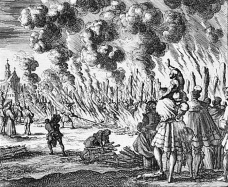
 The poor of Lyon or the Waldensians, spread all throughout Europe with many thousands of adherents. They were also harshly persecuted. Many faced the inquisition. Many
were killed. They were forced to flee into the Alps to find refuge. This is a picture of the burning to death of some of them in  Toulouse in the 1200’s.

From 1487-1489 a Crusade of 18,000 troops was sent against them, to persecute and kill them.


I want to highlight – 

Several characteristics of faithfulness from Waldo’s life

But first let me say, you don’t have to die to be faithful. I don’t want to give the wrong impression with these stories of faithfulness. We all have to lose our lives in this world in various ways by giving them up to follow Jesus. But not all will be killed for their commitment. Waldo died a natural death.

Regarding his faithfulness, 1. His fearless preaching of the Gospel stands out. Jesus said in Matthew 28:19, “Go therefore and make disciples of all nations . . ..” In a time when it was assumed that everyone was a Christian, he preached and called all people to repentance. And when some tried to stop him, he accepted rejection and persecution to continue to do this. He is a model for us of zeal to reach out and share our faith in our much, much easier set of circumstances, where the biggest issues for us are shame, laziness or making time in our busy lives.

2. His rejection of wealth. Jesus doesn’t call all people to give up all their wealth like the rich young ruler or Waldo. But he does call all of us to reject wealth as the source of our security and comfort. This is God’s role in our lives. As Waldo quoted Jesus from Matthew 6:24 – “No one can serve two masters . . .You cannot serve God and money.”

Jesus also tells us all in Luke 12:33 – “Sell your possessions, and give to the needy.” We should all give of what God has blesses us with to help those who have needs. And we can also give sacrificially, even cutting into what we need (Mark 12:41-44). 

3. He obeyed Jesus simply and radically. It is Jesus’ purpose that we do everything that he teaches. As he said in Matthew 28:19, everyone who is baptized is “to observe all that I commanded you,” that is, all that he taught the apostles. As he says in Luke 6:46, “Why do you call me ‘Lord, Lord,’ and not do what I tell you?” We are called to obedience.

Waldo heard what Jesus said, he listened to the Spirit and he acted. He did not need any fancy explanations or pressure, or an inspiring message to act. And he certainly didn’t listen to any who would explain away what Jesus said. He read it and he acted on all that Jesus said.

And he obeyed Jesus even when it was very difficult, giving up everything he had and living off of the charity of others; even when  the authorities, even the church authorities, told him not to; even when it brought him persecution.

Let me end with a call to commitment. We all only have one life to live. Why not give it to Jesus fully and radically? Why not give it as a monument of your love and devotion to him? Why use it up on the mundane things of this world, especially accumulating wealth and trying to live comfortably? Don’t waste your life. It is a gift from God. Don’t let the distractions of this world and earthly pursuits take up your life so that you wake up one day and you are old and you haven’t served or loved God in dramatic ways. What will any of this life’s comforts mean in the context of the final day? Why not choose to do something great for God? Lift up your eyes to see greater things than just living life like everyone else is, or just being a nominal Christian. What is God calling you to do? Do you have the courage to follow him? It is never too late.

[A note: If Waldo did leave his wife behind and put his children in a convent, then this is problematic. Neither Luke 14:26, nor Matthew 8:18-22 condone functionally divorcing one’s wife and orphaning one’s children. Even though he provided for them financially he was bound by his marriage covenant to be with his wife (Matthew 19:4-6; 1 Corinthians 7:3-5) and as a father to raise his children. Although perhaps it is possible that he maintained some contact with his wife and children.]

*I have relied on Gabriel Audisio’s The Waldensian Dissent, and also John Driver’s Radical Faith, who in turn draws on Amedeo Molnar’s work.

William Higgins


We are jumping right back into the middle of a really intense encounter between Jesus and his opponents. As we saw last week it is actually a trial scene, at least an informal one.

In the Jewish legal system anyone can bring charges and they have accused Jesus of two things: 1) breaking the law by healing on the Sabbath and 2) making himself equal to God, which is blasphemy, and carries with it the death penalty. Jesus defends himself by claiming to be God’s unique agent who only does what his Father, who sent him, told him to do. (For more see – Why Jesus can heal on the Sabbath). 

Well, Jewish trials were based on testimonies, not investigative or detective work. And the one who had the most impressive or honorable witnesses usually won. And so in our passage today Jesus seeks to lay out the positive case for who he is through the use of testimonies.

Testimonies to Jesus

31If I alone bear witness about myself, my testimony is not deemed true. 32There is another who bears witness about me, and I know that the testimony that he bears about me is true.”

Jesus’ testimony refers to what he has just said about himself in vs. 19-30 regarding who he is and his relationship with the Father. He understands that they don’t accept his words as valid testimony (although they should since he is not an ordinary person 8:13-18).

But the Father bears witness to him. This is what Jesus means when he says “there is another who bears witness about me.” (The present tense here excludes this from referring to John’s witness which is all in the past tense below)

And he presents this as coming through three different avenues, in accordance with the Mosaic Law that says, “A matter must be established by the testimony of two or three witnesses” – Deuteronomy 19:15 (NIV).

1) The testimony of John the Baptist. 33You sent to John, and he has borne witness to the truth. 34Not that the testimony that I receive is from man, but I say these things so that you may be saved. 35He was a burning and shining lamp, and you were willing to rejoice for a while in his light.”

Jesus appeals to John for two reasons: 1) God sent John and spoke through him (1:6). And 2) they themselves went to hear John’s testimony, giving credit to it. They had some openness to John for a time, so Jesus is saying, “remember his testimony to me.”

John told them that the Messiah was in their midst. And he testified to Jesus’ exalted status. He called Jesus the “Son of God” (1:34). And he said, “after me comes a man who ranks before me, because he was before me” (1:30). Even though John was older than Jesus, the Son of God existed before John.

Jesus himself doesn’t need John’s witness because he knows who he is apart from this. But he hopes they will listen to him.

(That this is all in the past tense seems to indicate that John is either in prison or more likely already dead.)

2) The testimony of Jesus’ works. 36But the testimony that I have is greater than that of John. For the works that the Father has given me to accomplish, the very works that I am doing, bear witness about me that the Father has sent me.”

Works here refer to the miracles and healings that he is doing in their midst, and has just done in healing the man who couldn’t walk for 38 years. (Jesus’ “works” can be more broadly construed, as in 5:20 where it has to do with Jesus’ role on the final day in giving life and judging. But here seems to be focused on his signs, as in 9:3) (See 10:37-38; 14:11 for the witness function of his signs)

As the man born blind, but later healed by Jesus says in 9:32-34, “Never since the world began has it been heard that anyone opened the eyes of a man born blind. If this man were not from God, he could do nothing.” And as Jesus himself says in 15:24 he does “works that no one else did.” These testify to who Jesus is. 

3) The witness of the Father’s word. 37And the Father who sent me has himself borne witness about me.”

This refers to the witness of the Scriptures as we will see in a minute (below v. 39, 46-47). (This is not a new witness of the Father, but it is a testimony that he “has” borne to Jesus.) 

But first let’s note that all three of these testimonies establish that the Father sent Jesus – vs. 36, 37, 38; they establish Jesus’ point about who he is; he is God’s authorized agent.

Next Jesus says more about this last witness of Scripture, but he does so in the context of making –

Countercharges against his opponents

In a Jewish legal context, unlike our own, the one who began as a defendant can become a prosecutor of his accusers and successfully bring charges against them. And this is what Jesus does in this section; he turns the tables on his opponents.

Talking about Scripture he says, “His voice you have never heard, his form you have never seen, 38and you do not have his word abiding in you, for you do not believe the one whom he has sent.”

When he speaks of God’s voice and form he is talking about the giving of the Law or Scripture at Mt. Sinai. When God gave the Law the children of Israel heard God’s voice as a trumpet sound, and they saw him as a thick cloud with smoke and fire – Exodus 19:9-11; 16-20 (They didn’t see God’s form per se – Deuteronomy 4:12, but a visible manifestation in fire – 4:36; or his glory –  5:24).

But his opponents have neither heard nor seen God. They haven’t truly received God’s word.It is not abiding in them.

And he knows this by their outward actions – they do not receive “the one whom he has sent;” God’s Word in human form (1:1; 14).

39You search the Scriptures because you think that in them you have eternal life; and it is they that bear witness about me, 40yet you refuse to come to me that you may have life.” “Search” refers to diligent Scripture study, in this case of the Hebrew Bible or the Old Testament. And there is no doubt that his opponents studied the Scriptures carefully.

But they have missed the central point of Scripture. They have a wrong focus and so they have missed the witness of the Scriptures to Jesus, which is the central point.

Here’s an example of this witness, from just before in John 5:27,  Jesus identifies himself as the Son of man spoken of in Daniel 7:13-14 who receives dominion and glory on the final day.

Although they hope that by studying the Scriptures they will  have life, they will not, since they have missed the point; they have missed Jesus who is the one who gives life.

And then we come to their core problem. “41I do not receive glory from people. 42But I know that you do not have the love of God within you. 43I have come in my Father’s name, and you do not receive me. If another comes in his own name, you will receive him. 44How can you believe, when you receive glory from one another and do not seek the glory that comes from the only God?”

In contrast to Jesus, who doesn’t care at all about human praise but only seeks after God and loves God, they do not love God, but do care about human praise.

As was the custom in that day there was great regard for teachers – with various honors, rank and titles given to them. Jesus is saying that they are more than happy to accept these fellow teachers who come in their own name and they will exchange praise with one another. But when God’s unique agent comes, in the Father’s name, they reject him. Why? Because their desire is for human glory and not the glory of the one God. Their pride keeps them from listening to Jesus as he challenges them and corrects their understanding of Scripture. (See Matthew 23 for a similar critique.)

(The phrase in v. 44, “the only God” is a statement of the Shema that there is only one God – Deuteronomy 6:4. So whatever we say about the relationship of the Father and the Son, there is still only one God)

Then the focus comes back to Scripture. 45Do not think that I will accuse you to the Father. There is one who accuses you: Moses, on whom you have set your hope. 46If you believed Moses, you would believe me; for he wrote of me. 47But if you do not believe his writings, how will you believe my words?”

They have missed the witness of Moses to Jesus. A specific example of this comes from Deuteronomy 18:15-18. Here the Lord says to Moses, “I will raise up for them a prophet like you . . . and I will put my words in his mouth and he shall speak to them all that I command him. And whoever does not listen to my words that he shall speak in my name, I myself will require it of him.” God spoke through Moses of sending an agent like Moses, who would speak God’s words and the fate of all would rest on their listening to him.

Although they hope that Moses will defend them on the final day (his role as the intercessor for Israel in Scripture was thought to continue), he will actually accuse them. For he himself wrote of Jesus. But they have not truly believed Moses, which leads them to reject Jesus.

(Notice the correspondence between the Father’s “word” 5:38 and “my words” in 5:47 [an inclusion] as well as how the subtext of Deuteronomy 18:18-19 uses the phrase “my words” for God’s words. Also notice the agency language of this subtext,  including coming “in my name.”)

 A summary of Jesus’ charges:

1. They have not truly received or believed God’s word in Scripture  and Moses.

2. They have missed the point of Scripture and Moses, which is Jesus.

3. Their hearts are focused on seeking after human glory, so they receive those who come in their own name.

4. And this pride leads them to reject God’s promised agent, Jesus, who comes in the Father’s name. They think they know the Scriptures and won’t listen to him.

And in rejecting Jesus they show that they have (or already had) rejected God. Because to reject an agent is to reject the one who sent him.

Some challenges for us

Do you accept who Jesus claims to be? As we saw last week, he is God’s agent. He only does and says what the Father tells him to do and say. He is the one who fully and truly reveals God (1:18). And he is testified to by John the Baptist; the works of Jesus recorded for us; and the word of the Father in the Scriptures.

Do you accept him for who he is? And if so, do you live your life like this is true, according to his words and example? This is the true test of what you believe about Jesus.

Don’t miss the point of Scripture. You can know everything there is to know of the details of Scripture – it background, various theories of composition, what this or that scholar says about any topic – but still miss the point and find no life.

Jesus is the point of Scripture. The Old Testament points to him, which is what Jesus is talking about, and now the New Testament presents him and points back to him. And it is when we see and know Jesus in the Scriptures that we find the life that the Scriptures can give.

Beware of teachers who seek human glory. Those who are seeking human praise are too proud to truly hear and receive from God. They are busy hearing and receiving praise from others.

Whether it is in popular Christian culture with teachers exalting themselves in various ways, or in Academia with its culture of giving and exchanging glory with one another with various ranks and titles – these are not the teachers to listen to. Look for teachers who love God and seeks after the glory that comes from God alone.  They are the humble ones that labor seeking no recognition. These are the ones who receive from God and can teach you the word.

Let’s learn from Jesus’ love for his enemies. They are actively seeking to kill him, making capital charges against him. But he shows his love for them. He certainly speaks the truth to them, calling out their sin. But he does this out of love. In 5:34 he says, “but I say these things so that you may be saved.” Wow! They are trying to kill him and he is trying to bless them with salvation.

May we also love our enemies, even when they make wrongful charges against us and seek to harm us.

William Higgins


Testimonies to Jesus

The Father’s testimony to Jesus: 31If I alone bear witness about myself, my testimony is not deemed true. 32There is another who bears witness about me, and I know that the testimony that he bears about me is true.

1. The testimony of John the Baptist: 33You sent to John, and he has borne witness to the truth. 34Not that the testimony that I receive is from man, but I say these things so that you may be saved. 35He was a burning and shining lamp, and you were willing to rejoice for a while in his light.

2. The testimony of the works of Jesus: 36But the testimony that I have is greater than that of John. For the works that the Father has given me to accomplish, the very works that I am doing, bear witness about me that the Father has sent me.

3. The testimony of the Father’s word: 37And the Father who sent me has himself borne witness about me.

Countercharges regarding the Father’s word

a. Don’t have God’s word in them/unbelief in Jesus: His voice you have never heard, his form you have never seen, 38and you do not have his word abiding in you, for you do not believe the one whom he has sent.

b. The Scriptures bear witness to Jesus/their false hope/life:  39You search the Scriptures (writings) because you think that in them you have eternal life; and it is they that bear witness about me, 40yet you refuse to come to me that you may have life.

 c. Receiving glory/seeking God: 41I do not receive glory from people. 42But I know that you do not have the love of God within you.

 d. Receiving agents: 43I have come in my Father’s name, and you do not receive me.

d1. Receiving agents: If another comes in his own name, you will receive him.

c1. Receiving glory/seeking God: 44How can you believe, when you receive glory from one another and do not seek the glory that comes from the only God?

b1. Judgment/their false hope/Moses wrote of Jesus: 45Do not think that I will accuse you to the Father. There is one who accuses you: Moses, on whom you have set your hope. 46If you believed Moses, you would believe me; for he wrote of me.

a1. Don’t believe Moses/unbelief in Jesus: 47But if you do not believe his writings, how will you believe my words?”

Last week we covered the healing of the man who couldn’t walk. In an amazing display of power, Jesus healed him. But he did so on the Sabbath. And when the authorities found the man who had been healed, he turned Jesus in. This story sets up what we are looking at today, which begins with –

An overview of the prosecution and Jesus’ defense – 5:16-18

16And this was why the Jews were persecuting Jesus, because he was doing these things on the Sabbath.”

The Jews here interpret Jesus’ healing as work and therefore forbidden on the Sabbath. To save a life was allowed, but if the healing could wait until after the Sabbath, it should wait (see Luke 13:14)

The phrase “doing these things” indicates that Jesus has healed on the Sabbath more than once, although John hasn’t narrated this.

Persecuting can also be translated “prosecuting.” And indeed, this is a trial scene. An informal one, but still the beginnings of Jesus’ later, formal trial.

In a Jewish setting anyone could act as a prosecutor. If the Law was being violated you bring charges against the person by confronting them. This is what is going on here. The case would be decided by witnesses both for or against the defendant – eventually before a judge. (Ben Witherington)

17But Jesus answered them, ‘My Father is working until now, and I am working.’”

“Answered,” both here and in v. 19 can have legal overtones (it is in the middle voice). Jesus is giving a defense to charges made against him. Jesus appeals to common agreement among Jews that God works on the Sabbath. He rested after creation, but continues to sustain the creation. Among other things, since people are born on the Sabbath and only God can give life, God gives life on the Sabbath. And also since people die on the Sabbath and only God attends to their fate, God exercises judgment on the Sabbath.(Raymond Brown)

In this case Jesus has given life on the Sabbath. But he is applying a justification for divine work, to himself. “My Father is working until now, and I am working.” This raises deeper issues about his relationship to God.

18This was why the Jews were seeking all the more to kill him, because not only was he breaking the Sabbath, but he was even calling God his own Father, making himself equal with God.”

So now there are two charges against Jesus . According to them 1) he is breaking the Sabbath, and 2) he is making himself equal to God, grasping after God’s role and glory – which is blasphemy (10:33). [Again, in terms of the first charge, Jesus often contradicted the traditions of the Elders (Mark 7) but he does not break the Sabbath. He is not a Mosaic law breaker or sinner (8:46); he does not annul the Law (10:35)].

The latter charge they see as confirmed in that he calls God “his own Father.” He is claiming a unique relationship with God, which is, in their view, inappropriate.

Jesus’ detailed defense – 5:19-30

This is an amazing speech by Jesus. From the handout you can see its parallelism and symmetry. But also there is an intricate intertwining of themes, as well as an astonishing concision – saying so, so much, in so few words. We will go through by theme, not verse by verse. Let’s begin with the second charge having to do with Jesus’ relationship with the Father because this one explains the first, his work on the Sabbath.

One way to say it, is that Jesus is God’s unique agent. An agent is an authorized representative who speaks for and carries out the sender’s will. In Jewish thought “a person’s agent is as himself.” (See m. Ber. 5.5). So he is to be accorded the honor that is due to the sender. To accept an agent is to accept the sender and to reject the agent is to reject the sender. Often the eldest son would act as a father’s agent, for instance in various business transactions.

That Jesus is God’s agent shows up in a number of ways here: In the Father, Son language in this passage; in that Jesus is sent by the Father (v. 23; 24; v. 30); in the note that those who reject the Son reject the Father (v. 23); and in the phrase the Son of Man (v. 27) who is God’s agent of judgment and rule on the final day in Daniel 7:13-14.

And it is clear in that the Father gives or delegates to the Son his own powers or tasks. And these are the very ones talked about above, that God does on the Sabbath:

  • The Son gives life. v. 26 – “For as the Father has life in himself, so he has granted the Son also to have life in himself.” And as v. 21 says, “the Son gives life to whom he will.”
  • The Son exercises judgment. v. 26 – “and he (the Father) has given him (the Son) authority to execute judgment.”

And both of these powers are exercised now and on the final day. In terms of now Jesus says in v. 24 “Truly, truly, I say to you, whoever hears my word and believes him who sent me has eternal life. He does not come into judgment, but has passed from death to life.” This is referring to receiving eternal life and salvation now by faith. [Jesus judges now (and on the Sabbath) in that when people reject him they are judged – John 3:18-21.]

In terms of the future Jesus says in vs. 28-29 – “ . . . an hour is coming when all who are in the tombs will hear his voice and come out, those who have done good to the resurrection of life, and those who have done evil to the resurrection of judgment.” This is talking about the final day.

(This picture of an apparently simultaneous resurrection of the good and evil is in accord with Daniel 12:2.) (Also v. 25 should be taken as a reference to the final day. This has to do with all the dead coming alive, not some who hear and believe. The phrase “is now here” refers to his soon coming death and resurrection which is the beginning of the final day. So it is brought near.) 

And Jesus testifies that he is a good and faithful agent, or Son of his Father.

– With regard to healing or giving life he says in v. 19 – “. . . the Son can do nothing of his own accord, but only what he sees the Father doing. For whatever the Father does, that the Son does likewise.”

– And with regard to judging he says in v. 30 – “I can do nothing on my own. As I hear, I judge, and my judgment is just, because I seek not my own will but the will of him who sent me.”

In v. 20 Jesus says, “the Father loves the Son and shows him all that he himself is doing.” This is a continuous revelation of the Father’s will to him, so there is no danger that he is out of touch with God. He is the ultimate agent and Son, fully obedient to the mission he has been sent to fulfill.

So Jesus doesn’t make himself God. He is not exalting himself or grasping after a status. He is rather completely subordinate to the Father only doing what he says, and receiving what the Father gives him in terms of giving life and judging. But precisely by being subordinate, he becomes equal to God by being and doing what only God is and does. Because it is the Father’s will to make him equal.

In answer to the charge: He does not make himself anything. It is the Father who makes him equal. The Son subordinates himself to the Father, but the Father lifts the Son up. So, if you think about it, Jesus is both subordinate to the Father and equal with the Father at the same time, the first by his own doing, the second by the Father’s doing.

Jesus doesn’t dishonor God in is claims about his relationship with the Father. Rather they dishonor God in rejecting him. As he says in v. 23 – “Whoever does not honor the Son does not honor the Father who sent him.” They are rejecting God’s authorized agent, which is a rejection of him.

[Also in v. 23 we learn that the Father’s purpose is “that all may honor the Son, just as they honor the Father.” Notice the “just as.” We are to honor and worship the Son just as we honor and worship the Father. This is part of how the Father raises up and exalts the Son as his equal.]

Then we come to the first charge and Jesus’ healing on the Sabbath. In John 7:21-23 Jesus refers back to this same miracle and defends it by saying that making a person whole on the Sabbath is lawful. (It is in keeping with the allowance of circumcision on the Sabbath. If you can make one member of the body whole on the Sabbath, why not the whole person?)

But here his defense is clearly focused on his identity; who he is. Jesus is God’s authorized agent; He is God’s Son. And so just as God gives life on the Sabbath, Jesus also gives life on the Sabbath.

As v. 19 says, speaking of the healing, “The Son can nothing of his own accord, but only what he sees the Father doing. For whatever the Father does, that the Son does likewise.” In other words, it was the Father’s will to heal this man and so Jesus, as God’s agent, healed him.

And as he says in v. 20 they will marvel at greater works than a healing on the Sabbath. He says in v. 28 “do not marvel at this,” marvel that the Son will one day raise the dead. Yes, as God’s agent he told one man to rise up and walk, but on the final day, as God’s agent, he will raise all the dead.

To those who can accept and believe that Jesus is God’s agent, then all this makes perfect sense. For the Jewish leaders who did not accept this, Jesus comes across as a lawbreaker and a blasphemer. As we will see next time, Jesus puts forward his positive case in vs. 31-47, as well as bringing counter charges against his opponents.

Let’s end today with – 

Some challenges for us

1. Do you accept that Jesus is God’s agent? Almost everybody likes Jesus.. But they usually pick and choose what they like and then fill the rest in with what they think is right. A little of Jesus and then a little (or a lot) of what I think is right.

But Jesus is claiming here to be the authorized representative of God. What he says is what the Father says. What he does is what the Father does. There is no separation between Jesus and the Father. As John 1:18 says, “No one has ever seen God; It is God the beloved (the Son) who is at the Father’s side, who has made him known.”

Do you accept Jesus’ claim to fully and perfectly make know the Father? And then do you live your life  by his words and example?

2. Have you received the life that Jesus gives? Jesus said in v. 24,  “whoever hears my word and believes him who sent me has eternal life. He does not come into judgment, but has passed from death to life.” You can receive, right now, the life that Jesus gives. It is not something that comes later. Jesus gives eternal life now by faith. Do you believe? Will you receive the gift that the Father gives through his Son?

3. Are you ready for the final day? As Jesus said, the day is coming “when the dead will hear the voice of the Son of God, and those who hear will live” (v. 25). Indeed “all who are in the tombs will hear his voice and come out, those who have done good to the resurrection of life, and those who have done evil to the resurrection of judgment” (vs. 28-29).

We will be judged by our deed. This is the consistent teaching of Scripture. That’s because our deeds truly reveal what is in our hearts, whether we have faith in God and have been transformed by his gift of grace and life. Will you be raised to the resurrection of life?

William Higgins