Feeds:
Posts
Comments

An overview of the prosecution and Jesus’ defense – 5:16-18

A. Why the Jews: 16And this was why the Jews were persecuting Jesus, because he was doing these things on the Sabbath.

B. Jesus’ answer: 17But Jesus answered them, “My Father is working until now, and I am working.”

A1. Why the Jews: 18This was why the Jews were seeking all the more to kill him, because not only was he breaking the Sabbath, but he was even calling God his own Father, making himself equal with God.

Jesus’ detailed defense – 5:19-30

A. Jesus only does what he sees the Father do. Life/healing: 19So Jesus said to them, “Truly, truly, I say to you, the Son can do nothing of his own accord, but only what he sees the Father doing. For whatever the Father does, that the Son does likewise. 20For the Father loves the Son and shows him all that he himself is doing.

B. Marvel at greater works: And greater works than these will he show him, so that you may marvel.

C. As the Father, so also the Son. Life, judgment: 21For as the Father raises the dead and gives them life, so also the Son gives life to whom he will. 22The Father judges no one, but has given all judgment to the Son, 23that all may honor the Son, just as they honor the Father. Whoever does not honor the Son does not honor the Father who sent him.

D. Hears Jesus/present life: 24Truly, truly, I say to you, whoever hears my word and believes him who sent me has eternal life. He does not come into judgment, but has passed from death to life.

D1. Hears Son of God/future life: 25Truly, truly, I say to you, an hour is coming, and is now here, when the dead will hear the voice of the Son of God, and those who hear will live.

C1. As the Father, so also the Son. Life, judgment: 26For as the Father has life in himself, so he has granted the Son also to have life in himself. 27And he has given him authority to execute judgment, because he is the Son of Man.

 B1. Marvel that he will raise the dead: 28Do not marvel at this, for an hour is coming when all who are in the tombs will hear his voice 29and come out, those who have done good to the resurrection of life, and those who have done evil to the resurrection of judgment.

A1. Jesus only does what he hears. Judgment: 30I can do nothing on my own. As I hear, I judge, and my judgment is just, because I seek not my own will but the will of him who sent me.”

—————————————

The words in italics in vs. 16-20 are all the same. Jesus does what the Father does. He does not make himself anything.

We are in the Gospel of John once again this morning with another story of Jesus healing a person in need. But we are also moving into new territory. We are into a new section of John that begins in chapter 5 and goes until the end of chapter 10. And within this new section, the healing and teaching of chapter 5 all go together and give us some really important insights about who Jesus is. And so I invite you to read ahead and follow along as we work our way through these Scriptures in the weeks to come.

Our story

1After this there was a feast of the Jews, and Jesus went up to Jerusalem. 2Now there is in Jerusalem by the Sheep Gate a pool, in Aramaic called Bethesda, which has five roofed colonnades.”

After healing a royal official’s son, Jesus has now gone from Galilee back to Jerusalem. He went up for a feast but John doesn’t tell us which one. As we will see, the focus of this story is the Sabbath.

“The Jews” is a phrase that refers to a certain group of Jews – the Judean establishment and those in agreement with them, not all Jews. After all, Jesus and his followers are Jews. This section of John, chapters 5-10 is all about conflict between Jesus and these ‘powers that be,’ and ultimately their rejection of him.
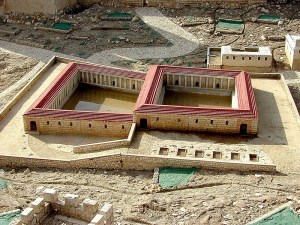
pool of Bethesda

This is a model that shows us what the pool of Bethesda looked like. As you can see there were actually two of them connected together. Both of them together were as big as a football field, and are thought to have been 20 feet deep.

(It’s not clear where the Sheep gate was -Nehemiah 3:1; 12:39. It was most likely a small opening in the north wall of the temple – A. Kostenberger).

“3In these (five roofed colonnades) lay a multitude of *disabled people – blind, lame, and paralyzed.” It’s unclear what this pool was used for (public baths? cleaning sheep before entrance to the temple?)  But it attracted those with physical afflictions because in the ancient world pools of water and springs were often thought to have healing powers. This is still true today in some quarters.

5One man was there who had been *ill for thirty-eight years.” As we learn from v. 7 he can’t walk. And here we learn that he has had this condition for a very long time. Longer than many people lived in that day – 38 years.

6When Jesus saw him lying there and knew that he had already been there a long time, he said to him, ‘Do you want to be healed?’” Jesus knew, supernaturally, that the man had been there a long time longing for healing.  So Jesus initiates this conversation with him. Usually people ask Jesus for healing. Here Jesus asks if he wants to be healed.   

7The sick man answered him, ‘Sir, I have no one to put me into the pool when the water is stirred up, and while I am going another steps down before me.’”

Perhaps some of you have in your Bible, or in a footnote a longer verse 3 and a verse 4. This is a textual variant, something not found in the earliest manuscripts of the New Testament. It says that those at the pool were 3bwaiting for the moving of the water; 4for an angel of the Lord went down at certain seasons into the pool, and stirred the water: whoever stepped in first after the stirring of the water was healed of whatever disease he had.”

This is an attempt to provide a background to our verse here. What is this stirring of the water about? An angel does this. And why does it matter that he can’t hurry in? Because only the first one in is healed.

A copyist of Scripture inserted this note in the column that sought to explain the situation or the superstition that was believed. (And some later copyist took it as Scripture).

The man thinks Jesus is wondering why he hasn’t been healed by the water yet. Does he really want to be healed? And so the man explains that he can’ walk to get in in time. He assumes that Jesus also believes in the healing power of the pool. But Jesus doesn’t operate by superstitions – he operates by the power of his word, for he is the Word made flesh. 

8Jesus said to him, ‘*Rise, take up your bed, and walk.’” His bed would have been a mat made of palm leaves or straw. This would have been be rolled up and easily carried.

The reason Jesus asks him to take up his bed and walk is to demonstrate the healing. This makes it clear that he is in fact healed.

9And at once the man was healed, and he took up his bed and walked.” This is an amazing healing! He wasn’t able to walk for 38 years, but when Jesus spoke he was healed at once and then he rose up and walked. Again, John narrates really difficult miracles that Jesus does as signs that point to who Jesus is and what he does. And this one certainly qualifies.

But there’s a problem . . . “Now that day was the Sabbath. 10So the Jews said to the man who had been healed, ‘It is the Sabbath, and it is not lawful for you to take up your bed.’”

If you are reading this story for the first time, this is the first indication that this took place on the Sabbath.

According to Mosaic law you cannot carry a work load on the Sabbath (Numbers 15:32-35; Jeremiah 17:21, Nehemiah 13:15). But this isn’t what is happening here. What is really at stake here is the oral law or what is called the traditions of the Elders. According to the oral law you cannot carry an item from one domain to another on the Sabbath. And he has carried his bed from the pool of Bethesda to the temple. (M. Shabbat 7.2; 10.5) He has broken a tradition of the Elders.

[Jesus often contradicted the traditions of the Elders (Mark 7) but he does not break the Sabbath. He is not a Mosaic law breaker or sinner (8:46); he does not annul the Law (10:35).]

[In this story the focus is not on Jesus healing on the Sabbath but on carrying things on the Sabbath, since they are confronting the man, not Jesus. (The latter is taken up in 5:16 and following and 7:21-24).]

Notice in all their concern for the things of God there is no recognition of the amazing healing that just took place!

11But he answered them, ‘The man who healed me, that man said to me, ‘Take up your bed, and walk.’’ 12They asked him, ‘Who is the man who said to you, ‘Take up your bed and walk?’’ 13Now the man who had been healed did not know who it was, for Jesus had withdrawn, as there was a crowd in the place.”

He feels the pressure of the authorities and is quick to point to Jesus as the source of the problem. Jesus is now seen as leading someone astray to break the Sabbath by telling him to do this, at least according to their understanding of the Law and their extra-biblical traditions.

14Afterward Jesus found him in the temple and said to him, ‘See, you are well! Sin no more, that nothing worse may happen to you.’”

Jesus makes a connection here between his previous physical ailment and his unfaithfulness to God. And he warns him to stop sinning so that an even worse fate doesn’t befall him. Now, of course, we have to be careful with this because there is certainly not always a connection between our sin and illness.

For instance in chapter 9:2-3 Jesus is clear that in the case of the man born blind that it was not because he or his parents sinned that he was blind. So it can be true (here, 1 Corinthians 11:30), but not always (Job and Jesus’ own sufferings). Jesus knows the connection in this case by supernatural insight. And unless God gives you this it is best not to make any assumptions.

(Notice how both the Jews and Jesus have a concern for sin in his life.)

15The man went away and told the Jews that it was Jesus who had healed him.” Throughout this passage the man doesn’t come across in a good light:

1) Jesus talks to him and heals him, but he doesn’t even know who Jesus is.

2) The man displays no faith in the story. Jesus simply found him, healed him and told him to rise up.

3) When he gets in trouble by the Jews he is quick to shift blame onto Jesus to get himself out of trouble.

4) When Jesus speaks to him again in the temple, he doesn’t thank Jesus or respond to his call to repentance.

5) Rather, he uses the healing Jesus gave him – his ability to walk – to go and find the Jews in order to turn Jesus in.

Some gleanings for us

1. Don’t be like this man. If last week the royal official was an example to us of one who had real faith in Jesus, this man is not an example to us. He received a great blessing from Jesus, but had no gratitude, and in fact turned Jesus over to his enemies.

Well, when Jesus blesses us how do we respond? With faith in him, with devotion, with gratitude? Or are we just focused on the blessing we got?

And when Jesus blesses us do we then still hang out with those in the world – who don’t know God, who don’t walk in God’s ways, who are enemies of God? (James 4:4)

Don’t follow the example of this man!

2. Nothing is too difficult for Jesus. Once again, even when a person has been unable to walk for nearly a lifetime, Jesus is able to bring instant healing. This should encourage us because this is the same Jesus who loves us and cares for us in all our difficulties.

3. Don’t focus on human teachings and miss the work of God. The Jewish leaders were zealous for mere human traditions that went beyond the word of God. And in their zeal for these, they missed out on what God was doing through Jesus – not just this healing, which they completely overlooked – but all that God was doing through Jesus. In fact, they came to oppose God and God’s work because of their concern for these lesser things that God didn’t even require.

Well, we like our extra-biblical traditions as well.

– What? New people are coming, so we are going to sing some different songs now that they can relate to? Even though there are a thousand different ways to worship God, we want what is comfortable to us. We hold on to our mere human traditions.

– What? God speaks a powerful message to us, but it came through tongues and interpretation and we don’t do that kind of stuff!

– What? God is bringing people into his kingdom here, but they are different than we are and we don’t know how to relate to them and it makes us uncomfortable.

Don’t hold on to the lessor things. When God moves, let him move.

4. Jesus gives life. This miracle is also called a sign (6:2). And what it tells us about Jesus is really the same as the last healing. Jesus is the one who gives life – resurrection life.

If we skip ahead here to John 5:21 we can see this connection. Jesus says, “For as the Father raises the dead and gives them life, so also the Son give life to whom he will.” The same word is used in v. 21, “raises” the dead as the word Jesus used in our story in 5:8 when he told the man “rise” take up your bed and walk.

This healing pictures Jesus as the one who raises the dead and gives new life. Remember, Jesus isn’t about miracles, the miracles are about Jesus – and this one teaches us that Jesus gives new life. May we all receive the new life that Jesus has for us this morning. May we be transformed by it. And may we go forth and share this good news with others.

William Higgins

A. The man: 5:1 After this there was a feast of the Jews, and Jesus went up to Jerusalem. 2 Now there is in Jerusalem by the Sheep Gate a pool, in Aramaic called Bethesda, which has five roofed colonnades. 3 In these lay a multitude of *disabled people—blind, lame, and paralyzed. 5 One man was there who had been *ill for thirty-eight years.

B. Jesus sees him and speaks to him: 6 When Jesus saw him lying there and knew that he had already been there a long time, he said to him, “Do you want to be healed?”

C. The man answers Jesus: 7 The sick man answered him, “Sir, I have no one to put me into the pool when the water is stirred up, and while I am going another steps down before me.”

D. Jesus tells him to take up his bed and walk: 8 Jesus said to him, “Get up, take up your bed, and walk.”

E. Healed/Sabbath: 9 And at once the man was healed, and he took up his bed and walked. Now that day was the Sabbath.

 E1. Healed/Sabbath: 10 So the Jews said to the man who had been healed, “It is the Sabbath,

D1. The Jews tell him it is unlawful to take up his bed and walk: and it is not lawful for you to take up your bed.”

C1. The man answers the Jews: 11 But he answered them, “The man who healed me, that man said to me, ‘Take up your bed, and walk.'” 12 They asked him, “Who is the man who said to you, ‘Take up your bed and walk’?” 13 Now the man who had been healed did not know who it was, for Jesus had withdrawn, as there was a crowd in the place.

B1. Jesus finds him and speaks to him: 14 Afterward Jesus found him in the temple and said to him, “See, you are well! Sin no more, that nothing worse may happen to you.”

A1. The man: 15 The man went away and told the Jews that it was Jesus who had healed him.


We are back into our series on the Gospel of John and today we are up to the story where Jesus heals the official’s son, in chapter 4:46-54. You can follow along on the handout you have, or you can open your bibles as we go through this.

I trust that God has something really good for each of you this morning and I hope you will listen and be alert to it, so that you can receive it.

By way of review, after talking to Nicodemus, Jesus left Jerusalem for the Judean countryside where his disciples baptized many people. Then he purposed to go to Galilee, but on the way went to Samaria and talked to the Samaritan woman and also the Samaritan village of Sychar. And now he has come back to Galilee and specifically back to Cana.

Alright, let’s look at –

Our story

 46So he came again to Cana in Galilee, where he had made the water wine.” Our story starts off harkening back to its parallel, when Jesus turned the water into wine, which also happened in Cana of Galilee. As you can see from your handout on an overview of John 2-4, these stories function as bookends to this section of John. (They are twins in these ways: There are several inclusion markers – “This, the first of his signs, Jesus did . . .” – 2:11; “This was now the second sign that Jesus did . . .” – 4:54. “Cana in Galilee” – 2:1, 4:26. 4:46 refers back to the making of wine in Cana. Both happen after a chronological note of two days – “On the third day” – 2:1; “after the two days” – 4:43. Additional parallels between both stories: 1. a need is expressed – for wine, for healing. 2. Jesus offers some resistance – “what does this have to do with me?” – 2:4; “unless you see signs and wonders you will not believe” – 4:48. 3. Faith in his power persists – “do whatever he tells you” – 2:5; “come down before my child dies” – 4:49. 4. Both focus on Jesus’ word – “do whatever he tells you” – 2:5; “the man believed the word that Jesus spoke.” – 4:50 5. Jesus responds differently than asked – he does a miracle behind the scenes on his own terms; he doesn’t come with the man but heals the boy from a distance. 6. Servants are involved in both stories. 7. Faith is noted at the end of each story – “his disciples believed in him” – 2:11; “he himself believed and all his household” – 4:53. With thanks to Ben Witherington for several of these.)

“And at Capernaum there was an official whose son was ill.” Capernaum, on the Sea of Galilee, was about 15 miles away, close to a day’s walk.

The word for “official” is better translated as “royal official.” He probably worked for Herod Antipas. It’s possible that he was a Gentile, but this point isn’t made in the story. Although, working for Herod would make him suspect to devout Jews. He would have been well to do, or upper class. He was an aristocrat. As we will see, he has servants – v. 51.

Beyond being “ill” we don’t know exactly what his son’s condition was, except that he was “at the point of death” – vs. 47; 49; and he had a “fever” – v. 52.

47When this man heard that Jesus had come from Judea to Galilee, he went to him and asked him to come down and heal his son, for he was at the point of death.”

So he has heard about Jesus, most likely from some of the Galileans who had seen Jesus’ public miracles in Jerusalem a few days before (4:45; 2:23). He comes to Jesus based on his reputation as a miracle worker. Can you put yourself in his place? You have child who is about to die and no one can help and so he comes to Jesus in hope. His request is for Jesus to come to Capernaum and heal his son. 

48So Jesus said to him, ‘Unless *you all see signs and wonders you will not believe.’” This response of Jesus is somewhat unexpected and jarring. But do notice that the “you” is plural here – “you all.” No doubt a crowd was around Jesus in Cana, so he is saying this to them as well. Perhaps the crowd wanted to see miracles in Galilee like he did in Jerusalem. (This might be behind their exuberant welcome of him in v. 45.)  They want to see their native son do miracles in Galilee as well. After all, his miracle in Galilee, turning water to wine, was a private miracle. They didn’t see it.

Jesus is here confronting mere “signs faith” among Galileans. This is a faith that is based on seeing miracles. Jesus, if you do miracles we will believe in you, Prove yourself to us! And even keep proving yourself to us with more and more miracles.

So although Jesus did miracles to create faith, it seems most often that such “signs faith” didn’t lead to its intended goal of real faith in Jesus. It didn’t lead people to understand what the signs point to – that Jesus is the eternal Son of God and that he has come to give eternal life, not just healings for this current life.

And so Jesus is challenging the man here , “Do you also just want to see if I can do a miracle?”

49The official said to him, ‘Sir, come down before my child dies.’” The man is undeterred by Jesus’ words. He repeats his urgent request.

50Jesus said to him, ‘Go; your son *lives.’ The man believed the word that Jesus spoke to him and went on his way.” Jesus responds to him in such a way as to give him an opportunity to move beyond mere “signs faith.” He asks him to believe without first seeing the miracle.

And the man does believe, not based on seeing a sign, but based on Jesus’ word to him. He heard Jesus’ word and he acted on it. This is true faith. His son was at the point of death and if this didn’t work this could be it. So he rests the life of his son in Jesus’ hands and heads back to Capernaum.

51As he was going down, his servants met him and told him that his *child *lives. 52So he asked them the hour when he began to get better, and they said to him, ‘Yesterday at the seventh hour the fever left him.’ 53The father knew that was the hour when Jesus had said to him, ‘Your son *lives.’”

So the man’s servants came to find him and tell him the good news and so they meet on the road. Between them they figure out that the boy was healed just when Jesus said that he was well – at 1:00 PM. So Jesus spoke in Cana and it happened in Capernaum, 15 miles away, right when he spoke.

Now at this time and perhaps still today, healing at a distance was thought to be harder than healing in close proximity. And this helps us understand why John included this as a “sign.” He only narrates exceptional miracles, the best of the best, that point to Jesus’ glory. 

“And he himself believed, and all his household.” His faith was confirmed. He heard Jesus’ word and he acted on this and now he has seen the result. He knows that Jesus is the one who gives life by his mere word. 

And his faith spreads. All his household believed . This would include his wife, children and servants. They believed based on his testimony about Jesus. [Most often a household would share the faith of the head of the household.]

This story illustrates how Jesus’ signs are supposed to work . They are to lead people to true faith in Jesus.

Our story ends – 54This was now the second sign that Jesus did when he had come from Judea to Galilee.”

[There are some parallels between this story and 1 Kings 17:17-24: the son of an outcast; the son died (or ill, no breath); Elijah prayed three times – “let child’s life come into him again”; the son is healed; he says, “see your son lives”; the woman acknowledges Elijah’s identity, “now I know you are a man of God and that the word of the Lord in your mouth is true.”]

[Matthew 8:5-13 and Luke 7:1-10 and this story are not the same. The encounter with the royal official takes place in Cana not Capernaum; the boy is called a son and his child (paidion) and so pais must mean child, not servant here. ; the main focus of the story in the Synoptics is the Gentile’s faith whereas in John the focus inJesus.]

Some gleanings for us

1. The unlikely ones often respond to Jesus. This continues the theme developed with the Samaritan woman and the contrast there with Nicodemus. The royal official worked for Herod Antipas. He was possibly a Gentile. He was most likely not a devout Jew. These were all negatives. But he and his family responded with true faith in Jesus.

Let’s keep this in mind as we work at VBS this week. Who do you think is unlikely to respond? The disruptive one? The inattentive one? This may well be the one that Jesus will touch. This may well be the one that gets it and comes to faith in Jesus. We don’t know. We are simply called to labor patiently in love to everyone.

2. The royal official is an example to us of faith. He came based on hearing about Jesus’ ability to heal – signs faith. But then when Jesus challenged him he responded and moved to a true faith that is based on Jesus’ word.

And like him we too need to hear Jesus’ words to us, whatever that may be this morning. What is he saying to you through his word? What has he been saying to you this past week, this past month? Where is he challenging you in an area of weakness or in an area where you need to step out it faith.

Wherever Jesus is speaking you us we need to act in faith, without first seeing the results. Right? This is how faith works. First we act on Jesus’ word in faith and then we see the results in our lives. And I can assure you that he will be there for you and come through for you as he did for the royal official. When we act on his word, like him, we will go on our way and find that his promises to us our true.

3. Nothing is too difficult for Jesus. He can do miracles that are unheard of.  He can do beyond what we can ask or think. The royal official thought that Jesus had to come to Capernaum to heal his son, but he didn’t. Jesus simply spoke the word and it happened 15 miles away.

I don’t know what you are going through this morning. But I do know that Jesus is able to take care of you. There is no obstacle that can stand in his way. He can act even beyond the assumptions that we make that limit him. He can do anything.

4. Jesus gives life. In John, signs point to who Jesus is and what he has come to do. In this case the message is clear – Jesus is the one who gives life. This is who he is. This is what this sign points to.

Three times in our story the phrase is repeated: Your son lives; your child lives, your son lives. This is being emphasized. And life has a double meaning. It is not just about the healing of the boy. It also pictures for us resurrection life or eternal life.

If in the first Cana miracle Jesus is pictured as providing the wine and the joy for the party on the day of resurrection; here he is pictured as the one who brings about the resurrection itself. Through his authoritative word (John 5:25) the dead will come to life, just as this boy came back from the point of death to live.

(Is the geography that is emphasized here a part of this symbolism? Jesus is in the hills of Cana and speaks and the boy lives in Capernaum below.)

William Higgins


A. From Judea to Galilee/first sign: 46So he came again to Cana in Galilee, where he had made the water wine.

B. Official/son/ill: And at Capernaum there was an official whose son was ill.

C. Trip/asked Jesus/point of death: 47When this man heard that Jesus had come from Judea to Galilee, he went to him and asked him to come down and heal his son, for he was at the point of death.

D. Jesus’ signs/belief: 48So Jesus said to him, “Unless you see signs and wonders, you will not believe.

E. Request/come/child dies: 49The official said to him, “Sir, come down before my child dies.

E1. Answer/go/son lives: 50Jesus said to him, “Go, your son lives.”

D1. Belief/Jesus’ word: The man believed the word that Jesus spoke to him and went on his way.

C1. Trip/asked servants/fever left him: 51As he was going down, his servants met him and told him that his child lives.  52So he asked them the hour when he began to get better, and they said to him, “Yesterday at the seventh hour the fever left him.”

B1. Father/son/lives: 53The father knew that was the hour when Jesus had said to him, “Your son lives.”

A1. Second sign/from Judea to Galilee: 54And he himself believed and all his household. This was now the second sign that Jesus did when he had come from Judea to Galilee.

(William Higgins and Harold Metz)

We are finishing up our series of basic teaching on what Christian marriage is.

As I have told you several times, Christian marriage is not necessarily the same as other ideas of marriage in the world we live in. There are many different understandings today, both secular and religious. Now if you are up on your news, you know that same-sex marriage is now legal in PA, and in many other places. So this is just one example of this.

Given all this, I have labored to lay out for you biblical teaching to ground us in our understanding of what marriage is. And today we will be looking at six key distinctives of a Christian understanding of marriage, that are often in tension with the world’s point of view.

Now, I do not think that it is our job as Christians to force our beliefs on others. That isn’t how the kingdom of God works. No, it is our job to be a city on a hill; a light to the world. It is our job to live out a Christian vision of marriage and then invite others to choose this for themselves. Let’s look at our six distinctives that are a part of this vision.

1. We believe that marriage is the place for sex.

Christian teaching is certainly in disagreement with much of society around us on this one! Scripture forbids any non-marital sex,whether it be:

  • prostitution – 1 Corinthians 6:15, 18
  • premarital sex, which is likened to prostitution – Deuteronomy 22:20-21; Leviticus 19:20-22; 1 Corinthians 7:2-3, 8-9
  • living together, which is another form of premarital sex – John 4:16-19; 1 Corinthians 7:8-9
  • or adultery, which is sex outside of your marriage – Exodus 20:14 (see also Proverbs 5:15-18)

As we have seen, in Christian thought the very purpose of sex is marital. It is to merge every part of two people into one, it is to bond them to each other like glue (Genesis 2:24) and it is to bring forth children (Genesis 1:28).

Speaking of children leads us to our second distinctive –

2. We believe that marriage is the place for having and raising children to be Christians

God says this about marriage in Malachi 2:15 – “and what was the one God seeking? Godly offspring.” One of the reasons God joins together bride and groom is so that they can have and raise godly children. As Paul teaches in Ephesians 6:4 – we are to “bring our children up in the discipline and instruction of the Lord.”

So having and parenting kids is not just about having kids, or raising them to be good people by some societal or worldly standard. It is about raising our children in such a way that they will hopefully one day choose to walk in God’s ways for themselves.

3. We believe that Christian marriage is between a man and a woman,who are not too closely related

Genesis 2:18-25, our key text in this series, gives us three creation boundaries:

a) animals are not fit partners for the man, so this is excluded.

b) The woman was made as a fit partner for the man, not another man so that you have two men or even two women. There was originally one person and then God made the woman out of the man. There is separation and differentiation. Sexual union, then, is the bringing together of the two differentiated parts to make, once again, a “one flesh” union. And this can only happen between a woman and a man, who correspond to each other in this way. (see the teaching on a one flesh union.)

c) One is to leave father and mother to find a spouse which excludes close relatives or incest. And in Jewish thought if you found out later you married someone who was too closely related, the marriage was considered to have never existed. (David Instone-Brewer, Divorce and Remarriage in the Bible, p. 158).

These three creation boundaries are treated together in Leviticus 18, not because they are equivalent, but because they are all a breach of God’s creation boundaries.

Jesus accepted these creation boundaries when he spoke of marriage in Mark 10:6-8, quoting Genesis 2. And he saw these, not just as a description of what happened in one particular case way back when (descriptive), but as normative for all time (prescriptive). The first marriage teaches us what God’s will is for humanity in the area of sex and marriage.

4. We believe that Christian marriage is between one man and one woman

It is true that polygamy (or more correctly polygyny – one man and more than one wife) is assumed in the Old Testament. But Jesus’ teaching in Mark 10:11 excludes this as an option. For if he forbids remarriage after an invalid divorce, because you are still one flesh with your spouse, then this also logically forbids polygamy. You can’t marry another spouse because this too would transgress your one flesh union with your first spouse.

Also in Mark 10 Jesus highlights that there are only two people involved in the first marriage.

  • He quotes Genesis 1:27 – “God made them male and female,” that is to say, two people.
  • He uses a different version than the Hebrew text of Genesis 2:24, one that has the phrase “the two shall become one flesh,” instead of simply “they,” emphasizing just two people. (The ESV misses this in its translation).
  • And he repeats this again in Mark 10:8 – “they are no longer two . . .”

He is making the point that “in the beginning” (Mark 10:6), which reveals God’s will to us concerning marriage, there was no polygamy. 

5. We believe that Christian marriage is between two Christians

Scripture teaches that we are only to marry fellow Christians. Paul tells the widow who is considering remarrying, “She is free to be married to whom she wishes, only in the Lord” – 1 Corinthians 7:39, that is to another believer.

Paul also says in 2 Corinthians 6:14-15 – “Do not be unequally yoked with unbelievers. For what partnership has righteousness with lawlessness? Or what fellowship has light with darkness? What accord has Christ with Belial? Or what portion does a believer share with an unbeliever?” Although he isn’t just talking about marriage here, this teaching does cover the marriage relationship.

It’s not just that there is a spiritual incompatibility, that can hinder our living for God (Deuteronomy 7:3-4). If you think about it, how can you work together to raise godly children, as Malachi 2:15 talks about, if you marry an unbeliever?

But also consider this. Christian marriage is classified differently than a mixed marriage between a believer and an unbeliever. In 1 Corinthians 7 Paul address those who became a Christian, but their spouse did not. And two things stand out:

1) He uses different terminology for mixed marriages. Paul writes “to the married” – v. 10, in reference to Christians who are married to each other. But in the case of mixed marriages he just says, “to the rest” in v. 12. Yes, they are married, he speaks of husbands and wives, but there is a difference in his mind.

2) Paul doesn’t apply Jesus’ teaching on marriage and divorce to mixed marriages. The latter do not fall under the saying of Jesus, “What God has joined together, let not man separate.” (Mark 10:9). And in fact, a divorce can take place here, even if there is no sexual immorality.

Different rules apply because mixed marriages are categorized differently.

6. We believe that Christian marriage is for life

We live in a time when there is low commitment in marriage relationships. Despite often lofty marriage vows, it is understood that if you can’t get along, or fall out of love, divorce is always there for you as an option. Marriage is a merely legal, human matter, not also a covenant before God.

From a Christian point of view the marriage covenant can only be ended by:

  • death – Romans 7:1-3 (This is also taught by implication in Mark 12:18-27).
  • or sexual immorality – Matthew 19:9, since this breaks the one flesh union, as well as the covenant vows.

Short of this our marriage to our spouse is to be just like the commitment of God to us, his bride. We are to display the same covenant love toward each other, as God does toward us. 

So these are six distinctives; six differences between a Christian understanding and the ideas of other groups. May we be empowered by the grace of God to live out these beliefs so that we are a light to all of God’s way of being married.

William Higgins

Series on marriage

We are back into our series on marriage, where we have been asking the question, ‘What is Christian marriage?’

I have shared with you two key components of marriage and will share a third today. The first is that it is a one-flesh union. This has to do with physical sexual union, but also a joining of two people in every way, and the bonding of the two into one. Second, marriage is a companionship of partners. It is sharing life together, loving and caring for each other and working together at common goals. Finally today, it is also a covenanted union.

Let’s begin by recognizing that –

Marriage is a covenant

For our purposes we can define a covenant as a binding commitment, in this case, to your spouse. (The blessings and also penalties for breaking the stipulations of the marriage covenant, especially in the Old Testament, fit this covenant idea as well). It is not a temporary, experimental, or consumerist relationship, where you stay in it until you don’t like it anymore and get out. It involves specific binding commitments and obligations to each other.

That Christian marriage is a covenant comes out in several ways in Scripture: 

1) Marriage is called a covenant. Proverbs 2:17 speaks of an adulterous woman as one “who has left the partner of her youth and ignored the covenant she made before God.” (NIV). Malachi 2:14 speaks of an unfaithful husband in this way, “you have been faithless, though she is your companion and your wife by covenant.”

2) Marriage is paralleled in many places to God’s covenant with his people. (Jeremiah 31:32; 11:10, 15 etc.). That is, God is pictured as married to Israel. And so we see from this the covenantal nature of human marriage. For instance in Ezekiel 16:8 God says to his people, his bride, “I made my vow to you and entered into a covenant with you . . .”

As this last verse evidences, 3) Marriage involves an exchange of vows. Vows are binding voluntary commitments. And as Numbers 30:2 says, “If a man vows a vow to the Lord . . . he shall not break his word. He shall do according to all that proceeds out of his mouth.” (Psalm 50:14) (Also see Jesus on keeping your word in Matthew 5:37)

The most basic vow is to take the other person as your spouse. Here are two examples from ancient Jewish documents: “she is my wife and I her husband from this day forever” (Elephantine); “you will be my wife according to the law of Moses.” Presumably a corresponding vow was said by the wife.

Interestingly, we have an example of this in Scripture between God and Israel. It is a divorce decree, however, which is the opposite of the marriage vow. This is found in Hosea 2:2. If we reverse it, the vow would be – “she is my wife and I am her husband.” (The covenant vow of God to Israel is the same in form – “I will be your God and you will be my people” – Leviticus 26:12; Deuteronomy 29:13)

There were also other vows and commitments made that had to do with marital obligations. Some of these are rooted in Exodus 21:10. The husband is to provide “food, clothing and oil.” And the wife is to use these for the family. (See also 1 Timothy 5:8.) (These came from Mosaic legislation about slaves. If a man takes a slave as his wife and then takes another wife, he cannot reduce the first wive’s food, clothing and oil. In Judaism this came to be applied to all wives).  The last one – “oil” came to have a double meaning. It can mean ointment, but also conjugal rights. Most translations, both ancient and modern say something like “marital rights.” Paul talks about these rights in 1 Corinthians 7:3-5.

This threefold set of obligations is seen in the description of God’s relationship with his bride, Israel:

  • God, the husband of Israel is portrayed as keeping these vows in Ezekiel 16. In vs. 8-9 he gave her conjugal love and also literal oil. In vs. 10-13 he gave her fine clothing, and in v. 13b he gave her excellent food.
  • Judah, his wife, did not keep her vows. In v. 15 she was sexually unfaithful to him. In vs. 16-18 she gave her clothing to idols, and in v. 19 she gave her food to idols. (See also Hosea 2:5; 8-13)

Vows and commitments would also include financial arrangements. The groom gave a financial gift to the bride’s family (the mohar or bride wealth, or less correctly bride price). Deuteronomy 22:28-29; Exodus 22:16-17; Genesis 24:53; Genesis 29:18; Genesis 34:12; 2 Samuel 3:14; Hosea 3:2. At least at one time it was 50 shekels of silver for a virgin. Perhaps it showed that the man is able to provide for the woman. This practice changed later (first century BC). The money was not paid unless the husband divorced the wife. This made marriage cheaper and divorce more expensive for the man.

The bride’s family gave a dowry to the husband, which was in essence her inheritance, and kept for her. This was a larger sum than the bride wealth. Judges 1:14-15; 1 Kings 9:16. If the husband died or wrongfully divorced her, breaking their agreement, she got this back. However, if she broke the agreement he retained it. This also discouraged divorce.

Later, the marriage contract was called the Ketubah. But since much of this had to do with what happens economically in case of the dissolution of the marriage, it became connected to divorce. And since the mohar (the amount to be paid in case of divorce) and the dowry were involved in this, the word Ketubah came to identified with these. (David Instone-Brewer, Divorce and Remarriage in the Bible, pp. 82-83)

In a New Testament context, where polygamy is disallowed and divorce is severely restricted, marriage vows include a life-long and exclusive commitment to your spouse, and any children that come from your union. As Jesus said in Mark 10:9, “what God has joined together, let not man (or, a mere human) separate.”

The wedding ceremony enacts the marriage covenant

Although in ancient times the marriage covenant could also be written out, usually it was implemented simply by means of the verbal exchange of vows in the ceremony. This is what established the marriage covenant.

Both in ancient times and today this involves a public ceremony with witnesses and a feast. This is important because it shows that when the bride and groom live together:

  • Both have consented to this, there is no force involved.
  • And it protects both from the charge of sexual immorality.

We understand the role of human witnesses, but God is also a witness at the wedding. Malachi 2:14 talks about how some Israelite men had wrongly divorced their wives. It says, “the Lord was witness between you and the wife of your youth.” God is saying, I was there and heard the commitments that you made and have now broken. This shows us that our vows are made to each other, before others – but also before God.

The covenant nature of Christian marriage

So Christian marriage is not just a sexual union, which you can have with a prostitute, as Paul says in 1 Corinthians 6:16 (see also Exodus 22:16-17 in relation to premarital sex). This will make you one-flesh with that person, but it is not a marriage, and in fact, should be stopped since it is a wrong use of sex.

And Christian marriage is also not just a sexual union plus living together as companions and partners. The Samaritan woman lived with a man who was not her husband, as we read in John 4:16-18. And she knew that this was wrong.

No, Christian marriage is a one-flesh union and it is a companionship of partners, but it is these built on the foundation of a covenant, with specific binding commitments. And it is this covenant that provides the proper context for a one-flesh union, a life-long companionship of partners, and for having and raising children.

By entering into a marriage covenant you take on the full responsibility of a marriage relationship – not some other, lessor kind of relationship. And you make yourself accountable for this before God and all the other witnesses.

The covenantal nature of Christian marriage makes clear that this is the most important human relationship you will ever have. It takes precedence over your relationship with your parents, blood ties, because you leave them to hold fast to your spouse (Genesis 2:24). And it takes precedence over your relationship with your children, also blood ties, because they will one day leave and most likely hold fast to a spouse of their own (Genesis 2:24).

Finally, let’s briefly look at marriage as a covenant in our key text –

Genesis 2:18-25

v. 24 says, “Therefore a man shall leave his father and his mother and hold fast to his wife, and they shall become one flesh.”

The man is told to “leave and cleave/hold fast” to his wife. This points to a new, covenanted union.

The word “hold fast” includes in its meaning loyalty and commitment. It is a word that often refers to Israel’s faithfulness to their covenant with God. There is also a covenant here to be committed to.

This also comes out in the phrase, “they shall become one flesh.” As we saw, the idea of “one-flesh” goes beyond the physical to the social; it works to bond two people together.

(I find Walter Brueggemann’s contention that the phrase “bone of my bones and flesh of my flesh” is a covenant formula unconvincing.  Although covenant is a prominent theme in this passage, this phrase is focused on the complimentarity between the man and the woman.) 

But the covenant nature of what is going on in Genesis 2 is especially evident when we see that it is portraying a wedding ceremony, the means of enacting a marriage covenant.

  • God gives away the bride – v. 22. God is here the wedding attendant or the father of the bride who gives her to the groom.
  • God is the witness to the wedding. God is the only third party in this case. But it is done publicly, before God.
  • God gives a covenant charge to the couple – v. 24. This verse can be read as simply the voice of the narrator. But Jesus takes it as the voice of God (Matthew 19:5). And so God is acting as the officiant of this wedding, charging them to leave and cleave, and become one flesh. (This also fits with the idea that God “joined them together” in Matthew 19:6).
  • It ends with the man and “his wife” – vs. 24-25. The phrase, “his woman/wife” (it can be translated either way) reflects the ancient marriage vow, “she is my woman/wife.” He has taken a marriage vow. (From a woman’s point of view it would say “her man/husband”).

William Higgins

This was a team sermon from Proverbs by our Elders: Paul Nolt, Tim Mangan, Kevin Baer and myself. The audio is available, but I am just posting my input.

Paul Nolt: Proverbs 2:1-8 – 1My child, if you receive my words and treasure up my commandments with you, 2making your ear attentive to wisdom and inclining your heart to understanding; 3yes, if you call out for insight and raise your voice for understanding, 4if you seek it like silver and search for it as for hidden treasures, 5then you will understand the fear of the Lord and find the knowledge of God. 6For the Lord gives wisdom; from his mouth come knowledge and understanding; 7he stores up sound wisdom for the upright; he is a shield to those who walk in integrity, 8guarding the paths of justice and watching over the way of his saints.”

William: 1. Proverbs 10:19 – “When words are many, transgression is not lacking, but whoever restrains his (or her) lips is prudent.”

The meaning is straightforward – too much talking gets us into trouble. There is a correlation between the amount we speak and our susceptibility to sin with our words. This is because, as James says, the tongue is a “restless evil, full of deadly poison” – 1:8. And also, I think, the more we speak, the more easy it is to become careless with our words. We don’t use our filter. Proverbs  15:28 says, “The heart of the righteous ponders how to answer, but the mouth of the wicked pours out evil things.” Are you a ponderer or a pourer when it comes to your words?

This is why we need to be “slow to speak” as James says in 1:19. We need to think before we speak. Our proverb talks about “restraining” our words. We need to pause and consider before we open our mouths. This is the way of wisdom.

When we don’t restrain our words it leads to lots of problems: things like gossip, breaking confidences, angry speech, critical speech, boastful speech, impure speech, and so on.

Now, I’m a fairly quiet person, at least when it’s not a Sunday morning. But this verse still challenges me. Here’s one example – I like to think that I’m funny or at least I try to be funny at times. I especially like to have a clever quip here and there. But this verse teaches me to be very careful with this, because in my desire to be funny, and it requires that I speak quickly, I can and have said things that are hurtful to others or things that are not edifying. So I still need to learn wisdom in this area, and to choose wisdom over trying to be funny more often.

Tim Mangan shared on:

2. Proverbs 12:25 – “Anxiety in a man’s heart weighs him down, but a good word makes him glad.” 

3. Proverbs 16:9 – “The heart of man plans his way, but the Lord establishes his steps.”

Kevin Baer shared on:

4. Proverbs 20:25 – “It is a snare to say rashly, ‘It is holy,’ and to reflect only after making vows.” 

5. Proverbs 16:2 – “All the ways of a man are pure in his own eyes, but the Lord weighs the spirit.”

William: 6. Proverbs 14:4 – “Where there are no oxen, the manger is clean, but abundant crops come by the strength of the ox.”

The phrase “the manger is clean” can also be translated, the manger is “empty,” or there is “no grain” in the manger. I am going with the ESV here because it makes good sense of the Proverb.

I am a perfectionist, at least at some things in life (I’ve been told I have a bit of OCD). By and large I like things in order and nice and tidy.

I wasn’t always like this for sure. I used to be a real slob. When I went to college my freshman year, I had one of the  messiest dorm rooms at my school. But I guess I got it out of my system and have learned to like having things in order.

So this Proverb challenges me because there is very little that is orderly and nice and tidy in pastoring. This is one reason I have this Proverb posted in my office, so that I can see it regularly.

Here’s the meaning: If you want a good crop, you need oxen. But to have oxen means cleaning up some manure. So you have to pick – have things nice and clean, but no harvest. Or have a good harvest, but clean up some messes.

More generally, if you want to get something done in life – or in the work of God – you need people, you need to take risks, and you need to be open to some chaos, and so there’s going to be some “manure.” So I have to choose: have things nice and tidy, but get nothing done. Or get things done, but clean up messes like: conflicts, misunderstandings, failures, making people mad, and dealing with some craziness.

Wisdom calls me to accept this, so that God’s work can be done.

Paul Nolt: Proverbs 3:13-15 – 13Blessed is the one who finds wisdom, and the one who gets understanding, 14for the gain from her is better than gain from silver and her profit better than gold. 15She is more precious than jewels, and nothing you desire can compare with her.”

Series on Marriage

We’re talking about Christian marriage again this morning. There are a lot of different understandings of marriage in the world today, both secular and religious. And so I am sharing with you three key components of what Christian marriage entails to help us get oriented and grounded in what the Scriptures have to say about this.

Last week we looked at the first component – a “one flesh” union. This has to do with sexual union, but also a joining of two people in every way, and the bonding of the two into one. But as we will see today, Christian marriage is not just a sexual union. Our second component is a companionship of partners.

This is talked about in several places in Scripture, for instance Proverbs 2:17 speaks of the husband as “the companion (or partner) of her youth,” talking to a wife. Malachi 2:14 speaks of the wife, saying, “she is your companion (or “partner).” And in Song of Solomon 5:16 the wife says to her husband, “this is my beloved, this is my friend” – different language, but the same idea.

But certainly –

Genesis 2:18-25

– is the key passage that teaches this. So let’s look at this and see what it has to say about partnership and companionship in marriage (Genesis 2 handout).

18Then the Lord God said, ‘It is not good that the man should be alone . . .’” So there’s a problem. Even though the man is living in paradise, something is wrong. “It is not good” stands out, in contrast to chapter one where everything is declared good.

What’s the problem? The man is alone; all by himself. Even though God is there with him, still something is missing. As we will see, the problem is that there is no woman yet. The creation is not yet complete.

Well, God initiates a solution to the problem. “. . . I will make him a helper corresponding to him.” What is “a helper corresponding to him”? First we have the word “helper” (ezer). This can also be translated as partner or companion. It does not in any way refer to someone who is subordinate, although the English word can give this idea. The Hebrew word is most often used of God helping his people Israel. And God, of course, is superior to Israel.

The second word, “corresponding to him” (kenegdo) conveys the idea of compatibility, similarity and equality. As we will see, in context it means someone who is on a par with the man, who is of the same kind as him, even though different.

19Now out of the ground the Lord God had formed every beast of the field and every bird of the heavens and brought them to the man to see what he would call them. And whatever the man called every living creature, that was its name. 20The man gave names to all livestock and to the birds of the heavens and to every beast of the field. But for the man there was not found a helper corresponding to him.”

So the search begins. God makes and brings all the animals to the man for him to name. But there’s more going on. In the process of naming he is examining all these animals to see what to call them. And he himself comes to the conclusion that he is alone, because none of these can be his partner and companion.The animals have partners and companions suitable to them – but he does not. This self-realization was, no doubt, a part of God’s purpose.

21So the Lord God caused a deep sleep to fall upon the man, and while he slept took one of his ribs and closed up its place with flesh. 22And the rib that the Lord God had taken from the man he made into a woman . . .” So we have some divine surgery going on here. God takes a rib from the man, and from this, it says literally, he “built” a woman.

The rib comes from his side and the word “rib” can also mean “side.” The idea seems to be that the woman is to be his partner and his companion, standing by his side. You have no doubt heard some version of this famous saying – “Eve was not taken from the feet of Adam to be his slave, nor from his head to be his ruler, but from his side to be his beloved partner.” (Peter Lombard)

“and (God) brought her to the man. 23Then the man said, ‘This at last is bone of my bones and flesh of my flesh; she shall be called Woman, because she was taken out of Man.’” “At last!” “Wow!!!” “Finally!” The man is recognizing that she is different than all the animals, because she is on the same level as him. She is of the same order as him. The phrase, “bone of my bones, flesh of my flesh” indicates that she is just like him in terms of humanity; she is from him and therefore they are the same.

Here is one who is his equal in every way, someone who “corresponds to him,” so that even in their differences they complement each other.

The man also names the woman, but it is a bit different than with the animals. Because in the act of naming her, he acknowledges her equality with him. “Bone of my bones, flesh of my flesh” – you are just like me, fully human.

He also names himself, after seeing her. He calls her “isha” = woman (wife), and for the first time he is called “ish” = man (husband).  (This is the first occurrence of this particular word for man.) He finds out about his own identity in relationship to her. (Sarna). And there is a play on words here between “ish” and “isha.” Even though they are from a different root word, they sound very much alike, pointing to the similarity between the man and the woman. They share a common status as humans.

24Therefore a man shall leave his father and his mother and hold fast to his wife, and they shall become one flesh. 25And the man and his wife were both naked and were not ashamed.” As we saw last week “one flesh” is not just about a physical relationship, it is the joining together of two people at every level. And as we also saw last week ‘they were both naked and not ashamed’ indicates that they had nothing hidden between them. Both of these point to a relationship of intimacy and companionship.

Let me draw out –

Three key themes for emphasis

1. Humans are made for relationships. Something was not good when the man was alone. And so we learn that being alone; being solitary is not ideal. Now, even though we are talking about marriage here, the lesson is larger and applies to singles, in terms of connections with family, friends and fellow believers. We all need relationships.

It is in relationships, just as with the first man, that we find out who we truly are. When he saw the woman he discovered something about himself. And it is in relationships that we discover things about ourselves – both our weaknesses and also our strengths.

2. The woman is on an equal footing with the man. She is different than the man, and they are to complement each other in their differences. But the emphasis of the passage is clearly on how they are on the same level with each other.

She is the center point of the story (see handout). She is the completion of the creation, as the story is told in Genesis 2. Things aren’t fully good until she is made. She is “a helper” or partner. She “corresponds to him” and is thus similar, compatible and equal. She is made from his rib to stand beside him as his partner. She is bone of his bones and flesh of his flesh, that is, of the same nature. Even the names “man” and “woman” point to similarity. She is a full partner. She brings as much to the relationship as he does.

And all this agrees with Genesis 1 where both male and female are together made in the image of God and both together are to rule and fill the earth.

Now, this is not to say that there aren’t aspects of marital roles in Genesis 2, which we will talk about later. But just to say that these roles need to work toward the partnership that is described here, not unequal relations. Hierarchy and Patriarchy come after the entrance of sin into the world, as we see in Genesis 3:16, when it talks about a husband ruling over his wife. Just as with the permanence of marriage, the ideal to which we are to strive in the kingdom of God is laid out for us in the original creation.

[Note: In 1 Timothy 2:13-14 Paul refers to the broader story of Genesis 2-3 to speak of marital roles. He appeals to the fact that the man was created first and that Eve was deceived and sinned. He is apparently countering teaching that did away with marital roles and so he needs to emphasize these points and not the partnership theme of our specific story. In 1 Corinthians 11 Paul refers to our story in Genesis 2 in reference to marital roles. If in vs. 8-9 he contemplates that the woman is made from and for the man, he balances this in vs. 11-12 by saying, “Nevertheless, in the Lord woman is not independent of man, nor man of woman; for as woman was made from man, so man is now born of woman. And all things are from God.”]

3. Because they are true partners they can share true companionship. To the degree that you lessen the status or dignity of a woman, through a misreading of this passage, to that very degree you lessen the relationship of companionship that is possible. It is precisely because they are on a par with each other; because the woman is the equal of the man, that they can experience true and full companionship with each other.

Finally, let’s end by looking at some –

Aspects of a companionship of partners

It means to be in deep relationship with each other. They were naked and not ashamed. Nothing was hidden. They had intimacy at all levels. They were together and not alone. They communicated and related to each other. And each one knew what it was like to be truly known by someone and accepted and to know someone truly and accept them.

It means to be united in purpose. This has to do with family life and raising children, working to provide for their needs – with both husband and wife laboring at this, subduing and filling the earth. And it has to do with serving God together and working for the kingdom of God.

 It means to have a shared life journey together. To love each other, care for each other, encourage each other, support each other, help each other, forgive each other. It means finding each other’s weaknesses and also discovering each other’s strengths as we travel along. It means weeping with each other, but also rejoicing with one another; sharing our burdens and our joys.

William Higgins

Series on Marriage

We are beginning a series this morning on Christian marriage, and we start by asking, “What is it?” Today there are many different understandings of marriage – some secular, some from various religious traditions. As Christians we need to understand that Christian marriage is its own unique thing. We should not think that society around us shares our views and values. And given the differences around us we need to remember what we believe and teach by looking to the Scriptures for our grounding and orientation. So I want to share three core components of what makes a Christian marriage, and the first is a “one flesh” union.

We will be working with Genesis 2:18-25 for this series. This rich text is the basis of much of what is taught about marriage in the Bible as a whole.

A. Alone: “18 Then the Lord God said, ‘It is not good that the man should be alone; I will make him a helper corresponding to him.’

B. Naming/animals not fit partners: 19 Now out of the ground the Lord God had formed every beast of the field and every bird of the heavens and brought them to the man to see what he would call them. And whatever the man called every living creature, that was its name. 20 The man gave names to all livestock and to the birds of the heavens and to every beast of the field. But for the man there was not found a helper corresponding to him.

C. The creation of woman: 21 So the Lord God caused a deep sleep to fall upon the man, and while he slept took one of his ribs and closed up its place with flesh. 22 And the rib that the Lord God had taken from the man he made into a woman and brought her to the man.

B1. Woman a fit partner/naming: 23 Then the man said, ‘This at last is bone of my bones and flesh of my flesh; she shall be called Woman, because she was taken out of Man.’

A1. No longer alone: 24 Therefore a man shall leave his father and his mother and hold fast to his wife, and they shall become one flesh. 25 And the man and his wife were both naked and were not ashamed.”

Our focus for today is the phrase in v. 24 – “they shall become one flesh.” And the question is –

What does “one flesh” mean?

At its most basic it is a sexual union between a man and a woman. The phrase that comes just before “one flesh” in v. 24 is that a man shall “hold fast” to his wife. A part of what this word means here has to do with joining together sexually. And also just after the phrase “one flesh” in v. 25 it says, “the man and his wife were naked and were not ashamed.” So clearly this has to do with sexual activity. To be one flesh is to be joined together sexually.

The result of this is that two people become “one body.” In 1 Corinthians 6:16 Paul says, “do you not know that he who is joined to a prostitute becomes one body with her? For, as it is written, ‘The two will become one flesh.’” He interprets Genesis 2:24 to mean that he “becomes one body with her.”

And then in Ephesians 5:28-29, in the context of quoting Genesis 2:24 – “the two shall become one flesh,” Paul says, “husbands should love their wives as their own bodies. He who loves his wife loves himself. For no one ever hated his own flesh . . .” Paul here takes “one flesh” to mean that they become one body.That’s why he can say that the wife is the husband’s own flesh or body. And that to love his wife is to love himself  – because they are one body. And notice he is not just talking about during intimate moments – but always.

What does this mean? As Paul indicates in Ephesians 5 it is mysterious (referring, I believe, not only to our connection to Jesus but also human marriage – v. 32). If you’ll pardon the pun we will try to “flesh” some of his out in just a moment. But first, let me say that the background to what “one body” means is almost certainly found in our passage in Genesis 2.

The woman is formed out of the man’s rib. So what was once one in man, one body, is separated and differentiated and then is brought back together again in sexual union. Originally, one flesh became two. And then the two become one again. In this light our sexual desire can be seen as a longing for completion.

Other aspects of a “one flesh” union

1. It is a joining of every part of two people. In Genesis 2 the idea of “one flesh” goes beyond just a physical sexual encounter. As we saw in v. 25, “the man and his wife were both naked and not ashamed.” This pictures an interpersonal relationship, and one where nothing is concealed.

Also, the words “flesh” and “body” can refer to the whole person. So again, to be one flesh or one body is more than a physical oneness. It means that all of us – our very heart and soul are joined together. We are still two people for sure – but we are joined or merged together in every way. It is a union of our whole person with the other. [This points us forward to the second component of Christian marriage – a relationship of companionship and partnership.]

This teaches us that sex (the means to a one flesh union) joins together two people in this way. It involves every part of us, body and soul, and it merges us together in both body and soul.

2. It is a unity of commitment and loyalty. The word “body” can also refer to a larger social unit. Even in English we can talk about “the body politic” or “the congressional body,” speaking of a corporate entity. So when a man and woman join as one body it also points to a new social unit – a marriage; a family. In Genesis we see that a one flesh union creates a new social unit – a new family. That is why there is a leaving of your father and mother, your family of origin, to start this new family.

And the word “hold fast” (v. 24) also has the meaning of loyalty (e.g. Deuteronomy 10:20; 2 Kings 18:6). So you leave behind father and mother and commit to this new bond. And in fact, you are to be more committed to your spouse than your parents. Using the older translation of the word for “hold fast,” “you leave and you cleave.” You leave what was your most important social unit and relationships to cleave to your wife, your new most important social relationship. [This points us forward to the third component of Christian marriage – a covenanted, family unit]

This teaches us that sex (the means to a one flesh union) bonds two people together. As we have seen, the word “hold fast” has both sexual and commitment connotations. So sex is like glue. It doesn’t just join every part of us together, it initiates a deep bonding of body and soul between a man and a woman. And it also helps to sustain this bond in terms of our continued marital life together.

Let me end with some –

Reflections on a “one flesh” union

1. Sex is not just for procreation – Proverbs 5:19; 1 Corinthians 7:3-5. Sex is also for merging two people into one, and for bonding two people together. And this is surely why a healthy sex life is so strongly encouraged for married couples in the Bible. I won’t read the verses, but you can.

2. This is why adultery or divorce is such a devastating experience. It is like ripping apart, in some sense, one whole person into two. To reverse the scriptural phrase, “the one, becomes two.” And by all accounts this involves a great deal of pain.

3. This is why sex outside of marriage is forbidden. This is the inner logic or rationale behind the various prohibitions on sex in the Scriptures.

Sex is very specifically designed for marriage. It is designed to join every part of two people together; and to bond them together in a new social unit.When we practice sex outside of marriage we are subverting its purpose, but we are also damaging ourselves – creating and then tearing apart one-flesh unions.

There is no such thing as sex that doesn’t join and bond two people together. Sex is not just physical – it is mystical; it is spiritual. That’s why there is no such thing as casual or meaningless sex.

4. Children are a sign of a “one flesh” union. If a couple can and does have a child it is not only an obvious sign of their sexual union – the child itself is an embodiment of the parent’s one flesh union. Here is one child, from two people – the two become one flesh. The husband and wife become one in their children.

So this is component #1. Christian marriage is a one flesh union. And I hope that we have learned some things about this today. But, Christian marriage is more than a sexual union. And so next time we will look at the second component of  Christian marriage – a relationship of companionship and partnership.

William Higgins