Feeds:
Posts
Comments

Easter so clearly proclaims the Christian message – Jesus is raised from the dead and he has provided for us a great hope of resurrection life in the world to come. And this is a time when we gather and sing and celebrate this great truth.

But the question I am asking this morning – Do you really believe in the resurrection? – has to do with whether this belief in our minds makes itself evident in our actions.

Let’s turn to-

1 Corinthians 15

In this passage Paul argues against some Christians who were saying that there is no resurrection.

  • In vs. 1-5 Paul reminds the Corinthians that the gospel he preached and that they believed is based on the resurrection – the resurrection of Jesus.
  • In vs. 12-20 Paul states that if there is no resurrection this means that Christ is not raised, and so our faith is in vain. It also means that we are still in our sins, and so there is no salvation.
  • And then in vs. 30-32 he makes the argument that I want us to look at. Let’s read these verses:

vs. 30-32 – “And why are we putting ourselves in danger every hour? I die every day! That is as certain, brothers and sisters, as my boasting of you—a boast that I make in Christ Jesus our Lord. If with merely human hopes I fought with wild animals at Ephesus, what would I have gained by it? If the dead are not raised, ‘Let us eat and drink, for tomorrow we die.'” (NRSV)

I want to turn this passage around and make Paul’s point in reverse. Paul’ point is that if the dead are not raised, why would Christians be willing to give up their lives in this world? He references his own experience as he talks about being in constant danger and fighting with wild beasts in Ephesus. If this life is all there is they should all be out living it up, enjoying this life, because it’s all anyone has.

So he argues from their current behavior back to a belief that sustains that behavior. He’s saying, it’s our belief in the resurrection that allows us to give up our lives in this world – because there is another, better world to come.

My point moves from a belief in the resurrection to the kind of life that such a belief should produce in our actions and choices. Since we believe that there is a resurrection, we are free to give up our lives in this world. This life is not all there is and what is to come is better. So we don’t need to cling to our lives in this world.

Our belief in the resurrection and new life in the world to come gives us a whole new outlook on this life, which should reorient our everyday decisions. I call this a resurrection perspective. We are not to live for this life, but for the next.

This resurrection perspective is truly liberating

It sets us free to serve God in bold new ways. For instance, 1. We can give up pursuing our own dreams in this world. We can give up our own ambitions; all the things that we seek to find meaning and worth in life.

Maybe your dream is about having a family and enjoying life with them all your days. Or maybe it’s being with your friends and living life with them. Maybe it’s gaining more and more wealth, or making a name for yourself or finding “fulfillment” in life – making of yourself all that you can.

We can give this all up and follow God wherever that may take us. We can let God’s will for us be our dream, our ambition, our meaning – making everything else secondary or even setting them aside to do God’s will.

Paul says in Philippians 3:8 in the context of the resurrection, “I have suffered the loss of all things.” He gave up everything for Jesus.

Paul was not bound by fear of the loss of his own dreams and ambitions connected to this life, because this world is passing away and another is coming that is better than our best earthly dreams.

Belief in the resurrection set him free so that he could pursue God’s call on his life wherever that took him.

Another example of the liberating power of belief in the resurrection is that 2. We can give up being comfortable, secure, and settled in this world. We can give up having all that we want, just like we want it; living life like we always have, where we want to live.

Rather we can endure hard times and suffering in this world in obedience to God’s will. Paul in 2 Corinthians 11:23-27 talks about his many “imprisonments . . . countless beatings, and (how he was) often near death.” He says, “Five times I received at the hands of the Jews the forty lashes less one. Three times I was beaten with rods. Once I was stoned. Three times I was shipwrecked; a night and a day I was adrift at sea; on frequent journeys, in danger from rivers, danger from robbers, danger from my own people, danger from Gentiles, danger in the city, danger in the wilderness, danger at sea, danger from false brothers; in toil and hardship, through many a sleepless night, in hunger and thirst, often without food, in cold and exposure.”

He was not bound by the fear of loss of earthly comfort, security and settledness, because his true comfort and security is waiting for him in the world to come. As he says in 2 Corinthians 4:17, “this slight momentary affliction is preparing us for an eternal weight of glory beyond all measure.”

Belief in the resurrection set him free to obey God radically, even if it means that suffering for doing Gods’ call, will be a part of this.

3. We can literally give up our lives in this world. We can obey God even when others threaten to take away our lives for doing it.

In 2 Timothy 4:6 he says, “For I am already being poured out as a drink offering, and the time of my departure has come.” And indeed he was killed for his faith.

He was not bound by the fear of death. Because he has a life in the world to come he doesn’t’ need not cling to his earthly life.

Belief in the resurrection set him free to obey God boldly, even if that means dying for Jesus.

Now, Paul said that “he dies daily” in v. 30. What he means is that he is prepared to lose all these things each day – earthly dreams, comforts and his own life. And he can do this because there is a resurrection.

What about you?

Do you really believe in the resurrection? Does it show up in your everyday life choices?

When others look at your life, do they see you living like this world is all there is? Do they see you chasing after the good things of this life, wanting more and more, and guarding against the loss of what you already have? In other words, living like everyone else?

Or do they see you living for the world to come? Do they see that you are free to serve God boldly and sacrificially, making life decisions based on your faith in the God who raises the dead, and doing things you would never do unless there was a resurrection?

We can all say what we want this morning, as we sing and talk about the resurrection. But if it doesn’t affect how we live, it’s meaningless.

This is the challenge I leave with you – let’s live our lives like we really
do believe in the resurrection.

William Higgins

(Community sunrise service)

It is an honor to be able to share with you this morning. I want speak on a theme that I believe God has put in my heart – Jesus has overcome!

Scripture portrays three powerful enemies who oppose God and seek to destroy us.

The first is Sin. For sure, Scripture talks about sins in the plural. But it also talks about Sin, with a capital “S.” This is the power of sin personified as a tyrant.

God said to Cain in Genesis 4:7, “sin is crouching at the door. Its desire is for you.” Jesus said in John 8:34, “Truly, truly, I say to you, everyone who commits sin is a slave to Sin.” Sin is a power that comes to control and destroy our lives.

But we have good news to celebrate this morning – Jesus has overcome the power of Sin! Jesus himself was tested in every way, but without sin (Hebrews 4:15). And when he walked this earth he called all to repentance and forgiveness.

Even on the cross when he bore our sins, Sin could not overcome him, but rather his death brought about the provision for the forgiveness of our sins. Jesus overcame.

And this same Jesus now sets us free from the power of Sin. Paul says in Romans 6:17-18, “thanks be to God, that you who were once slaves of sin have become obedient from the heart . . . having been set free from sin . . ..”And although Jesus tells us in John 8:34 that all who sin are slaves of sin, he also tells us in John 8:36, “if the Son sets you free you will be free indeed.”

Jesus has overcome! Can I hear you say it! “He has overcome.” What has Jesus done? “He has overcome.” He has overcome the power of Sin.

Satan is another powerful enemy. In Luke 11:21-22 Jesus describes him as a fully armed strongman who holds his captives hostage. And John tells us in 1 John 5:9, that “the whole world lies in the power of the evil one.”

But, sisters and brothers, we have good news to celebrate this morning – Jesus has overcome the power of Satan! Jesus himself did not give in to Satan’s temptations and testing, and when he walked this earth he delivered people from the power of Satan, and this was especially evident when he cast out demons.

Because of the cross, as Jesus said in John 12:31, “the ruler of this world (is) cast out.” And this should not surprise us for 1 John 3:8 tells us that “the reason the Son of God appeared was to destroy the works of the devil.” If at the beginning of the gospel of Matthew Satan is portrayed as having authority over all the kingdoms of the world, at the end of the gospel of Matthew, after his death and resurrection, Jesus tells us, “All authority in heaven and on earth has been given to me.” Things are quite different – now Jesus has all the authority!

And this same Jesus now sets us free from the power of Satan. As Jesus went on to say in Luke 11, Satan may be a strong man, but Jesus is the stronger one who “attacks him and overcomes him” and sets his captives free! (v. 22). Jesus sets us free from Satan! As Paul says in Colossians 1:13, “God has delivered us from the domain of darkness and transferred us to the kingdom of his beloved Son.”

Jesus has overcome! What has Jesus done? “He has overcome.” What has Jesus done? “He has overcome!” He has overcome the power of Satan.

The final enemy is Death. Death is also personified in Scripture. In 1 Corinthians 15 Paul speaks to Death as if it were a person. And in the book of Revelation Death is the rider of the pale horse rider who comes to bring judgment (6:8). Death is a power that enslaves and destroys us.

But, brothers and sisters, we have good news to celebrate this fine Easter morning – Jesus has overcome the power of Death! Jesus himself was not under the power of Death, but as he said in John 5:26, the Father has “granted that the Son . . . have life in himself.” And when he walked this earth he healed people and raised the dead.

Even though he died on the cross for us, Death could not keep him down. After all, as Peter says in Acts 3:15, he is “the author of life.” And as h also says in Acts 2:2, “it was impossible for Jesus to be held by the power of Death.” As Hebrews 7:16 tells us, Jesus had “the power of an indestructible life.” Jesus really is, as he calls himself in Revelation 1 (17-18) “the first and the last and the living one.” Jesus truly is “the resurrection and the life,” as he himself said in John 11:25.

This same Jesus, who is life, sets us free from the power of Death. Hebrews 2:14-15 tells us that since we are flesh and blood, “Jesus himself likewise partook of the same things, that through death he might destroy the one who has the power of Death, that is, the devil, and deliver all those who through fear of Death were subject to lifelong slavery.” We no longer need to fear. Jesus sets us free!. For as Jesus said in John 11:25-26, “Whoever believes in me, though he die, yet shall he live, and everyone who lives and believes in me shall never die.”

Jesus has overcome! What has Jesus done? “He has overcome!” What has Jesus done? “He has overcome!” He has overcome the power of Death.

And if Jesus has overcome these most powerful enemies of God, he can overcome any obstacle that we face and give us freedom, and give us victory and give us God’s blessings. Jesus has overcome. And because he has overcome, we too can overcome through him.

William Higgins

I’m doing something a little different this morning. Earlier we spent several weeks on our series Jesus and Nicodemus. And we have just now finished several weeks on our series Jesus and the Samaritan woman. And what I want to do this morning is to bring these stories together and compare them to see what we can learn.

By looking at the Gospel of John we can see that –

We are meant to compare these stories

This is because of the way John has arranged his gospel, putting them side by side, as it were. They are paralleled to each other. Here is an overview of literary structure of John 2-4:

A. Water to wine in Cana – 2:1-12. Galilee [sign 1]

B. The leaders of Jerusalem in conflict with Jesus – 2:13-22. Jerusalem

C. Conversation with Nicodemus – 2:23-3:21. Jerusalem

D. Jesus baptizes more than John – 3:22-4:3. Judean countryside

C1. Conversation with Samaritan woman – 4:4-27. Samaria

B1. Many in Sychar believe – 4:28-45. Samaria

A1. Healing of child in Cana – 4:46-54. Galilee [sign 2]

[For the detailed outline go here.] You can see that Nicodemus and the Samaritan woman are coordinated. And this pairing extends to include the temple scene in Jerusalem – Nicodemus’ community, just before his conversation with Jesus, and the Sychar scene in Samaria – the Samaritan woman’s community, just after her conversation with Jesus.

But not only this there are also similarities in the stories themselves that should lead us to compare them:

We have two extended conversations of Jesus with an individual in close proximity.

In both, Jesus’ knowledge of them is a theme. With regard to Nicodemus, in the setup to the conversation it says, “Jesus on his part did not entrust himself to them (partial believers like Nicodemus), because he knew all people and needed no one to bear witness about a person, for he himself knew what was in a person.” (2:24-24). With regard to the woman he knew of her various relationships with men, including her current sinful one, that she tried to hide from him (4:16-18).

–  Both Nicodemus and the woman begin by misunderstanding Jesus in an overly literal way. He took “born from above” as born again; and that as a literal physical rebirth (3:4); she took “living water” as another natural water source better than Jacob’s well (4:12, 15).

–  There is some similar content as well: In both, Jesus talks about the Spirit – being born of the Spirit with Nicodemus, and the living water of the Spirit with the Samaritan woman. And in both he speaks of eternal life.

So there are a lot of indicators that these stories are meant to be compared together.

When we do compare them –

The expectation of what should happen is clear

One is “set up” to anticipate how they will each respond to Jesus based on a series of clear contrasts between them:

To begin with the obvious – 1. He was a man. She was a woman. In that day men were favored and teachers normally didn’t even talk to women.

2. He is namedShe is not named. His name, Nicodemus is given. She is simply “a woman of Samaria” (4:7).

3. He was a Jew. She was a Samaritan. He was a part of the right group,  whereas she was a part of a despised group with wrong beliefs and practices.

4. He was righteousShe was a sinner. He was a Pharisee and they were known for being rigorous and devout. She was living with a man who was not her husband.

5. He was honoredShe was an outcast. He was a ruler and enjoyed a high place in his society. She was by herself at the well most likely because she was rejected by the other women of Sychar.

6. He was educatedShe was uneducated. Jesus calls him a teacher. She would have had little training, as was the case for women in that day.

So he has everything going for him; he is the cream of the crop. She has nothing going for her; she is the bottom of the barrel; an outcast from an outcast people. Clearly the expectation is that Nicodemus is the one who will respond to Jesus as they converse together; he is the one who will get it.

But the reality turns out to be quite different

This is already foreshadowed by the mention of the time of day when these conversations take place, for light and dark are symbolic in John’s gospel. Light stands for God’s truth and darkness for the realm of the evil one and ignorance of God’s truth (1:5). She came to the well “about the sixth hour” or at noon (4:6). He “came to Jesus by night” (3:2)

She makes no claim to know who Jesus is, but ends up knowing quite a lot by the end. He thinks he knows a few things about Jesus, but is admonished. He said to Jesus, “We know that you are a teacher from God” – 3:2. But Jesus said, “are you the teacher of Israel and you don’t understand these things?” – 3:10. He got shot down.

She misunderstands at first, but recovers. Her questions become more focused and Jesus engages with her and answers her. He never recovers from misunderstanding. He asks “How” questions that reveal his astonishment and inability to follow what Jesus is saying.

She remains active in the conversation. She came to almost hold her own with Jesus. He fades out of the conversation. His remarks get shorter and shorter. In Greek he moves from 24 words (3:2) to 18 (3:4) to 4 (3:9) to nothing.

She progresses in her understating of Jesus. She first just saw him as a Jew and called him “sir.” Then she perceived him to be a “prophet.” Then she receives from Jesus  a clear revelation of his identity as the “Christ.” He makes no progress and is frustrated.

She becomes a disciple doing God’s work. He does not believe. As Jesus said, “you do not receive our testimony” (3:11); and “you do not believe” (3:12).

She brings others from her community to faith in Jesus. He does not. His community remains marked by unbelief or inadequate faith.

My point in all of this is that –

These two stories illustrate kingdom reversal

That is, how the coming of the kingdom turns things on their head. Jesus talks about this a lot in the first three (synoptic) gospels.

Speaking to those who expected to be blessed when the kingdom came, he said in Luke 13:28-30, “In that place there will be weeping and gnashing of teeth, when you see Abraham and Isaac and Jacob and all the prophets in the kingdom of God, but you yourselves cast out. (So they will be out, but others who are not expected to be in will be in) And people will come from east and west, and from north and south (from the whole world, not just Israel), and recline at table in the kingdom of God. And behold, some are last who will be first, and some are first who will be last.”

The coming of the kingdom turns things upside down. What is assumed and expected is not always true. And this is certainly the case here.

She is the one who responds correctly to Jesus.

  •  although she was a woman, and not a man
  • although she was unknown, and not named
  • although she was an outsider, and not an insider
  • although she was a notorious sinner, and not devout
  • although she was an outcast, and not honored
  • although she was uneducated, and not a scholar.

Although she is a lowly one from a lowly people, she is the one who gets it!

Now it does appear that Nicodemus came to real faith later. [We find him trying to stand up for Jesus among the authorities (7:50) and he is involved with burying the body of Jesus, a job for a disciple (19:39). But apparently it was a difficult and long process for him.] But here, at this time – she is the one who responded to Jesus and received his blessings.

Let’s end with –

Some lessons for us

that come from Jesus,  and that John wants us to get from how he tells these stories side by side.

In light of how the kingdom can reverse things 1. Don’t judge others! In Luke 6:37 Jesus says, “judge not” and also “condemn not.” He is teaching us that we should never write others off as beyond God’s mercy, as beyond God’s redeeming grace. No matter how they might appear to us with our expectations and assumptions – we can never make that call. It is not our place to say that someone is already judged and set aside.

2. We too should invite all to hear and receive of the gospel, just like Jesus in the story of the Samaritan woman. Just like Jesus said in Matthew 9:13, “I came not to call the righteous, but sinners.”

We can’t let our expectations and assumptions about who might respond to Jesus get in the way. God is busy bringing all kinds to himself. It is our job to be merciful and open to all who might come to Jesus to find living water and eternal life. And so we invite all to do this.

3. Don’t be discouraged if you don’t measure up to expectations of who might respond to Jesus. Maybe you’re like the Samaritan woman who didn’t have anything going for her in terms of human assumptions about who God wants.

But don’t be discouraged, be encouraged! You are the very person that God loves deeply. You are the very person that Jesus is seeking after. God wants you to come to him and know him. God wants to touch your life so that you are transformed and blessed.

William Higgins


A. Water to wine in Cana – 2:1-12. Galilee [sign 1]

B. The leaders of Jerusalem in conflict with Jesus – 2:13-22. Jerusalem

C. Conversation with Nicodemus – 2:23-3:21. Jerusalem

D. Jesus baptizes more than John – 3:22-4:3. Judean countryside

C1. Conversation with Samaritan woman – 4:4-27. Samaria

B1. Many in Sychar believe – 4:28-45. Samaria

A1. Healing of child in Cana – 4:46-54. Galilee [sign 2]

____________________________

A and A1 – 2:11 – There are several inclusion markers – “This, the first of his signs, Jesus did . . .” – 2:11; “This was now the second sign that Jesus did . . .” – 4:54. “Cana in Galilee” – 2:1, 4:26. 4:46 refers back to the making of wine in Cana. Additional parallels between both stories: 1. a need is expressed – for wine, for healing. 2. Jesus offers some resistance – “what does this have to do with me?” – 2:4; “unless you see signs and wonders you will not believe” – 4:48. 3. Faith in his power persists – “do whatever he tells you” – 2:5; “come down before my child dies” – 4:49. 4. Both focus on Jesus’ word – “do whatever he tells you” – 2:5; “the man believed the word that Jesus spoke.” – 4:50. 5. Jesus responds differently than asked – he does a miracle behind the scenes on his own terms; he doesn’t come with the man but heals the boy from a distance. 6. Servants are involved in both stories. 7. Faith is noted at the end of each story – “his disciples believed in him” – 2:11; “he himself believed and all his household” – 4:53. (With thanks to Ben Witherington for several of these.)

B and B1 focus on two cities: Jerusalem and its temple, and Sychar of Samaria. In the first Jesus symbolically announces judgment and encounters resistance. In the second there is acceptance of Jesus and salvation. In the first Jesus’ death and resurrection are foreshadowed. In the second Jesus as the Savior of the world is foreshadowed.

C and C1 focus on two conversations: Nicodemus is from Jerusalem, is a man, is upright; The woman is a Samaritan (heterodox), a woman, and immoral. Nicodemus came at night; the woman came at noon. Jesus knows people in general -2:24-25 and he knows that Nicodemus doesn’t truly believe – 3:12; Jesus knows the woman’s marital history – 4:16-19. In both Jesus speaks of “eternal life.” In both Jesus speaks of the “Spirit.”

B and C are bound together by – 2:13 “the Passover feast of the Jews was at hand, and Jesus went up to Jerusalem”; 2:23 – “Now when he was in Jerusalem at the Passover Feast.” Nicodemus as a ruler of Israel also links these two passages together.

B1 and C1 are bound together by an inclusion – 4:4-6 – Jesus passes through Samaria; 4:43-45 – Jesus goes to Galilee. The woman from Samaria links these two passages together.

In B and C and B1 and C1) there are overly literal misunderstandings: B) Jesus says destroy this temple. They think he means the building, but he means his body. C) Jesus says you must be born from above. Nicodemus thinks he means another natural birth, but he means by the Spirit. C1) Jesus speaks of living water. The woman thinks he means a new spring of water, but he means the Spirit. B1)  Jesus speaks of food. The disciples think that he means literal food, but he is talking about doing God’s will.

*There is also geographical symmetry. It begins with Galilee, then two stories connected to Jerusalem, with the Judean countryside in the middle. Then there are two stories connected to Samaria, and Galilee again at the end.

William Higgins

Series: Jesus and the Samaritan Woman

We’ve been looking at the story of Jesus and the Samaritan woman and the conversation they had, recorded for us in John 4

It moves from the depths (Jacob’s well) to the heights (Mt. Gerizim). It is certainly spirited at times, especially in relation to the differences between Jews and Samaritans. She challenged Jesus with several questions: Why would you, a Jew, ask me to give you water? Are you better than Jacob? Which is the right mountain to worship on? And she raised these divisive issues knowing that they could cut off the conversation.

Although Jesus for his part is clear that the Jews are right on the old issues that divided them,  he invites her to be a part of the new thing that God is doing through him, which transcends the old arguments between Jews and Samaritans.

The conversation also is operating on different levels at points:

• She was focused on which was the better source of water – Jacob’s well or this new well that Jesus seems to be talking about. But Jesus was talking about the living water of the Holy Spirit.

• She was focused on which was the right mountain to worship on – Gerizim or Zion. But Jesus was talking about worshiping in the Holy Spirit and truth.

The conversation also turns on veiled and unveiled identities. For her part, she tried to hide her identity, at least when it came to her personal life. She told Jesus, “I have no husband.” But Jesus revealed her personal story; she has had five husbands and the one she now lives with is not her husband.

For Jesus’ part, his identity is veiled to her at the beginning of the conversation. He says, if you knew who I was you would ask me for living water. But by the end of the conversation, Jesus unveils his identity to her. He says to her in the clearest way possible that he is the Messiah or Christ.

And this is where we pick up the story today in –

John 4:28-42

“28So the woman left her water jar and went away into town and said to the people, 29‘Come, see a man who told me all that I ever did. Can this be the Christ?’ 30They went out of the town and were coming to him.”

The woman is so captivated with Jesus and the revelation of his identity that she sets aside the whole reason she had come to the well in the first place – in order to tell others about Jesus.

She invites those in her city to “come and see.” This is the same phrase that Philip used in chapter 1 when he spoke to Nathaniel. She is taking up the part of a disciple and a sower of the gospel.

When she talks about Jesus as the one “who told me all that I ever did,” well, this is an overstatement. Her whole life was not her various relationships with men. But you can understand her amazement. This was miraculous.

She asks somewhat cautiously, “Can this be the Christ?” The hesitancy isn’t due to unbelief, but because of her lack of standing in the community. She is not exactly an ideal witness given her moral life. So she invites them to evaluate the issue for themselves – Can he be the Christ? As we will see at the end (vs. 39, 42), the people take her words as a positive testimony to her faith in Jesus.

What happens next is that this scene in Sychar moves to the background, and Jesus’ conversation with his disciples at the well moves to the foreground. Jesus is preparing them for the Samaritans that are coming to him. As it says in v. 30 – “they were coming to him.”

Delmar and Harold will cover this material. As you can see from your handout, there are two parts to it, and Delmar will now teach us about the first part.

[Delmar Lehman] Vs. 31-34 say, “Meanwhile the disciples were urging him, saying, “Rabbi, eat.” 32 But he said to them, “I have food to eat that you do not know about.” 33 So the disciples said to one another, “Has anyone brought him something to eat?” 34 Jesus said to them, “My food is to do the will of him who sent me and to accomplish his work.”

Let’s take a look at some of the significant points of these verses. In v. 31 the disciples want Jesus their teacher to eat. This may seem a little strange to us, but it was the job of the followers of the teacher to take care of the food and lodging of their teacher. They were really just doing their duty. They knew Jesus was tired and probably hungry from travel (v. 6). He has sent them into town to get food. We also know that he was thirsty because he asked the woman at the well for a drink.

In v. 32 Jesus suddenly announces that he is refusing the food they have brought and states that he already has food. Teachers at this time used food as metaphor for spiritual food. We see this in a couple of places. When Ezekiel was called to be a prophet, he is told to eat a scroll. And Jeremiah 15:16 says, “Your words were found and I ate them, and Your words became for me a joy and the delight of my heart; for I have been called by Your name, O Lord God of hosts.” This metaphor was a common thing.

In v. 33 the disciples are obviously perplexed. Like the woman a couple verses earlier, they immediately respond in the natural thinking of literal food. They question where Jesus could have gotten food from (this was their job). I believe Jesus was a normal guy. He was not always going around quoting Scripture. While they were walking they were probably talking about the basketball games from the night before. Just when they think they are ready to eat, Jesus says he’s full. (In fact, we never hear that Jesus ever gets anything to eat or drink.) But Jesus is setting the stage for a teaching moment for his disciples. This is one of the only times in the first part of the book of John where he does this.

In v. 34 Jesus begins the real teaching; the real point. There are several things that I see as important. First Jesus uses the metaphor that food is required for work. In physics, work from energy is measured in calories. That’s why when you look at the back of a box or a bag you look for what? How many calories are in it. So food is required for work – the question is the kind of food.

Next we see that Jesus is performing the will of the sender. Jesus is saying I get filled by doing what God has for me to do. Jesus knows his mission; the Samaritans are on their way. Notice that he doesn’t say God’s will or the Father’s will but the Sender’s will. He says this in other places: John 5:30 – “I can do nothing on My own initiative…., because I do not seek My own will, but the will of Him who sent Me.” And also in John 6:38 – “For I have come down from heaven, not to do My own will, but the will of Him who sent Me.” Jesus makes it very clear that he was sent for a purpose and it has nothing to do with him, but it has to do with the will from the Sender.

And we see here Jesus’ devotion to God’s work. What is God’s work? God’s work is creation, sustaining creation, and ultimately redeeming creation. If God’s work needs done eating (natural food) will have to wait. This is referred to in Deuteronomy 8:3 – “He humbled you and let you be hungry, and fed you with manna which you did not know, nor did your fathers know, that He might make you understand that man does not live by bread alone, but man lives by everything that proceeds out of the mouth of the Lord.” If you remember, this is the same passage Jesus used when being tempted in the wilderness. So when Jesus is hungry, the Sender’s will become more important than eating. His hunger turns into spreading the good news. His work is the harvest.

Harold is going to come now to talk more about the harvest.

[Harold Metz] “35Do you not say, ‘There are yet four months, then comes the harvest’? Look, I tell you, lift up your eyes, and see that the fields are white for harvest. 36Already the one who reaps is receiving wages and gathering fruit for eternal life, so that sower and reaper may rejoice together. 37For here the saying holds true, ‘One sows and another reaps.’ 38I sent you to reap that for which you did not labor. Others have labored, and you have entered into their labor.”

Let’s take these verses one at a time. Two things from v. 35. First, Jesus is quoting a Jewish proverb ‘There are yet four months, then comes the harvest’. He quotes this to contrast it with the current situation that he and the disciples are in. Normally you invest time in sowing and then there is a delay before the harvest.

Second, when he says, “the fields are white for harvest” – white can be interpreted as ripe; and barley looks white when it’s ready to be harvested. Another interesting thing is that modern day Samaritans are known for wearing white, and it’s possible this was also the case in Jesus’ day, so that literally a crowd dressed in white is coming toward him and the disciples. This is not a certainty but it is possible.

In v. 36 I would point out that the use of the present tense and the word “already” might be a bit confusing. Who is right now reaping and receiving wages? Jesus seems to be using “already” and the present tense as hyperbole to emphasize the fact that the Samaritans are almost here. It’s like when the pizza guy is coming up the sidewalk but is still not at the door, but you say, “he’s here” – but he’s not literally at the door yet. The disciples are right on the cusp of what is about to happen; its already going on. There’s no time to eat the food the disciples brought.

Also in v. 36, who are the sowers and who are the reapers? Sowing has to do with the initial investment of sharing the gospel with someone. Jesus has sown the word to the Samaritan woman and the Samaritan woman has sown her testimony to the other Samaritans. The reapers are the disciples (see v. 38).

And then, what are the wages and fruit? Gathering fruit refers to bringing the Samaritans into God’s kingdom. The wages have to do with the blessings from God for doing His work.

We will take vs. 37-38 together because they have one basic idea. Jesus quotes another Jewish proverb, ‘One sows and another reaps.’ This proverb is similar to the situation that Jesus and the disciples are in, whereas the first proverb pointed out a contrast. Often, to accomplish God’s work multiple people are involved. This is a reoccurring pattern in the Bible. See Hebrews 11:13. For instance Moses brought Israel out of Egypt but he didn’t take them into the promised land. Joshua did this; this was his role. We all have different roles, and no one person can accomplish everything.

Finally, the past tense in verse 38 has a similar affect to the use of the present tense in verse 36. When Jesus says, “I sent you” and “you have entered into” the labor of others, he means that this is about to happen and it is so close that he can speak of it in the past tense.

Next, the background comes to the foreground as the Samaritans come to Jesus and they are all together. William will talk about this.

“39Many Samaritans from that town believed in him because of the woman’s testimony, ‘He told me all that I ever did.’ 40So when the Samaritans came to him, they asked him to stay with them, and he stayed there two days.”

They are impressed by her testimony of a miracle,  his knowledge of her life, and believe. And as was customary in that day they sought to provide hospitality for Jesus and his disciples. So Jesus stayed there with them for two days.

“41And many more believed because of his word. 42They said to the woman, ‘It is no longer because of what you said that we believe, for we have heard for ourselves, and we know that this is indeed the Savior of the world.’”

When they say to the woman it’s no longer because of you that we believe – it’s not a put down. It’s just a comment on the importance of Jesus and meeting him for themselves. Their faith has moved from her testimony about a miracle to a direct encounter with Jesus, which confirmed her testimony as true. And everyone at some point has to move from someone’s testimony about Jesus to encountering Jesus in person for themselves. This is a part of the Christian journey.

The title, “Savior of the world” was used for Roman emperors. In fact, this whole scene is quite similar to how a city would welcome an emperor. They come out of the town to meet him, escort him back into town and then host him for a time.

This title also emphasizes that though “salvation is from the Jews” (v. 22) it is for everyone (v. 42). He saves Jews, but also Samaritans, and also women, and also those whose lives are messed up and burdened with failures. He saves people like you and like me.

Let’s end with –

Some lessons on being a part of God’s mission

– that we learn from this passage

1. The Father sent Jesus, and Jesus sends us. In v. 34 Jesus speaks of “him who sent me,” referring to the Father. Jesus is very conscious of being sent by the Father and talks about it a lot, and he is very focused on completing God’s mission and work in this world. But Jesus will go away back to the Father.

And this is why he also sends us. In v. 38 he says to the disciples “I sent you.” We now fill the role of Jesus; we represent him, just as he represented the Father. And it is now our job to complete the mission and work of the Father in this world. That is the purpose of the church and God has given each one of us roles to fulfill personally to make this happen. Do you know what your role is? How are you doing?

2. The priority of God’s mission. We see Jesus’ absolute devotion to God and his will in this passage. Although weary, thirsty and hungry, he sets aside his personal needs in order to do God’s work.

Now, this was a bit of an unusual situation. Here there is not time between sowing and reaping, but the point is that he was willing to do this because his true food is doing God’s will and completing his mission.

What priority does God’s mission have in your life? What is your level of devotion to doing God’s will and accomplishing his mission? Is your food to do God’s will? Jesus is our example here.

3. You too can share about your encounter with Jesus. The woman simply shared her experience with Jesus. And if you have been touched by Jesus you are fully qualified to share as well; to sow seeds into the lives of others.

You don’t need to have a set of arguments lined up. You don’t need to have all the answers. All you need to do is share your experience with Jesus. This is your testimony, and others can listen or not listen.

4. It’s a team effort. In this case, Jesus and the woman did the sowing, and now the disciples are involved in the reaping.

We are all working on a team and we all, as Jesus said, enter into the labor of others.

• This is true personally in that we have different gifts and roles in the work of God.

• And it is true between churches. For sometimes others sow seeds and then people come here and are harvested. And sometimes we sow seeds and people go somewhere else and are harvested.

But we are all a part of the work of God and God uses all of us to fulfill his mission.

5. Be alert to the opportunities around you

Jesus said in v. 35, “lift up your eyes, and see that the fields are white for harvest.” Now he is talking about a specific situation here. This won’t always be the case, but yet there they were concerned about food and were unaware of what was happening around them.

And we too can be caught up in the normal routines of life, unaware that there are those around us who are ready for harvest. And so we need to “lift up our eyes, and see.”

Along these lines, how did this week go for you? Did you have any divine appointments? What would you share this morning with the congregation?

William Higgins, Delmar Lehman, Harold Metz
 

Beginning inclusion

Jesus goes to Samaria: 4 And he had to pass through Samaria. 5 So he came to a town of Samaria called Sychar, near the field that Jacob had given to his son Joseph. 6 Jacob’s well was there; so Jesus, wearied as he was from his journey, was sitting beside the well. It was about the sixth hour.

Jesus and the Samaritan woman

A. Jesus speaks with a Samaritan woman/disciples away: 7 A woman from Samaria came to draw water. Jesus said to her, “Give me a drink.” 8 (For his disciples had gone away into the city to buy food.) 9 The Samaritan woman said to him, “How is it that you, a Jew, ask for a drink from me, a woman of Samaria?” (For Jews have no dealings with Samaritans.)

B. Jesus’ identity: 10 Jesus answered her, “If you knew the gift of God, and who it is that is saying to you, ‘Give me a drink,’ you would have asked him, and he would have given you living water.”

C. Jacob’s well/another source of water vs. living water of the Spirit: 11 The woman said to him, “Sir, you have nothing to draw water with, and the well is deep. Where do you get that living water? 12 Are you greater than our father Jacob? He gave us the well and drank from it himself, as did his sons and his livestock.” 13 Jesus said to her, “Everyone who drinks of this water will be thirsty again, 14 but whoever drinks of the water that I will give him will never be thirsty again. The water that I will give him will become in him a spring of water welling up to eternal life.” 15 The woman said to him, “Sir, give me this water, so that I will not be thirsty or have to come here to draw water.”

D. Her married life: 16 Jesus said to her, “Go, call your husband, and come here.” 17 The woman answered him, “I have no husband.” Jesus said to her, “You are right in saying, ‘I have no husband’; 18 for you have had five husbands, and the one you now have is not your husband. What you have said is true.”

C1. Mount Gerizim/Jerusalem vs. worship in Spirit and truth:

a. the question: 19 The woman said to him, “Sir, I perceive that you are a prophet. 20 Our fathers worshiped on this mountain, but you say that in Jerusalem is the place where people ought to worship.”

b. hour: 21 Jesus said to her, “Woman, believe me, the hour is coming when neither on this mountain nor in Jerusalem will you worship the Father.

c. the Jews: 22 You worship what you do not know; we worship what we know, for salvation is from the Jews.

b1. hour: 23 But the hour is coming, and is now here, when the true worshipers will worship the Father in Spirit and truth, for the Father is seeking such people to worship him. 24 God is spirit, and those who worship him must worship in Spirit and truth.”

a1. who will answer the question: 25 The woman said to him, “I know that Messiah is coming (he who is called Christ). When he comes, he will tell us all things.”

B1. Jesus’ identity: 26 Jesus said to her, “I who speak to you am he.”

A1. Disciples back/Jesus speaks with a Samaritan woman?: 27 Just then his disciples came back. They marveled that he was talking with a woman, but no one said, “What do you seek?” or, “Why are you talking with her?”

The city of Sychar

A. The woman’s witness/Samaritans come: 28 So the woman left her water jar and went away into town and said to the people, 29 “Come, see a man who told me all that I ever did. Can this be the Christ?” 30 They went out of the town and were coming to him.

B. Gods’ work/Jesus’ food: 31 Meanwhile the disciples were urging him, saying, “Rabbi, eat.” 32 But he said to them, “I have food to eat that you do not know about.” 33 So the disciples said to one another, “Has anyone brought him something to eat?” 34 Jesus said to them, “My food is to do the will of him who sent me and to accomplish his work.

B1. God’s work/harvest: 35 Do you not say, ‘There are yet four months, then comes the harvest’? Look, I tell you, lift up your eyes, and see that the fields are white for harvest. 36 Already the one who reaps is receiving wages and gathering fruit for eternal life, so that sower and reaper may rejoice together. 37 For here the saying holds true, ‘One sows and another reaps.’ 38 I sent you to reap that for which you did not labor. Others have labored, and you have entered into their labor.”

A1. The woman’s witness/Samaritans come:

  • Many believed/woman’s testimony: 39 Many Samaritans from that town believed in him because of the woman’s testimony, “He told me all that I ever did.”  40 So when the Samaritans came to him, they asked him to stay with them, and he stayed there two days.
  • Many more believed because of Jesus/woman’s testimony: 41 And many more believed because of his word. 42 They said to the woman, “It is no longer because of what you said that we believe, for we have heard for ourselves, and we know that this is indeed the Savior of the world.”

Ending inclusion

Jesus goes to Galilee:43 After the two days he departed for Galilee. 44 (For Jesus himself had testified that a prophet has no honor in his own hometown.) 45 So when he came to Galilee, the Galileans welcomed him, having seen all that he had done in Jerusalem at the feast. For they too had gone to the feast.

Series: Jesus and the Samaritan Woman

Last week we began looking at the story of Jesus and the Samaritan woman. We saw how Jesus crossed the social boundaries of gender, morality and religion/culture to speak to her about the living water he gives – that is, the Holy Spirit who brings eternal life. This is why he “had to pass through Samaria” as it says in John 4:4; it was the Father’s purpose.

Today we look at the middle portion of our story  and our focus in on worshiping the Father in Spirit and truth.

John 4:16-27

“16Jesus said to her, ‘Go, call your husband, and come here.’ 17The woman answered him, ‘I have no husband.’ Jesus said to her, ‘You are right in saying, ‘I have no husband’; 18for you have had five husbands, and the one you now have is not your husband. What you have said is true.’”

So they’ve been talking and Jesus turns the conversation toward her. He wants to get at a core issue in her life. Although she was bold before when she was questioning Jesus, here she becomes evasive. In fact, she wants to hide something from Jesus.

She tells Jesus, “I have no husband.” Now the word that is used here by both Jesus and the woman can mean “husband” or simply “a man.” She uses it to mean that she is not married, making her sound like she is not in a relationship.

But Jesus knows her heart and her story, just as he knows all about each of our lives. As John 2:24 says, “Jesus knew all people . . . for he himself knew what was in a person.”

He knows that she has been married five times. It’s not clear to us why, but there were almost certainly some divorces involved here. By the standards of the day (at least in Judaism) only 3 legal marriages were acceptable. So she has been in and out of a number of relationships, which would have reflected badly on her.

But more importantly, Jesus knows that she is in a sixth relationship. She is in a non-marital sexual union; as we say today, she is living with someone.

Jesus also employs the double meaning of the word husband/man and thereby takes her statement “I have no husband” as a confession of her sin. He emphasizes how true her words are, despite her intention to mislead him. He is saying, ‘Yes, you are right, you don’t have a “husband.” You are living in sexual immorality with “a man” who is not your husband.’

“19The woman said to him, ‘Sir, I perceive that you are a prophet. 20Our fathers worshiped on this mountain, but you say that in Jerusalem is the place where people ought to worship.’”

She’s impressed by what he knows and comes to the conclusion that he’s a prophet. So she has a theological question for him about the right way to worship. She asks which mountain is the right place to worship, Mt. Gerizim or Mt. Zion in Jerusalem.

Again division raises its head. She says that “our fathers” worshiped on this mountain, most likely referring to Abraham (Genesis 12:7) and Jacob (Genesis 33:10) who worshiped at Mt. Gerizim. And since Samaritans didn’t accept any Scriptures except the Law of Moses – the first five book of the Bible – and these don’t talk about a temple in Jerusalem, the Samaritans argued that true worship should take place on Mt. Gerizim (Some of their case: Jacob’s dream took place here, where he said, “God is in this place – Genesis 28:16, and he built an altar here in 33:19-20; Deuteronomy 27:3-5).

But Jews, of course, based on further Old Testament teaching, built the temple in Jerusalem.

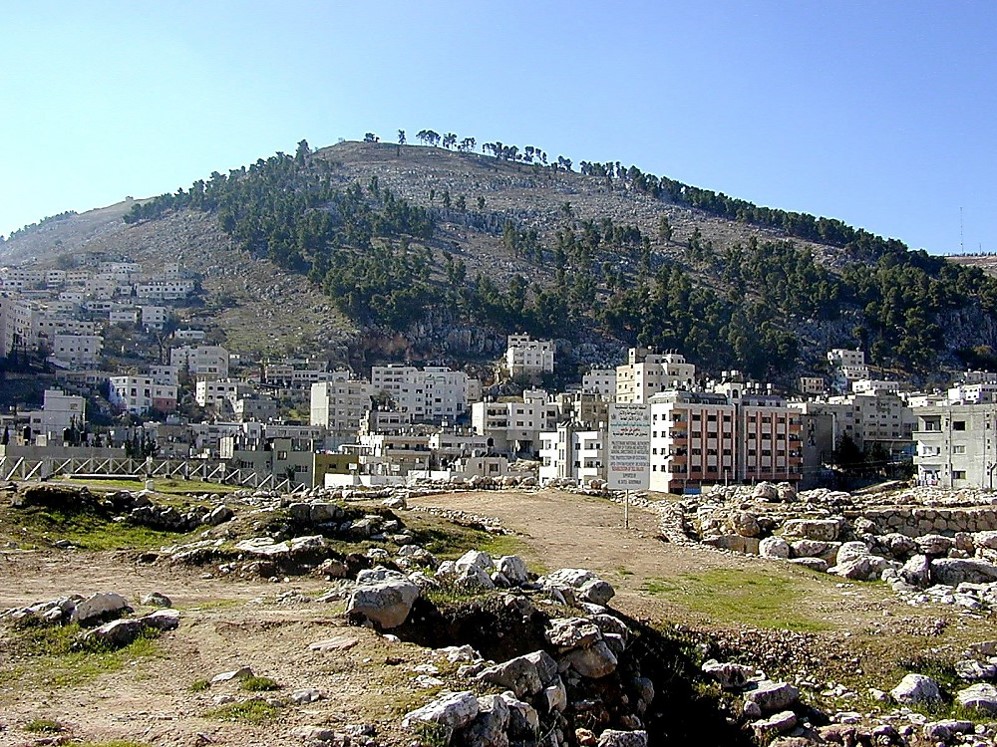
mt Gerizim

If you will remember they are talking at Jacob’s well. This is a picture of Mt. Gerizim near Jacob’s well. The Samaritans did build a temple here in 400 BC. But it was destroyed by a group of Jews in 128 BC. Well, the ruins of this temple would have been in sight from Jacob’s well,
 as they were talking.

“21Jesus said to her, ‘Woman, believe me, the hour is coming when neither on this mountain nor in Jerusalem will you worship the Father. 22You worship what you do not know; we worship what we know, for salvation is from the Jews.’”

With the coming of Jesus things are changing. And his coming transcends the divisions between Jews and Samaritans. From now on neither mountain is key.

Although, for the record, Jesus confirms that prior to his coming the Jews were right about Jerusalem and right about what true worship is. He also acknowledges that “salvation if from the Jews,” both as a matter of God’s historical working through them, and specifically in that he, Jesus is Jewish. (Jesus clearly here affirms that he is a Jew. Most often in John “Jew” is used negatively for Judeans who oppose Jesus.)

“23But the hour is coming, and is now here, when the true worshipers will worship the Father in Spirit and truth . . .”

Again, things are changing and Samaritans can be a part of this. True worshipers will not be marked by which mountain they worship on, they will be marked by two things. They will worship:

In Spirit – this is worship that is inspired and empowered by the Spirit. (Jesus has just taught her about living waters that refer to the Spirit and so we should take this to be a reference to the Holy Spirit, as in almost every other case of the word Spirit in John).

In truth – this is worship that is in accord with what Jesus teaches; which is the full revelation of God’s truth.

What he is doing here is teaching her one part of this, that true worship is not exclusive to a central shrine or temple but is Spirit inspired. If the current worship of Samaritans is not fully true (you worship what you do not know – v. 22 ) they can offer true worship if they worship in accord with what Jesus says.

“ . . . for the Father is seeking such people to worship him. 24God is spirit, and those who worship him must worship in Spirit and truth.”

This is an amazing statement. God is on a mission. God doesn’t sit back a wait for people. He actively seeks out people to know and honor him. And this includes this Samaritan woman. God wants her and all people to worship him in Spirit and truth.

When Jesus says, “God is spirit” he means that God is not physical; he is not just found in one place. He can be worshiped anywhere.

Notice that we worship the Father, in accord with what the Son teaches, empowered by the Holy Spirit.

“25The woman said to him, ‘I know that Messiah is coming (he who is called Christ). When he comes, he will tell us all things.’”

Having heard Jesus’ answer, she isn’t fully committed. She speaks of the coming Messiah who will “tell us all things,” that is, settle this dispute and others. The Samaritans had a different idea of the Messiah. They spoke of the Taheb or restorer based on Deuteronomy 18:15-19 where Moses speaks of God raising up a prophet like him, to whom all should listen. They saw the Messiah as more of a teacher. She is saying, ‘when he comes he will sort out the differences between Jews and Samaritans.’

“26Jesus said to her, ‘I who speak to you am he.’”

At the beginning of their conversation Jesus notes that she doesn’t know who he is. “If you knew who it is that is speaking to you . . .” you would ask him for living water. But now he has clearly told her. This is an amazing revelation of Jesus to her, ‘I am the Messiah.’ It is very unusual for Jesus to be so clear. She is certainly blessed to have him speak this way to her.

Specifically, he is saying that he is the one Moses spoke of and he has just settled the dispute between the Jews and Samaritans as he spoke to her.

“27Just then his disciples came back. They marveled that he was talking with a woman, but no one said, ‘What do you seek?’ or, ‘Why are you talking with her?’”

So we end today where we began last week, with Jesus crossing the social boundary of gender, and the disciples are duly shocked, but don’t say anything.

Once again I have two questions from the passage that should challenge us:

Do you worship in Spirit and truth?

To use the language of Jesus in v. 23, are you a “true” worshiper of God?

It is not about coming to this building each Sunday, so that you think you have worshipped because you have come to a certain place and sat through a service. Perhaps you are here but you are really distracted about your week to come and all that you have to do, or you are still trying to figure out how to deal with the problems of last week. Or maybe you are here but you are busy talking or texting to others. Or maybe your coming here is more about a weekly ritual than true worship.

True worship is about the Spirit of God opening up your heart to receive from God – as we gather to sing and pray and hear God’s word, or as you do these things during the week wherever you are at. We have to allow the Spirit to move within us and among us so that we connect to God. This is true worship.

And again, as last week, I ask –

Are you a part of God’s mission?

It is so clear in this passage, God is seeking people to worship him truly. God wants them to know him and honor him and to be made whole be recognizing our true King.

Are you a part of this? Do you let God work through you in your everyday lives to fulfill his mission? Being a part of God’s mission includes several things. We saw last week:

1. It includes divine appointments. This is why Jesus “had to pass through Samaria.” God wants this woman, with all of her brokenness and failures to worship him truly.

2. It includes crossing social boundaries. In our part of the story today all three boundaries are dealt with – gender, morality and the differences between Jews and Samaritans.

3. It includes a focus on Jesus. When possible division came as she asked which mountain is correct for worship, Jesus focused on how his coming transcends these differences.

And then we also see today two more aspects of God’s mission:

4. It includes dealing with issues:

– her sexual immorality – v. 16. Jesus didn’t shy away from this. It needed to be dealt with.
– her misunderstandings – v. 22. The Samarian errors about worship.

5. It includes leading people to true worship. This is the point of God’s mission. Once we have come alive to God by drinking of the living waters, the Spirit leads us to be in relationship with God through worship.

William Higgins


Series: Jesus and the Samaritan Woman

We’re back into our series on the Gospel of John. And I would like for us to focus on the story of Jesus and the Samaritan woman for the next few weeks, and really dig in and see what it can teach us.

Last we saw, Jesus he was in Jerusalem talking with Nicodemus. From there he went into the Judean countryside where his disciples were baptizing people who responded to Jesus’ preaching. Then he decided to go up to Galilee, but he went through Samaria to get there. And he ended up staying in the village of Sychar in Samaria for a few days.

Let’s look at –

John 4:4-15

“4And he (Jesus) had to pass through Samaria. 5So he came to a town of Samaria called Sychar, near the field that Jacob had given to his son Joseph. 6Jacob’s well was there . . .” Although some Jews avoided going through Samaria, many used it as a path between Jerusalem and Galilee because it was faster. However, when John tells us that “he had to pass through Samaria” it isn’t because Jesus was in a hurry. In fact he stayed there for a while. The “had to” points to the Father’s leading.

As you will remember, the “Samaritans” came from the remnants of the northern tribes of Israel from the time of the Assyrian conquest centuries before (721 BC) who intermarried with those settled in the region by the Assyrians (2 Kings 17:24-41).

At this time Sychar, modern day Askar, was probably the main Samaritan town (because Shechem had been destroyed). Jacob’s well was a ½ mile or so from Sychar. The land that Jacob gave to Joseph is mentioned in the Old Testament, but not the well itself (Genesis 48:21-22; 33:18-20; Joshua 24:32).

Jacob's well now covered by a church building

Jacob’s well now covered by a church building

“ . . . so Jesus, wearied as he was from his journey, was sitting beside the well. It was about the sixth hour.” So it’s 12:00 noon which means it’s really hot. And we get a good picture of Jesus’ humanity here – he is tired and, as we will see, he is thirsty.

“7A woman from Samaria came to draw water. Jesus said to her, ‘Give me a drink.’ 8(For his disciples had gone away into the city to buy food.) 9The Samaritan woman said to him, ‘How is it that you, a Jew, ask for a drink from me, a woman of Samaria?’ (For Jews have no dealings with Samaritans.)”

It was the role of the disciple to take care of the teacher. So the disciples have gone to get food. And they would have gotten him water if they were still there. But Jesus asks her for water.

In doing this, we need to recognize that he is crossing several social boundaries:

1. The first has to do with gender. It was not generally acceptable in this day for a man to talk to a woman in private that he didn’t already know. John highlights this by noting that Jesus’ disciples were absent. There were a number of Old Testament stories about men talking with women at wells, but these ended with marriage. (Genesis 24:11-28; 29:4-18; and Exodus 2:16-22; but see 1 Kings 17:8-16). That this was unusual is apparent when the disciples come back in v. 27. John tells us that “they marveled that he was talking with a woman.” According to the framework of his day Jesus is stretching things here.

2.The second has to do with morality. Women usually came in groups to draw water in the morning or evening when it wasn’t so hot. Since this woman came alone, in the heat of the day it indicates that she was likely not accepted by the other women of the village. As we learn later, but Jesus already knows, she is sexually immoral. So just as in the first three Gospels, Jesus is relating here to an outcast and someone who would be labeled a notorious or public sinner.

3. The third has to do with religion/culture. Jews considered Samaritans to be a breakoff group that opposed Judaism with their similar but at times quite different faith and practice. They were considered unclean. The woman herself, aware of this boundary, questions Jesus – ‘Why would you ask me for a drink?’ She comes across to me all throughout this story as feisty; she is not afraid to question or challenge Jesus and he is fine with this.

John adds the explanatory comment “Jews have no dealings with Samaritans.” That is, in general they didn’t interact. Indeed, there was a lot of hostility between the two groups. (This assumption is a part of the parable of the Good Samaritan in Luke 10).

“10Jesus answered her, ‘If you knew the gift of God, and who it is that is saying to you, ‘Give me a drink,’ you would have asked him, and he would have given you living water.’” She has challenged Jesus, ‘Don’t you know who I am – a Samaritan – and you want me to give you, a Jew, water?’ Jesus turns it around, ‘If you knew who I am, a Jew, yes, but much more, you could ask me for a much better kind of water.’ He defuses any animosity between them by noting that he is willing to give her much more than what he asks of her.

Here we learn about Jesus’ identity. Jesus is the one who gives “the gift of God” also called “living water.” Living water has a double meaning here. It can mean running or fresh water as opposed to stagnant water, or it can also represent the Spirit. For instance in John 7 Jesus talks about being thirsty and drinking and he talks about how he will give forth rivers of living water. And then John tells us that “this he said about the Spirit, whom those who believed in him were to receive . . ..” – v. 39. So living water refers to the Spirit. And this is “the gift of God” that Jesus gives to those who ask him for it.

“11The woman said to him, ‘Sir, you have nothing to draw water with, and the well is deep. Where do you get that living water? 12Are you greater than our father Jacob? He gave us the well and drank from it himself, as did his sons and his livestock.’” She misunderstands Jesus in an overly literal way thinking of running water. She observes that he can’t get it from Jacob’s well because it’s deep, in fact, it’s a 100 ft deep still today – and he has no rope and vessel.

She refers to Jacob or Israel, the father of the 12 tribes, the common ancestor of Jews and Samaritans. Notice she says, “our” father, finding commonality. She is saying, ‘Jacob gave us good water. It was good enough for him, his sons and his animals! Do you have a better water supply than what Jacob knew of? Are you greater than Jacob?’

“13Jesus said to her, ‘Everyone who drinks of this water will be thirsty again, 14but whoever drinks of the water that I will give him will never be thirsty again. The water that I will give him will become in him a spring of water welling up to eternal life.’”

Jesus makes the contrast:
• Jacob gave water to the 12 tribes, that doesn’t quench true thirst.
• Jesus gives water, not just to Jews, but also Samaritans and thus the 12 tribes, that cures true thirst. (There is almost certainly a reunification of Israel theme here.)

Jesus’ water is better. But it is a spiritual water that quenches a spiritual thirst. He gives the living water of the Spirit. And as he said, “The water that I will give him will become in him a spring of water welling up to eternal life.’” As Jesus also said in John 6:63 – “it is the Spirit who gives life.” The Spirit is like a spring of water within us that results in “eternal life.”

And the presence of the Spirit and eternal life within us fully satisfies and fulfills us spiritually. We will thirst no more. So, in answer to her question – yes, Jesus is greater than Jacob.

“15The woman said to him, ‘Sir, give me this water, so that I will not be thirsty or have to come here to draw water.’” Again, she takes him overly literally. She wants to drink this mysterious water that will relieve her physical thirst. She doesn’t fully understand, and we will have to wait until next time to see the progress she makes. But she is open to what Jesus has to say. She is asking for the water Jesus gives.

As I worked with this first part of our story this week, two questions came to mind by way of challenge to us:

Have you asked Jesus for living water?

As Jesus said to the woman in our story, ‘If you knew who I am, you would ask me for living water.’ Well, we know who Jesus is. As we have just learned he is the one who gives the Spirit who brings new life to us. And as he said to her, if you asked “he would have given you living water.”

In the same way if you ask Jesus for living water, he will give it to you. Let me say it again, if you ask Jesus for living water, he will give it to you – the presence of the Spirit within you who brings forth eternal life and fully satisfies any spiritual thirst that you might have. If you ask, he will give this to you. Ask him today! Why would you wait? Ask him right now!

Finally –

Are you a part of God’s mission?

God is always reaching out seeking people that they might come to him. Are you a part of this activity of God? As we learn in this story this includes several things:

1. Divine appointments. Why did Jesus “have to go through Samaria”? Because there was a woman that the Father wanted him to talk to. And Jesus was always in tune with the Father and did just what he wanted.

So when I ask are you a part of God’s mission I’m not talking about going on a mission trip, I am talking about your everyday life. Are you looking for divine appointments? Are you in tune with what God wants you to do? Are you open to this? This week? This is my challenge to you – look for these this week. I will be praying for you that God will work through you.

2. Crossing social boundaries. In our story this had to do with gender, morality and culture/religion. Don’t let these stand in the way. One of you shared last week about the young man with an offensive tattoo – well, God wants to reach all kinds of people no matter how different they are than us. Don’t just be shocked, look for the opportunity to relate even if it stretches you. God wants all people to come to know him and worship him. And so we should expect to come across people that are different than us, some so different that it blows our minds. But God loves them just as much as us and wants them to be blessed with the gift of God.

3. A focus on Jesus. When the Samaritan woman raised the divide between Jews and Samaritans – which was meant to kill the conversation, Jesus focused on the living water that he gives to all; that supersedes the divide. In like manner, we are to keep things focused on Jesus as we are a part of God’s mission. When division come up because of differences speak of the gift that Jesus has for all of us.

My challenge is be open to how God wants to work through you this week as he seeks people to know and love him. Be open to this; get tuned in. Let God fulfill his mission to the world through you. And I will give you a chance to share next week what God has done.

William Higgins

When you read the Gospels there are two things that stand out in how they present Jesus to us. First, Jesus is supremely giving. He is full of compassion and love. You constantly see his concern and care for people as he serves and blesses others; as he teaches, heals and delivers.

Second, Jesus is clearly demanding. He speaks the truth with clarity; he speaks radically and absolutely in terms of what God requires. He makes bold claims on every part of everyone’s lives.

This is an interesting mix of qualities – he is fully giving and he is fully demanding. Sometimes we get ourselves in trouble and misunderstand and distort Jesus when we emphasize just the one side or the other – Jesus is only giving or Jesus is only demanding. But Jesus is both, at the same time. This is who Jesus is. He is fully giving and at the same time he is fully demanding.

I want us to look at this and we begin with –

What Jesus gives

1. He gives freedom from our old lives. This includes forgiveness for our sins – all the self-centered, hurtful and even shameful things that we have done. Through his death on the cross Jesus provides for our forgiveness. As he said in Matthew 26:28, “my blood . . . is poured out for many for the forgiveness of sins.” Our sins can all be wiped away! We can be clean and pure! We can leave our shameful past behind!

Freedom from our past also includes deliverance. Jesus sets us free from all the powers of Sin and Satan and anything that would seek to keep us back in our old lives and away from God. As he said in John 8:34, 36, “Truly, truly, I say to you, everyone who practices sin is a slave to sin.  . . . (But) if the Son sets you free, you will be free indeed.”

Jesus frees us from our old lives so that we can start fresh with a new beginning.

2. He gives us new life – even now. Jesus said in John 7:37-39, “If anyone thirsts, let him come to me and drink. Whoever believes in me, as the Scripture has said, ‘Out of his heart will flow rivers of living water.’ Now this he said about the Spirit . . ..” The Spirit is the life, power and presence of God. Jesus gives us the Spirit so that we can have new life.

We only have to ask, as he said in Luke 11:13, “If you then, who are evil, know how to give good gifts to your children, how much more will the heavenly Father give the Holy Spirit to those who ask him!”

And we are not just made new within:

  • He gives us a new identity and purpose. We are now followers of Jesus, who are gifted to serve him (Matthew 25:14-30).
  • He gives us a new community, the church, which is his new family (Mark 3:34-35). A community where we love, care for and support each other.

Jesus gives us the gift of new life.

3. He gives us life in the age to come. Jesus said in John 11:25-26, “I am the resurrection and the life. Whoever believes in me, though he die, yet shall he live, and everyone who lives and believes in me shall never die.” He gives us the gift of eternal life with him in the kingdom of God forever.

Jesus is full of love and compassion. And gives us everything that is good; he gives us new life.

Now we look at –

What Jesus demands

1. He demands our total allegiance. “Jesus said to them, ‘. . . who do you say that I am?’ Simon Peter replied, ‘You are the Messiah, the Son of the living God’” – Matthew 16:15-16. Peter confessed that Jesus is the Messiah, the one anointed by God to rule and have all authority.

And Jesus wants all of us to acknowledge him as the Messiah. As he said in Matthew 10:32, “So everyone who acknowledges me before men, I also will acknowledge before my Father who is in heaven . . ..” If we acknowledge him now as the true Lord over all, he will acknowledge us then before the Father on the final day.

Jesus demands our full and complete allegiance to him as Lord of all.

2. He demands our total obedience. We are to do God’s will just as Jesus teaches us what this is. As he often said, “You have heard that it was said, that is by Moses, but I say to you.” (Matthew 5). And he also said in Matthew 23:1, “You have one instructor, the Messiah.” Jesus guides us into God’s perfect will.

By way of summary he said, “You shall love the Lord your God with all your heart and with all your soul and with all your mind. This is the great and first commandment. And a second is like it: You shall love your neighbor as yourself.” -Matthew 22:37-39. We are to love God and love and serve others.

Here a just a few specific examples:

  • only worship God – Matthew 6:24
  • love your enemies  – Matthew 5:43-48
  • remain faithful in marriage – Matthew 19:3-9
  • be generous with the poor – Luke 12:13-34
  • don’t condemn others as beyond God’s mercy – Luke 6:37-38
  • accept social lowliness – Luke 14:11
  • serve God in the work of the kingdom – Matthew 25:14-30

We are to give our complete and total obedience to Jesus.

3. He demands that we put him above all else. Our allegiance and obedience to him is to be above even what we give to our family. Jesus said in Matthew 10:37, “Whoever loves father or mother more than me is not worthy of me, and whoever loves son or daughter more than me is not worthy of me.”

And our allegiance and obedience to him is to be above even regard for our own lives. As Jesus said in Mark 8:34, “If anyone would come after me, let him deny himself and take up his cross and follow me.” To take up a cross is to die.

As we saw before, Jesus gives everything, but as we see here, Jesus also demands everything.

Several observations before I give you a chance to respond. First, notice how –

This is a summary of the whole message of Jesus

Mark 1:15 tells us that Jesus preached, “The time is fulfilled, and the kingdom of God is at hand; repent and believe in the gospel.” “The kingdom of God” is a way of talking about God’s coming salvation.  Jesus is saying that it has begun; the time is fulfilled. The kingdom then, is what Jesus gives – freedom from our old lives, new life now, and life everlasting in the resurrection.

To “repent” is to have a change of heart and mind that leads you to do God’s will from now on. This then, is what Jesus demands – our total allegiance, our total obedience, and our putting him above all else. What Jesus gives and what Jesus demands summarizes the message of Jesus to us.

Notice also that –

This explains the place of Jesus’ cross and also our cross

Jesus said in Mark 8:31, “the Son of Man must suffer many things and be . . . killed” speaking of his cross. Jesus’ cross is what provides all that Jesus gives us – freedom from our past, new life now and the resurrection

But Jesus also said in Mark 8:34, “take up (your) cross and follow me.” Our cross is all that Jesus demands from us – our total allegiance and obedience to him above all else.

And then finally,

Mark 8:35 brings this all together

– and shows the relationship between what Jesus gives and what Jesus demands. “For whoever would save his life will lose it . . .” If we refuse Jesus’ demands, we will lose our lives in the coming judgment of this world and its evil.

“ . . . but whoever loses his life for my sake and the gospel’s will save it.” If we lose our lives, that is, give Jesus all that he demands, which is everything, then we will save our lives. We will receive all that Jesus has come to give us.

Where do you stand this morning in relation to what Jesus gives? Have you received his gifts to you? Where do you stand in relation to what Jesus demands? Have you given him everything?

William Higgins

From time to time I want to share with you stories about Christians who lived after the time of the Bible who can both teach us and encourage us to live more faithfully ourselves. And in each case I want to show how their lives embody specific aspects of faithfulness from the Scriptures.

The first one I shared with you was the story of the young woman, Perpetua, who lived in Carthage Africa in the early 200’s. Today we jump all the way to the early 1500’s and we are in Switerland. So this was around 500 years ago. This is the story of Felix Mantz (or Manz). We begin with his –

His life in Zurich

Zurich with the Limmat river in the foreground and the Grossmunster in the background

Zurich with the Limmat river in the foreground and the Grossmunster in the background

He was born here in 1498. He was the illegitimate child of a priest at the main church in Zurich, the Grossmunster. It was not uncommon at this time for priests to have concubines.

He was in his early 20’s when the Protestant reformation began to gain a foothold in Zurich. And he became very involved in it, working with the Protestant leaders and attending bible studies.

He had studied at the University of Paris and knew Latin and Greek, and he learned Hebrew at this time. He was on his way to being appointed as a scholar and teacher of Hebrew in what would become the University of Zurich.

A reform of the Protestant reformation?

But he, along with several others, became disillusioned with the Protestant leaders of Zurich. Although they talked about having a church based on the New Testament, they constantly allowed the city council to determine what, if anything, would change in the church of Zurich. The State, even though made up in part of unbelievers, was in charge of the church and its reformation.

The first public break between Mantz and these leaders came in October 1523 when the city council called for a debate about the Lord’s Supper, or when to change from a Catholic service to a Protestant one.

City council building

City council building

City council building in the 1500s

City council building in the 1500s

Mantz argued that when you know what is right based on the Bible, you need to act on it, not wait. The Protestant leaders deferred to the conservative city council and decided to wait to make a change.

Mantz and the others had been meeting together in their own bible study for a while, often in his mother’s home. They went ahead and began to observe a simple Lord’s supper among themselves.

The controversy came to focus next on infant baptism. The radicals asked, where is this in the Bible? The city council called for a debate on this topic which took place on January 10 and 17, 1525. Mantz was a spokesperson for the radical group.

Now, a State church needs infant baptism to bind together everyone in one faith in their territory. Mantz and the radicals were coming to see that the church should only be made up of people who choose the Christian faith for themselves. So these are very different ideas of what the church should be.

Anabaptist and Protestant leaders in the council building

Anabaptist and Protestant leaders in the council building

Street on which the first baptisms took place

Street on which the first baptisms took place

The radicals argued that there is a pattern in Scripture, which is that faith and repentance come before baptism. The disputation, of course, was given to the Protestant leaders by the council since they worked hand in hand. But this wasn’t all.

On January 18th, the council ordered all parents to have their children baptized within a week. (One of their group had just had a daughter four days before). And on January 21st – Mantz and the others were silenced, and their meetings banned.

That very evening the group of radicals gathered at Mantz’s mother’s house and received from each other believer’s baptism, thus starting a new Christian group.

Life as a persecuted evangelist

First Anabaptist church site

First Anabaptist church site

The next day the group fled to the village of Zollikon, just south of Zurich. And they began preaching and baptizing people. Mantz baptized a farmer named George Shad, who himself later went on to baptize 40 more people. Things really took off and people began to respond.

Also in Zollikon, Mantz baptized Hans Bruggbach. An account of this said that after a Bible study, Hans “stood up, wept and wailed what a great sinner he was and asked those present to pray for him.” After he confessed his faith, Mantz baptized him. Right after this another man, Jacob Hottinger stood up and asked to be baptized and Mantz baptized him. This became the first Anabaptist congregation.

An Anabaptist prison break

An Anabaptist prison break

Within a week the authorities cracked down. Mantz was arrested along with many others. He was put in prison on a diet of mush, water and bread until he had a change of heart. But he escaped from prison and went to other areas outside of Zurich to minister. He was arrested again in July and was in jail for 3 months. But then he was released and began to preach and baptize again.

Once again he was arrested and brought to Zurich. As a prisoner at this time he took part in one final debate, November 6-8 in the Grossmunster. Almost a thousand people came.

Debate in the Grossmunster

Debate in the Grossmunster

After this he was sentenced to life in prison, and isolated from outsiders. In the Spring the council decreed the death penalty for anyone who baptized outside of the State church. In March (1526) he escaped through a window that was left open in the prison tower.

For the next nine months he was constantly on the run. He held secret meetings with believers in fields and forests. He taught them the Scriptures, baptized and celebrated a simple Lord’s supper.

His death

His final arrest was in December of 1526. He was sentenced to death by Zurich authorities. He was killed January 5, 1527 in the Limmat river at the age of 29.

Zurich in the 1500s

Zurich in the 1500s

He was taken from the Wellenberg tower situated in the Limmat river (above – the bottom right corner) by boat, to the east bank by the fish market near the city council building. Here his sentence was read. Then he was taken past the council building to the slaughterhouse where he was put into a boat and taken out to a fisherman’s hut (above – the bottom left corner). As he made his way he praised God that he was about to die for the truth. A great crowd watched. And his mother encouraged him to stay true.

The martyrdom of Felix Mantz

The martyrdom of Felix Mantz

They bound his hands over his knees with a rod to keep him immobile. His final words were, “Into Thy hands, O Lord, I commend my Spirit.” Then they  pulled him off the platform and he drowned at 3:00 in the afternoon.

Area of the Limmat river where he was drowned

Area of the Limmat river where he was drowned

Finally, here are –

Several characteristics of faithfulness

– that stand out to me in Mantz’s life:

1. He worked to fulfill the great commission. Jesus said in Matthew 28:19-20, “Go therefore and make disciples of all nations, baptizing them in the name of the Father and of the Son and of the Holy Spirit, teaching them to observe all that I have commanded you.”

He had an exemplary ministry of disciple making, baptizing and teaching throughout the area of Zurich. And this is a challenge to us. He did this when there were great obstacles to fulfilling the great commission of Jesus:

  • at this time everyone thought that everyone in Europe was already Christian.
  • he was being told that he was a heretic for simply following the New Testament.
  • it was against the law of the land.

The challenge is this – in our situation where none of these obstacles exist, why aren’t we more active in fulfilling the great commission?

2. He was not afraid of persecutors. Jesus said in Matthew 10:28, “do not fear those who kill the body, but cannot kill the soul.” And he was fearless. He was constantly breaking the law in order to spread the word. And even when he knew near the end, that if he were caught he would die, he kept going.

This is a challenge to us – he carried out his ministry under constant threat of arrest and death. But the worst we have to fear is that we will be ridiculed and dishonored. Yet we often allow this fear to stop us.

3. He gave up his earthly life. Jesus said in John 12:25, “Whoever loves his life loses it, and whoever hates his life in this world will keep it for eternal life.”

  • He hated his earthly life in comparison to his love for Jesus when he was killed for his faith as a young man. He could have recanted. He could have sought a way out and changed course.
  • And he hated his earthly life in comparison to his love for Jesus when he gave up comfort and status to become an evangelist on the run. He could have taken a wife and had kids and been honored as a professor and outstanding member of the Zurich community. He could have enjoyed all the comforts and privileges that Zurich has to offer in that day.But he lost his life, he gave all this up for faithfulness to God, and for a life in the world to come.

This is a challenge to us. What have we given up for Jesus? Even short of physical death, what have we hated of our life in this world; what have given up to serve Jesus? We should not think that if there were suddenly persecution in our context and our lives were on the line that we would out of the blue give up our physical lives for Jesus if we have not already been giving up our lives in service and sacrifice for Jesus more generally. If we are not taking up our cross and dying every day, we will not be prepared to literally give up our lives.

Mantz had already given everything up. He had sacrificed all for Jesus. That is why he could be joyful even as his physical death approached.

William Higgins

(I am indebted to John Allen Moore’s Anabaptist Portraits)