Feeds:
Posts
Comments

Posts Tagged ‘repentance’

Series: Jesus and the Samaritan Woman

Last week we began looking at the story of Jesus and the Samaritan woman. We saw how Jesus crossed the social boundaries of gender, morality and religion/culture to speak to her about the living water he gives – that is, the Holy Spirit who brings eternal life. This is why he “had to pass through Samaria” as it says in John 4:4; it was the Father’s purpose.

Today we look at the middle portion of our story  and our focus in on worshiping the Father in Spirit and truth.

John 4:16-27

“16Jesus said to her, ‘Go, call your husband, and come here.’ 17The woman answered him, ‘I have no husband.’ Jesus said to her, ‘You are right in saying, ‘I have no husband’; 18for you have had five husbands, and the one you now have is not your husband. What you have said is true.’”

So they’ve been talking and Jesus turns the conversation toward her. He wants to get at a core issue in her life. Although she was bold before when she was questioning Jesus, here she becomes evasive. In fact, she wants to hide something from Jesus.

She tells Jesus, “I have no husband.” Now the word that is used here by both Jesus and the woman can mean “husband” or simply “a man.” She uses it to mean that she is not married, making her sound like she is not in a relationship.

But Jesus knows her heart and her story, just as he knows all about each of our lives. As John 2:24 says, “Jesus knew all people . . . for he himself knew what was in a person.”

He knows that she has been married five times. It’s not clear to us why, but there were almost certainly some divorces involved here. By the standards of the day (at least in Judaism) only 3 legal marriages were acceptable. So she has been in and out of a number of relationships, which would have reflected badly on her.

But more importantly, Jesus knows that she is in a sixth relationship. She is in a non-marital sexual union; as we say today, she is living with someone.

Jesus also employs the double meaning of the word husband/man and thereby takes her statement “I have no husband” as a confession of her sin. He emphasizes how true her words are, despite her intention to mislead him. He is saying, ‘Yes, you are right, you don’t have a “husband.” You are living in sexual immorality with “a man” who is not your husband.’

“19The woman said to him, ‘Sir, I perceive that you are a prophet. 20Our fathers worshiped on this mountain, but you say that in Jerusalem is the place where people ought to worship.’”

She’s impressed by what he knows and comes to the conclusion that he’s a prophet. So she has a theological question for him about the right way to worship. She asks which mountain is the right place to worship, Mt. Gerizim or Mt. Zion in Jerusalem.

Again division raises its head. She says that “our fathers” worshiped on this mountain, most likely referring to Abraham (Genesis 12:7) and Jacob (Genesis 33:10) who worshiped at Mt. Gerizim. And since Samaritans didn’t accept any Scriptures except the Law of Moses – the first five book of the Bible – and these don’t talk about a temple in Jerusalem, the Samaritans argued that true worship should take place on Mt. Gerizim (Some of their case: Jacob’s dream took place here, where he said, “God is in this place – Genesis 28:16, and he built an altar here in 33:19-20; Deuteronomy 27:3-5).

But Jews, of course, based on further Old Testament teaching, built the temple in Jerusalem.
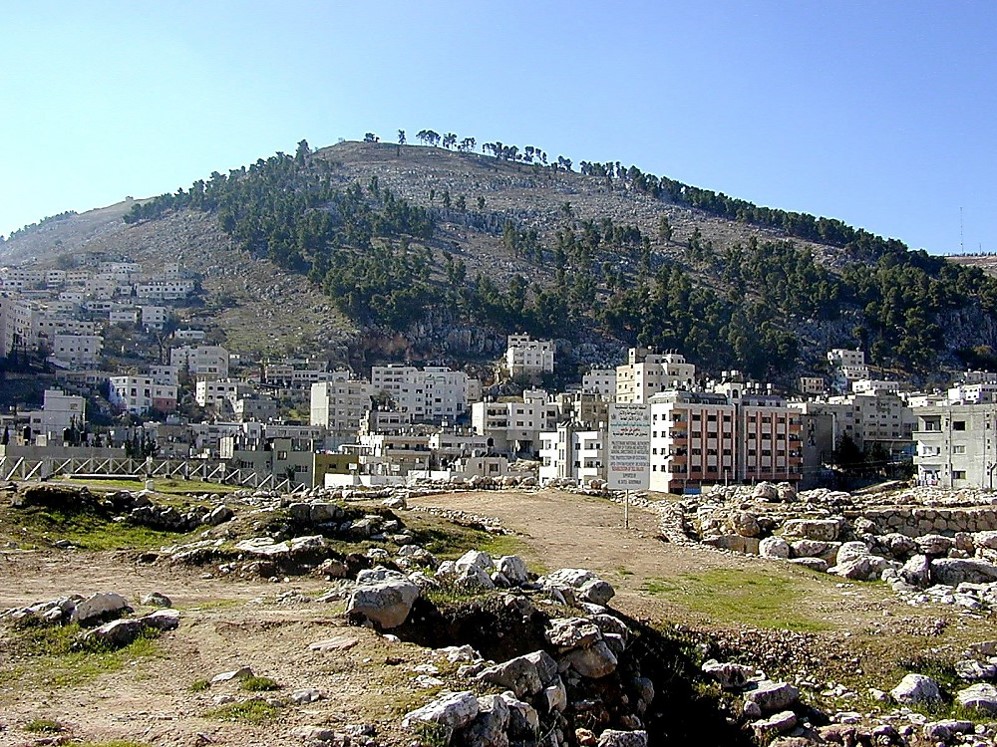
mt Gerizim

If you will remember they are talking at Jacob’s well. This is a picture of Mt. Gerizim near Jacob’s well. The Samaritans did build a temple here in 400 BC. But it was destroyed by a group of Jews in 128 BC. Well, the ruins of this temple would have been in sight from Jacob’s well,
 as they were talking.

“21Jesus said to her, ‘Woman, believe me, the hour is coming when neither on this mountain nor in Jerusalem will you worship the Father. 22You worship what you do not know; we worship what we know, for salvation is from the Jews.’”

With the coming of Jesus things are changing. And his coming transcends the divisions between Jews and Samaritans. From now on neither mountain is key.

Although, for the record, Jesus confirms that prior to his coming the Jews were right about Jerusalem and right about what true worship is. He also acknowledges that “salvation if from the Jews,” both as a matter of God’s historical working through them, and specifically in that he, Jesus is Jewish. (Jesus clearly here affirms that he is a Jew. Most often in John “Jew” is used negatively for Judeans who oppose Jesus.)

“23But the hour is coming, and is now here, when the true worshipers will worship the Father in Spirit and truth . . .”

Again, things are changing and Samaritans can be a part of this. True worshipers will not be marked by which mountain they worship on, they will be marked by two things. They will worship:

In Spirit – this is worship that is inspired and empowered by the Spirit. (Jesus has just taught her about living waters that refer to the Spirit and so we should take this to be a reference to the Holy Spirit, as in almost every other case of the word Spirit in John).

In truth – this is worship that is in accord with what Jesus teaches; which is the full revelation of God’s truth.

What he is doing here is teaching her one part of this, that true worship is not exclusive to a central shrine or temple but is Spirit inspired. If the current worship of Samaritans is not fully true (you worship what you do not know – v. 22 ) they can offer true worship if they worship in accord with what Jesus says.

“ . . . for the Father is seeking such people to worship him. 24God is spirit, and those who worship him must worship in Spirit and truth.”

This is an amazing statement. God is on a mission. God doesn’t sit back a wait for people. He actively seeks out people to know and honor him. And this includes this Samaritan woman. God wants her and all people to worship him in Spirit and truth.

When Jesus says, “God is spirit” he means that God is not physical; he is not just found in one place. He can be worshiped anywhere.

Notice that we worship the Father, in accord with what the Son teaches, empowered by the Holy Spirit.

“25The woman said to him, ‘I know that Messiah is coming (he who is called Christ). When he comes, he will tell us all things.’”

Having heard Jesus’ answer, she isn’t fully committed. She speaks of the coming Messiah who will “tell us all things,” that is, settle this dispute and others. The Samaritans had a different idea of the Messiah. They spoke of the Taheb or restorer based on Deuteronomy 18:15-19 where Moses speaks of God raising up a prophet like him, to whom all should listen. They saw the Messiah as more of a teacher. She is saying, ‘when he comes he will sort out the differences between Jews and Samaritans.’

“26Jesus said to her, ‘I who speak to you am he.’”

At the beginning of their conversation Jesus notes that she doesn’t know who he is. “If you knew who it is that is speaking to you . . .” you would ask him for living water. But now he has clearly told her. This is an amazing revelation of Jesus to her, ‘I am the Messiah.’ It is very unusual for Jesus to be so clear. She is certainly blessed to have him speak this way to her.

Specifically, he is saying that he is the one Moses spoke of and he has just settled the dispute between the Jews and Samaritans as he spoke to her.

“27Just then his disciples came back. They marveled that he was talking with a woman, but no one said, ‘What do you seek?’ or, ‘Why are you talking with her?’”

So we end today where we began last week, with Jesus crossing the social boundary of gender, and the disciples are duly shocked, but don’t say anything.

Once again I have two questions from the passage that should challenge us:

Do you worship in Spirit and truth?

To use the language of Jesus in v. 23, are you a “true” worshiper of God?

It is not about coming to this building each Sunday, so that you think you have worshipped because you have come to a certain place and sat through a service. Perhaps you are here but you are really distracted about your week to come and all that you have to do, or you are still trying to figure out how to deal with the problems of last week. Or maybe you are here but you are busy talking or texting to others. Or maybe your coming here is more about a weekly ritual than true worship.

True worship is about the Spirit of God opening up your heart to receive from God – as we gather to sing and pray and hear God’s word, or as you do these things during the week wherever you are at. We have to allow the Spirit to move within us and among us so that we connect to God. This is true worship.

And again, as last week, I ask –

Are you a part of God’s mission?

It is so clear in this passage, God is seeking people to worship him truly. God wants them to know him and honor him and to be made whole be recognizing our true King.

Are you a part of this? Do you let God work through you in your everyday lives to fulfill his mission? Being a part of God’s mission includes several things. We saw last week:

1. It includes divine appointments. This is why Jesus “had to pass through Samaria.” God wants this woman, with all of her brokenness and failures to worship him truly.

2. It includes crossing social boundaries. In our part of the story today all three boundaries are dealt with – gender, morality and the differences between Jews and Samaritans.

3. It includes a focus on Jesus. When possible division came as she asked which mountain is correct for worship, Jesus focused on how his coming transcends these differences.

And then we also see today two more aspects of God’s mission:

4. It includes dealing with issues:

– her sexual immorality – v. 16. Jesus didn’t shy away from this. It needed to be dealt with.
– her misunderstandings – v. 22. The Samarian errors about worship.

5. It includes leading people to true worship. This is the point of God’s mission. Once we have come alive to God by drinking of the living waters, the Spirit leads us to be in relationship with God through worship.

William Higgins


Read Full Post »

You brood of vipers! Who warned you to flee from the wrath to come? Bear fruits in keeping with repentance. And do not begin to say to yourselves, ‘We have Abraham as our father.’ For I tell you, God is able from these stones to raise up children for Abraham. Even now the axe is laid to the root of the trees. Every tree therefore that does not bear good fruit is cut down and thrown into the fire.

– Luke 3:7-9


Read Full Post »

I want us to look at John the Baptist this Sunday and next for our Advent focus. Certainly a part of Advent is anticipating and preparing for the celebration of Christmas – the coming of Jesus to us. So we’re getting ready for this. But a part of it is also looking ahead so that we’re prepared for the second coming or second advent of Jesus.

And who better to prepare us than John, whose ministry it was to do just this. Today we’ll focus on how his message prepares us.

But first let’s look at –

John’s life and ministry

He was quite unique and that in several ways. He lived in the wilderness. He lived here before his ministry (Luke 1:80) and this is where he received his prophetic message (Luke 3:2). And he continued to minister from here. Matthew 3:1 says, “In those days John the Baptist came preaching in the wilderness of Judea . . .”

In terms of food his diet was unique. Jesus said, he came “eating no bread and drinking no wine . . .” (Luke 7:33). He was known for fasting and certainly not for feasting. And he was known for abstaining from alcohol. Rather he ate “locusts and wild honey” (Matthew 3:4).

His clothing was unique as well, “John wore a garment of camel’s hair and a leather belt around his waist . . .” (Matthew 3:4) looking very much like Elijah (2 Kings 1:8)

He was a prophet. He was widely acknowledged to be this by the people of Israel. The Jewish leadership in Jerusalem bore witness to this, when they said, “all the people . . . are convinced that John was a prophet” (Luke 20:6).

Jesus also held this view. Speaking of John he said, “What then did you go out to see? A prophet? Yes . . .” (Matthew 11:9). As we’ll see, he had a strong prophetic message for the people.

He was the forerunner, the one sent to prepare the way. As Jesus said, John is “more than a prophet. This is he of whom it is written, ‘Behold, I send my messenger before your face, who will prepare your way before you.’” (Matthew 11:9-10).

This comes from Malachi 3:1. And John is the fulfillment of this prophecy. He has this unique role of preparing the people for the Lord’s coming.

Another text that sees John as the forerunner is found in Luke3:4. It identifies John as “the voice of one crying in the wilderness: Prepare the way of the Lord, make his paths straight.” This prophecy comes from Isaiah 40:3-5.

He prepared the way for Jesus in several ways. One is that he called people to look for the one to come. He said, “I baptize you with water for repentance, but he who is coming after me is mightier than I, whose sandals I am not worthy to carry. He will baptize you with the Holy Spirit and with fire. His winnowing fork is in his hand, and he will clear his threshing floor and gather his wheat into the barn, but the chaff he will burn with unquenchable fire.” – Matthew 3:11-12.

He also identified Jesus as this one. He said, “I saw the Spirit descend from heaven like a dove, and it remained on him (Jesus). I myself did not know him, but he who sent me to baptize with water said to me, ‘He on whom you see the Spirit descend and remain, this is he who baptizes with the Holy Spirit.’ And I have seen and have borne witness that this is the Son of God.” – John 1:32-34

He was faithful to his call. John did what God told him to do without hesitation. He didn’t care what others thought and he was fearless with those who held power.

He called the Pharisees and Sadducees who came to him a “brood of vipers” or a nest of poisonous snakes (Matthew 3:7). And proceeded to warn them of judgment in they didn’t change. He also criticized King Herod – Mark 6:18, which eventually led to his own death

And he was faithful to death. Matthew 14:6-11 tells this story. “When Herod’s birthday came, the daughter of Herodias danced before the company and pleased Herod, so that he promised with an oath to give her whatever she might ask. Prompted by her mother, she said, ‘Give me the head of John the Baptist here on a platter.’ And the king was sorry, but because of his oaths and his guests he commanded it to be given. He sent and had John beheaded in the prison, and his head was brought on a platter and given to the girl, and she brought it to her mother.” He stayed true to God until the end.

Now we look at –

How John’s message prepares us for the coming of Jesus

John’s message was a message of repentance. He preached, “repent, for the kingdom of heaven is at hand” – Matthew 3:2. So repentance is the way to prepare for the proper celebration of Christmas, as well as the second Advent of Jesus.

  • Repentance is a change of heart and mind that leads to changed behaviors.
  • It is choosing to turn away from our sin so that we can do God’s will from now on.

Here are some examples of John’s call to repentance. 1. He pointed out personal marital and sexual sins. “John had been saying to Herod, ‘It is not lawful for you to have your brother’s wife.’” – Mark 6:18. In this particular case Herod was guilty of both adultery and incest (Leviticus 18:16). And John was not afraid to call him to repentance.

2. He pointed out human greed. Our desire to have and to hold on to more than we need. “And the crowds asked him, ‘What then shall we do?’ And he answered them, ‘Whoever has two tunics is to share with him who has none, and whoever has food is to do likewise.’” – Luke 3:10-11. If you have more than you need, share your food and clothing with those who do not have these.

3. He pointed out the abuse of power, that is, using your power to take advantage of others. “Tax collectors also came to be baptized and said to him, ‘Teacher, what shall we do?’ And he said to them, ‘Collect no more than you are authorized to do.’” – Luke 3:12-13. That is, don’t do what most tax collectors do, take more than required in order to pad your own income. Only take what you are supposed to.

Not only did he address very specific issues of sin, he undercut their excuses for their unfaithfulness. They thought, Abraham’s our father. We’re the chosen people. It’s OK. We’ll be alright.

John said, “do not presume to say to yourselves, ‘We have Abraham as our father,’ for I tell you, God is able from these stones to raise up children for Abraham.” – Matthew 3:9. So what if you are Abraham’s children! God can turn a rock into a child of Abraham. Repentance is what’s necessary.

As he said to them, “Bear fruit in keeping with repentance. . . Even now the axe is laid to the root of the trees. Every tree therefore that does not bear good fruit is cut down and thrown into the fire.” – Matthew 3:8, 10. Bearing the fruit of repentance is what God requires.

What about you? Where are you allowing yourself to continue in wrong behavior? Where are you holding out on God? Those areas that you would rather not think about? And what are your excuses? You think, well God doesn’t really care about that issue. Or, hey, I go to church. Well, God can make church members out of rocks too! That won’t rescue you.

John teaches us that getting ready for Jesus’ Advent means dealing with our sin through repentance. It means setting aside our excuses, our rationalizations and our justifications so that we begin to do God’s will.

And then, like the many sinners who responded to John in his day (Matthew 21:32), we too can confess our sins and find forgiveness (Mark 1:4-8). And then we will be ready to welcome Jesus and follow him in all of life.

Read Full Post »

Our text today is often called the parable of the two sons. I think parents with teens will relate to it. It’s about a father trying to get his kids to do chores. One kid is rude about it and the other doesn’t do anything.

But in all seriousness, it’s an important Scripture because it gives us a very clear understanding of what God wants from us.

It comes right in the middle of a fairly long confrontation between Jesus and the leaders of Jerusalem – the chief priests and the elders of the people (21:23). And this is the first of three parables intended to give them a message.

First, let’s work at –

Understanding the parable

Jesus initiates this stage of the conversation with a question. v. 28 – “What do you think?” They had just refused to answer a question he posed, but as we will see in what follows, this parable forces them to answer him.

Now before we move on, let me say here that in some ancient manuscripts of the New Testament the order of the two sons is actually reversed. So if your Bible has this you will know what is going on. For instance the older New American Standard Bible. I am using the ESV as always.

The first son. v. 28 – “A man had two sons. And he went to the first and said, ‘Son, go and work in the vineyard today.’” The word translated as “first” can also mean “older,” as in the oldest son. Some translations take it this way.

“Sons” is actually the word for “children.” And when the father says, “son, go and work,” it is actually “child, go and work,” a more affectionate way of putting it. He is asking him to do some work on the family farm.

v. 29 – “And he answered, ‘I will not.’” The son’s response is rude and disrespectful. In its culture this would be seen as rebellious and unacceptable. And it’s a real contrast to the father’s affectionate address to him.

The story goes on, v. 29 – “but afterward he changed his mind and went.” Although he said no, he does work.

The word behind the phrase, “changed his mind” can also be translated as ‘he regretted it’ or ‘he thought differently about it,’ or even ‘he repented.’

This part of the parable has some connection to Luke 15 and the parable of the prodigal son, the only other parable of Jesus that involves a father and two sons. The first son here is quite similar to the prodigal son. And both show us what repentance looks like. They changed their minds and acted differently.

The second son. v. 30 – “And he went to the other son and said the same. And he answered, ‘I go, sir.’” This is a very respectful answer, in contrast to the first son’s words to his father. The word “sir” is actually the word for ‘lord’ or ‘master.’

v. 30 – “but did not go.” He said yes, but he was full of hot air.

Now let’s look at –

Jesus’ interpretation

v. 31 – “’Which of the two did the will of his father?’ They said, ‘The first.’ Jesus said to them, ‘Truly, I say to you, the tax collectors and the prostitutes go into the kingdom of God before you.’”

  • From this we see that the father represents God.
  • The first son represents the tax collectors & prostitutes. They said no to God initially, but when they heard the message of the kingdom, they changed their minds and began to do God’s will.
  • The second son represents the chief priests & elders. They said yes to God, but when they heard the message, they did not act.
  • And most likely the vineyard represents Israel – the people of God.

The point of the parable is clear. Those who refuse God but later repent and obey, like the first son, will go into the kingdom. And they will go in before those who say yes, but don’t obey God, like the second son. (Indeed the leaders won’t get in at all unless they repent.)

Jesus gives his strong affirmation to this lesson when he says, “Truly I say to you.” He is saying, ‘take note!’ ‘This is absolutely the truth.’

Finally, notice how Jesus forces them to answer. The only possible answer to his question is that the first son did the father’s will. Yet the first son undeniably represents well repentant sinners – those moral outcasts that these leaders looked down on.

And the leaders look very much like the second son, in that they did not take heed to the message of the kingdom. So they, in effect, condemn themselves.

Now this parable can be applied quite broadly, but in this context Jesus applies it specifically to –

John the Baptist’s ministry

– the subject of the argument at this point between Jesus and the leaders of Jerusalem.

v. 32 – “For John came to you in the way of righteousness, and you did not believe him.” Even though they had said yes to obey God, they did not believe John was from God. So they didn’t do what he said.

Although John came in the way of righteousness, that is, he was righteous and preached a righteous message from God, they rejected him.

v. 32 – “but the tax collectors and the prostitutes believed him.” Even though they had said no to God, they believed John and repented.

Finally, Jesus says, v. 32 – “And even when you saw it, you did not afterward change your minds and believe him.” Even after they saw others respond, they rejected him, and would not change their minds about him, and heed his message of repentance. They blew it twice with John, just like they were blowing it with Jesus as they spoke with him.

Lessons for us

1. We learn what God wants from us. God wants us to believe and respond to the message of the kingdom. And how do we respond? We are to respond by obeying God. To say it another way, God is looking for a change within that leads to obedience; so that we come to do our heavenly father’s will, instead of ours or anyone else’s.

This is the bottom line of what God wants from us.

2. Don’t be the second son. As Christians we have said “yes” to God, and so we are reminded in this parable that we need to come through on our commitment. We need to make sure we are working in the vineyard, doing God’s will; using our gifts and doing all that God tells us to do.

Now, the second son echoes Matthew 7:21. “Not everyone who says to me, ‘Lord, Lord,’ will enter the kingdom of heaven, but the one who does the will of my Father who is in heaven.” Both use the address of “Lord,” and both don’t obey the will of the father. And both are, as Jesus interprets the parable, excluded from the kingdom of God. (Davies & Allison)

This is a word to us not just the ancient leaders of Israel. We must come through on our commitments to God.

3. Don’t be self-righteous. We need humility so we don’t become like the leaders of Jerusalem.

Think about it. Who are the ones who will never repent? Rank sinners? No. There’s a chance for them. The ones who will never repent are those who think they don’t need to repent; who don’t see the need; who think they are in the right.

Paul says, “Let anyone who thinks that he stands take heed lest he fall” – 1 Corinthians 10:12. This is a warning for us. You never get to a place where you can’t receive God’s message to you; where you don’t need to be open to repentance.

4. The gospel is great news for sinners! So if you are here today and you have sin in your life – I mean even really bad sin; you have made terrible and shameful choices – it isn’t too late.

You haven’t done God’s will so far? Jesus teaches that you can change your mind! You can have a change within so that you believe the message and start to obey your heavenly father. It isn’t too late.

And if there is anyone here today who wants to do this very thing I invite you to come forward . . ..

[Note: This is not an example of the first and the last from 20:16. In this last verse the first and the last has to do with equalization, not reversal – both the first and the last were made equal.]
 
[Note: Literary structure of the parable.
A. Question/two sons: What do you think? A man had two sons.
B. First son: And he went to the first and said, ‘Son, go and work in the vineyard today.’ And he answered, ‘I will not,’ but afterward he changed his mind and went.
`B. Second son: And he went to the other son and said the same. And he answered, ‘I go, sir,’ but did not go.
`A. Question/two sons: Which of the two did the will of his father?” They said, “The first.”

William Higgins

Read Full Post »

Last week we began to look at the question, “Am I my brother’s keeper?” from the story of Cain and Abel. And we saw how even though Cain asked it to try to avoid any responsibility for his brother, the question actually has to be answered with a “yes.” Cain did have a responsibility to his brother. And as well, we all have responsibilities to our brothers and sisters, and neighbors.

We also spent a good deal of time looking at Scriptures that show that we are to care for and help our neighbor – especially those who are weak and in need.

Well today, I want us to look at a specific example of suffering and need, one that has been on my daughter’s heart for several years now. And then we will look at some ways to respond.

Marie: Darfur comprises the three westernmost regions of Sudan, the largest country in Africa. 99% of the population is Muslim and most speak Arabic. They are mostly rural farmers. The people of Darfur have been marginalized since Sudanese independence in 1956 when power was given to the northern Arab elites. They deliberately tried to keep Darfuris out of school. There were no hospitals, roads, schools or economic systems in place. They had no political representation, and were left poverty-stricken.

Omar al-Bashir, the dictator of Sudan has been indicted by the International Criminal Court for 7 counts of war crimes and crimes against humanity and 3 counts of genocide and extermination.

In 2003 rebel groups from Darfur attacked the capital, Khartoum. After some successful attacks in spring of 2003 the government responded by killing the Darfuris. They hired an Arab militia called the Janjaweed which literally translates to “devils on horseback.” The government gives them uniforms, money, arms, plunder, livestock, land and impunity. They even let criminals out of jail and pay them to burn villages and slaughter their fellow  countrymen.

There are many different forms of oppression there. They suffer starvation because their crops and livestock are burned. The government poisons their water supplies by stuffing dead bodies down their wells. The government denies access to humanitarian aid and even kicked out 13 of the major groups last spring. The militias and the government adhere to a scorched-earth policy in Darfur. Women and girls are forced to get water and firewood for cooking, but then face the risk of being raped. If the men go, they will be killed so the “better alternative” is having the women go since they only get raped. Government planes bomb their own peoples’ villages. Then once the survivors flee to a refugee camp, they are bombed there as well. The Darfuris suffer abductions, torture and murder. Facial mutilations are also common by other terrorist militias that haunt Darfur.

The dead are estimated to be between 400,000 and 600,000 and 2.7 million people have been displaced thus far. These results are devastating especially considering that Darfur only has a population of 6 million.

Now there are so many situations in the world and, no doubt, others of you would focus on a different one, because God has put that on your heart. But this gives us an example to work with. And I think it will help us to see what we can do with a tragedy that is far away from us. You know, when it’s in your neighborhood you can just roll up your sleeves and get to work. But so often the need is an ocean away.

There are certainly ways to work at this through earthly political mechanisms. That is, trying to get the United States government, the United Nations or the African Union to act to address Darfur. But this isn’t what I want to talk about. If you want to learn more about this you can find ample resources on the internet.

My purpose is to help us see what we can do precisely as Christians, with the resources of the kingdom of God to help those in Darfur; to be our brother and sister’s keeper.

1. Pray for God to act

We know that, “The Lord works righteousness and justice for all who are oppressed.” – Psalm 103:6. And “The Lord will maintain the cause of the afflicted, and will execute justice for the needy.” – Psalm 140:12.

And so we should call on God to be true to his nature and intervene to bring the suffering to an end. Remembering that “the prayer of the righteous is powerful and effective.” – James 5:16.

Here are some things to pray for in Darfur:

1. For the evildoers, both individuals and governmental powers, to be put down; that is to lose their power to harm and kill.

2. For resources to meet the material needs of those who are suffering and the refugees.

3. For peace and healing for the many who are broken and traumatized by this war. Even if the war were to end today the effects would go on for decades. And there will be great need for work at healing.

2. Help to relieve suffering

Now, God might well call some of us to go and help with the situation in Darfur. To be there in person. But apart from this, any of us can give resources from here to be shared in Darfur and with the refugees.

And Jesus teaches us to give to those with needs. He said, “give to the needy” – Matthew 6:2; and “give to the poor” – Luke 12:33.

Jesus also told the story of the Good Samaritan who helped one who was not like him. The people of Darfur are different than us.  And he told us to “go and do likewise” – Luke 10:37. The people of Darfur are different than us. They are Muslim and speak Arabic.

Paul says, “As we have opportunity, let us do good to everyone . . ..” – Galatians 6:10. And in context he is saying, don’t just help fellow believers, also help others.

If you would like to give toward this need, you can give to Christian Aid, a British interdenominational Christian aid organization, which does work in Darfur. (Freepost, London, SE1 7YY; or online at christianaid.org.uk/give).

3. Speak out in the name of the Lord

This particular tragedy is not the result of a natural disaster or an accident. The suffering in Darfur has come from the hands of humans. And so there is an element of human sin that needs to be addressed in our response and which must stop for the suffering to stop.

Now when I say speak out, I’m not referring to politics. I am talking about representing God’s point of view on what is going on in Darfur. We speak in the name of the Lord to name the evil that is being done; to call for repentance, and to warn of God’s judgment on sin.

It is not right or Christian to know of and to watch great evil happen while saying nothing. This is a way for you to make your voice heard as a representative of the kingdom of God.

The prophets did this, for instance Amos speaking to rulers in his day. And  Jesus did this speaking to the authoritative teachers and the leadership of Jerusalem – Matthew 23:13-36. And we should also speak up when there is need.

I have written a letter to send to the government of Sudan, and I am going to sign my name to it. If you would like to add your name, just let me know.

“To the Government of Sudan – Hear the words of the one, true God: “Give justice to the weak and the fatherless; maintain the right of the afflicted and the destitute. Rescue the weak and the needy; deliver them from the hand of the wicked.” Psalm 82:3-4.

Hear the cry of those who suffer in Darfur – innocents including women and children. So many have been terrorized. So many have died. So many are refugees. God calls you to change your heart and bring this to an end!

But know this, if you do not hear their cries, God does. And God will incline his ear “to do justice for the orphan and the oppressed, so that those from earth may strike terror no more.” Psalm 10:18.

And God hears the blood of the innocent as it cries out against you even now. And God will not forget what has happened. “For he who avenges blood is mindful of them; he does not forget the cry of the afflicted.” Psalm 9:12.

Will you hear what God says? Then weep for your evil deeds. Humble yourself before the Lord. Lift up those who are bowed down, and bring healing to those you have broken.”

Finally, and more radically, there is –

4. Intercessory suffering

We talked about this in the Sunday School class on loving enemies, but let me say a few words about this.

It goes like this. When you suffer oppression, instead of returning evil for evil, endure it and call on God to act for you. And God will act to bring justice. This is biblical nonresistance, as I understand it (or cruciform holy war).

We see God acting to bring justice in the story of Cain and Abel. Even though Abel suffered death, God said to Cain, “The voice of your brother’s blood is crying to me from the ground.” – Genesis 4:10. And then God judged Cain.

We also see this in Jesus’ words in Luke 18:7-8. “And will not God give justice to his elect, who cry to him day and night? Will he delay long over them? I tell you, he will give justice to them speedily.”

And you can do this on behalf of others, this is the intercessory part, by going to suffer with them and calling on God to act.

This is what Jesus did for us. Jesus came and suffered with us without returning evil for evil. Rather, he called on God to act for him. And both spiritual and political powers were brought down:

  • Satan was cast out of heaven – Revelation 12:9
  • And the authorities that killed Jesus were judged in 70 AD when Jerusalem was destroyed, as he predicted -Matthew 23:32-24:2.

Alright these are some specifically Christian ways to respond. And I certainly encourage you to respond as the Lord leads you.

William Higgins, Marie Higgins

Read Full Post »

“To the Government of Sudan – Hear the words of the one, true God: “Give justice to the weak and the fatherless; maintain the right of the afflicted and the destitute. Rescue the weak and the needy; deliver them from the hand of the wicked.” Psalm 82:3-4.

Hear the cry of those who suffer in Darfur – innocents including women and children. So many have been terrorized. So many have died. So many are refugees. God calls you to change your heart and bring this to an end!

But know this, if you do not hear their cries, God does. And God will incline his ear “to do justice for the orphan and the oppressed, so that those from earth may strike terror no more.” Psalm 10:18.

And God hears the blood of the innocent as it cries out against you even now. And God will not forget what has happened. “For he who avenges blood is mindful of them; he does not forget the cry of the afflicted.” Psalm 9:12.

Will you hear what God says? Then weep for your evil deeds. Humble yourself before the Lord. Lift up those who are bowed down, and bring healing to those you have broken.”

Read Full Post »

We are bringing our series on Haggai to a close today. I hope that you have been looking at the book yourself, reading through it and thinking about it over these last few weeks. I certainly welcome your comments and questions. As I said at the beginning, it’s short, but it has a lot in it.

What we are doing today is looking back at the book as a whole to learn some things about serving God. Some of it will be review, some of it new. I thought it would be good to pull together the teaching on this theme and look at it all at once. The first lesson is that –

1. God requires our service

This comes out clearly in chapter one in the contrast between God’s house and the people’s houses and what God has to say about this. The Lord asks, “Is it a time for you yourselves to dwell in your paneled houses, while this house (the temple) lies in ruins?” – Haggai 1:4. This is one of the most pointed questions in all of scripture, especially given the wealth that we have in this country.

And then God says, “Go up to the hills and bring wood and build the house, that I may take pleasure in it and that I may be glorified, says the Lord” – Haggai 1:8.

They were putting themselves first, busying themselves with their affairs and not God’s. And God calls them on it and requires them to put him first.

God also challenges us because we so often put ourselves first. Our work and our houses are fine, but God’s work and God’s house gets little attention in our busy lives. What we learn from Haggai is that we need to fulfill the call to serve God.

2. God calls us to serve even when it’s hard

In Haggai they were experiencing bad economic times. And so to obey meant taking a risk; giving of their time and resources to do God’s work when they already felt that they didn’t have enough to take care of their needs.

It was also hard to obey because people were critical of their work on the temple. It lacked the glory proper to a temple of God. And so people were thinking and saying things that discouraged the workers.

It won’t always be easy for us either. Whether it is has to do with lack of resources, or criticism, or other factors. God speaks to us through the book of Haggai to say to us as well that we need to serve God even when it is hard. If you only serve God when things are easy, you won’t be serving God for long.

3. Disobedience brings God’s judgment

They were under God’s corrective discipline for not working on the temple. This comes out in several places. The Lord says, “You looked for much, and behold, it came to little. And when you brought it home, I blew it away. Why? declares the Lord of hosts. Because of my house that lies in ruins, while each of you busies himself with his own house. Therefore the heavens above you have withheld the dew, and the earth has withheld its produce . . .” – Haggai 1:9-10.

If they had obeyed, God would have blessed them according the covenant he had with them. But they disobeyed and the blessing was withheld.

Too often we think that we can walk in willful sin and still have God’s blessing. But we clearly learn from Haggai that blessings only come with obedience.

4. The only solution to disobedience is repentance

We saw how they tried to cover over their disobedience with sacrifices. But their sacrifices were unclean. They weren’t acceptable because of their disobedience.

What God wanted was that they “turn” to him (Haggai 2:17); that they set aside their disobedience and serve him.

We also have all kinds of ways of trying to gain God’s favor even while we willfully choose to rebel against God. We try to do other good things to cover over or balance out our sin. But none of these things work.

What we learn from Haggai is that we need to repent of our sin and get to work serving God.

5. God helps us to serve him

This is the sequence of events in chapter one:

  • God challenged their disobedience
  • They resolved to work
  • God stirred them up, and
  • Then they worked

What comes before the work, is God doing a work in them.

Haggai 1:14 says, “And the Lord stirred up the spirit of Zerubbabel the son of Shealtiel, governor of Judah, and the spirit of Joshua the son of Jehozadak, the high priest, and the spirit of all the remnant of the people. And they came and worked on the house of the Lord of hosts, their God . . ..” God acted to move them along and enabled their obedience.

It’s the same with us. God doesn’t just call us to serve, he empowers our service. That’s because none of us can serve God in our own strength. And so, we learn from Haggai that we need to receive God’s help as we serve him; we need to have God stir our spirits. We need God to stir us up!

6. God encourages us as we serve him

This is a big theme in Haggai. God is revealed as an encourager. For instance, in chapter one, as soon as the people decided to obey, the Lord encouraged them. Haggai 1:13 – “I am with you,’ declares the Lord.” God was concerned to give them hope, to know that they could do what he asked of them.

In chapter two when they were discouraged at the prospects of their work on the temple, the Lord spoke to them. Haggai 2:4-5 – “Be strong, all you people of the land, declares the Lord. Work, for I am with you, declares the Lord of hosts, according to the covenant that I made with you when you came out of Egypt. My Spirit remains in your midst. Fear not.” Here we have lots of words of encouragement, so that they wouldn’t give in to discouragement and stop working.

When they began to obey the Lord, he told them in Haggai 2:19 – “from this day on I will bless you.” God wanted to assure them that his hand of judgment was lifted and they would have a good harvest to provide for their needs in the coming year.

Finally, the Lord encouraged Zerubbabel with a word to him and a promise concerning the house of David. Haggai 2:23 – “I will take you, O Zerubbabel my servant, the son of Shealtiel, declares the Lord, and make you like a signet ring, for I have chosen you, declares the Lord of hosts.” Zerubbabel is not rejected, but will be used by God, along with his line.

It’s easy to be discouraged as we try to serve God. We have our own personal weaknesses, other people that discourage us and hard circumstances.

But we learn from Haggai that we need to receive God’s encouragement into our hearts, so that we can be strong and continue on. Whether it’s through other people, through the scriptures or straight from God, however it comes, we need to receive it.

7. God gives value to our work

This comes out clearly in the second message, when they fretted about their lack of ability to make the temple glorious with silver and gold. Their work wasn’t amounting to much. As God said, the temple is “as nothing” – Haggai 2:3.

  • But God promised to bring in silver and gold for the temple – Haggai 2:7-8.
  • And God promised great glory for what they were working on. It would be more glorious than the previous temple – Haggai 2:9.

God took what they had, which wasn’t much, and gave a value to it that it didn’t have in itself.

And in the same way, we need to trust that God will take our work and give it lasting value. Even if we can’t see it with our own eyes, or if it is off in the future.

———————-

So, the book of Haggai is a call to do God’s work. And I hope that by looking at this book you will be challenged and encouraged to do what God is calling you to do.

And I also hope that you will take to heart the lessons that we learn from Haggai about serving the Lord.

William Higgins

Read Full Post »

We are looking at the final verses of Haggai today. We have already looked at Haggai’s first message: Instead of building up your own houses, get to work on rebuilding the temple – God’s house. And we have looked at Haggai’s second message: Even though the temple doesn’t seem glorious, God will give it glory; in fact, more glory than the previous temple.

In our verses today there are actually two messages that Haggai gives on the same day – December 18th 520 BC. (And so we will have two messages on the same day). In the first of these, or Haggai’s third message overall, he encourages the people by telling them that-

The  blessings are coming

The blessings are on the way.

Now this third message is connected to Haggai’s first message in chapter one, in that both of them note that they were going through hard times because of their disobedience. In other words, God was disciplining them. But the background to this third message is that they had been obedient now for some three months and things were still hard.

To address this, the Lord has Haggai ask two questions. v. 11 – “Thus says the Lord of hosts: Ask the priests about the law.” He is asking for an official ruling from the priests, as a way of making a point.

In v. 12 we have the first question, “’If someone carries holy meat in the fold of his garment and touches with his fold bread or stew or wine or oil or any kind of food, does it become holy?’ The priests answered and said, ‘No.’” After certain sacrifices, you would carry the leftover meat in the fold of your garment. The meat was considered holy, and the garment as well (Leviticus 6). But the holiness of the meat and the garment doesn’t make anything else it touches holy. And this is the point. As a general rule, holiness isn’t contagious.

In v. 13 we have the second question. “Then Haggai said, ‘If someone who is unclean by contact with a dead body touches any of these, does it become unclean?’ The priests answered and said, ‘It does become unclean.’” So if holiness isn’t contagious, uncleanness is contagious. We are dealing with the rotten apple principle here. A good apple can’t make a rotten apple good, but a rotten apple can make a good apple bad.

Next, Haggai makes the application, which is that the people of Judah were unclean. v. 14 – “Then Haggai answered and said, ‘So is it with this people, and with this nation before me, declares the Lord, and so with every work of their hands. And what they offer there is unclean.’” They were unclean due to their disobedience in that they put themselves first and didn’t work on the temple. And this uncleanness infected all that they did and had. More specifically it is the “work of their hands” that is unclean; that is, their harvests and their animals – all that they brought before God as sacrifices.

They thought that, even though they were walking in disobedience, their sacrifices would make them acceptable; that they would cover over their disobedience and make them holy. But the message of Haggai is that their disobedience made their sacrifices unclean and unacceptable.

The holiness of their sacrifices didn’t make their actions holy. But the uncleanness of their actions made their sacrifices unclean.

Next Haggai reminds them that because of their prior disobedience God disciplined them. vs. 15-17 – “Now then, consider from this day onward. Before stone was placed upon stone in the temple of the Lord, how did you fare?” He is asking, ‘how were you doing before you started working on the temple?’

And then, in words similar to what we find in chapter 1, he says, “When one came to a heap of twenty measures, there were but ten. When one came to the wine vat to draw fifty measures, there were but twenty. I struck you and all the products of your toil with blight and with mildew and with hail, yet you did not turn to me, declares the Lord.”

And then Haggai points toward the future. Since they began work on the temple; since they began to be obedient, God will now bless them. v. 18-19 – “Consider from this day onward, from the twenty-fourth day of the ninth month. Since the day that the foundation of the Lord’s temple was laid, consider: Is the seed yet in the barn? Indeed, the vine, the fig tree, the pomegranate, and the olive tree have yielded nothing. But from this day on I will bless you.” [The time reference here is unclear. Is it looking back three months to when they began work on the temple and they are now, on December 18th supposed to start looking for the blessing? Or is it saying that the foundation was laid or finished on December 18th  and because of this the blessings will start on this day?]

This is a bold prediction. At this time of year (December) the seed would have just been planted after the late fall rains, and the orchards would not have been bearing fruit. And so without any outward indication of the kind of harvest the seed will bear, and without any indication of the kind of harvest the orchards will bear next season, the Lord says, “from this day on I will bless you” – v. 18.

The problem that they had complained about – hard economic times, would be dealt with. God’s discipline would be lifted, and God would bless them.

What Haggai is really doing in these verses is presenting a before and after picture. Before, they were disciplined because of their disobedience. But now, after, they will be blessed because of their obedience.

Lessons

Let’s see what we can take away from Haggai’s third message. First of all, obedience brings God’s blessing. They were under God’s corrective discipline because of their sin. God was trying to get their attention; to wake them up.

And God does the same with us. As Hebrews 12:6 says, “The Lord disciplines the one he loves.” When we allow sin in our life, we get discipline, not blessing.

But like them, if we submit ourselves to God and obey the Lord, we can know the fullness of God’s blessings for us.

I guess it’s just human nature that everyone thinks they will find happiness by doing their own thing; making their own choices apart from God. But it only comes by doing God’s will. This is how we find peace and happiness.

Second, you can’t cover over sin with good or religious practices. Or to say it another way, you can’t cancel out a life of disobedience to God by doing other good things, so that you say I have done some bad things, but I have also done some good things and they balance each other out.

They thought that since they offered up sacrifices, their disobedience could be overlooked. Sometimes we do the same. We think, ‘I will pray to God,’ or ‘I will come to church,’ or ‘I will help in the soup kitchen’ even though we are willfully choosing to sin. We think, ‘It will be OK. God will accept me. Things will be alright.’

But our unrepented sin contaminates all that we do, just as their sin contaminated their sacrifices. The only remedy is repentance – as Haggai 2:17 says, to turn to the Lord.

Haggai’s fourth message, given on the same day is brief. It has to do with a –

A promise concerning the house of David

By way of background, in Jeremiah 22 King Jehoiachin, or Coniah, as he was also known, a descendent of David, is rejected. v. 24 says, “As I live, declares the Lord, though Coniah the son of Jehoiakim, king of Judah, were the signet ring on my right hand, yet I would tear you off . . ..” And in v. 30 the Lord says, “none of his offspring shall succeed in sitting on the throne of David and ruling again in Judah.”

Why is this relevant? Zerubbabel was the grandson of Jehoiachin, and this pronouncement would certainly put a cloud over him and the line of David.

And so Haggai speaks to Zerubbabel, personally, but also as a representative of the Davidic line. vs. 21-22 – “Speak to Zerubbabel, governor of Judah, saying, I am about to shake the heavens and the earth, and to overthrow the throne of kingdoms. I am about to destroy the strength of the kingdoms of the nations, and overthrow the chariots and their riders. And the horses and their riders shall go down, every one by the sword of his brother.”

This shaking of the nations is also referred to in Haggai’s second message. Although here it seems more uniformly to point to the end of all things.

v. 23 – “On that day, declares the Lord of hosts, I will take you, O Zerubbabel my servant, the son of Shealtiel, declares the Lord, and make you like a signet ring, for I have chosen you, declares the Lord of hosts.” A signet ring is the seal of a king. It functioned like a signature. It was an instrument of authority and a symbol of a most prized possession, usually kept on the possession of the king. And so Haggai is saying – if Jehoiachin is rejected, Zerubbabel is accepted. He is precious, like a signet ring that is not cast off, but kept near. He is God’s servant. He is chosen.

But God is also speaking to him as a representative of the Davidic line. And he is saying that when all other kingdoms have run their course and are judged – the line of David will continue on.

This is similar to the second message about the temple. Even though it seemed paltry, there was a glorious future for it. So also here, even though Zerubbabel is a mere governor in the Persian empire, what will come from him will be great and beloved by God.

The fulfillment can be seen in that:

  • God preserved the line of David through Zerubbabel
  • Jesus comes from this ancestry, from Zerubbabel, through Joseph – Matthew 1:12.
  • When Jesus returns all kingdoms will be judged and he will reign as King of kings and Lord of lords.

Lesson

From this last message of Haggai we learn something about God that we need to remember. And that is that God is in control. Certainly the nations seemed all powerful to small and insignificant Judah. But God can shake them and judge them when he chooses. And even though they sin and rebel, ultimately, they are under his control.

And God has a plan for the world which he will fulfill in the proper time. God is in control of the outcome of history, and this will include the line of David.

But God also has concern for individuals, as we see with Zerubbabel. And so in the midst of our confusion, our inability to control things and our inability to see into the future – we can trust the God who does see into the future, who is in control and who cares for each of us. And we can know that if God can make all of history turn out like it should, he can certainly do the same with our lives – as we seek to follow him.

William Higgins

Read Full Post »

[rewritten]

Step #1 – Understanding what God’s will is, acknowledge your weakness to do what God says. To be prepared for testing, learn God’s will and humbly acknowledge your areas of weakness.

Jesus knew God’s will for his life, that he was to die on the cross –  Mark 10:33-34. And Jesus was upfront that this would be hard. He acknowledged that “the flesh is weak” – Mark 14:28.

Step #2 – Remain alert in prayer for times of testing and temptation. We are weak and Satan is out to destroy us. To be prepared we need to be alert and to pray to God to be spared testing.

Jesus was alert and so he prayed  that “the hour might pass from him” – Mark 14:35. He prayed fervently, three times, “remove this cup from me” – Mark 14:36.

Step #3 – In a time of testing – Keep your mind focused on God’s truth. Once you are in a test, Satan works on your mind to make you unsure of God’s truth so that you will rationalize making wrong choices. So you need to stay focused on the Scriptures (reading, quoting, meditating on them) and tell Satan to leave in the name of Jesus

Earlier, when Satan tempted Jesus to take another way than the cross, Jesus spoke out God’s truth and told Satan to leave. As Jesus was arrested he said, “let the Scriptures be fulfilled.”

Step #4 – In a time of testing – Receive strength from the Spirit to do God’s will. Once you are in a test, Satan works on your heart to get you to choose what is wrong; to give in to the desires of your flesh to take the easy way out. Ask God for strength from the Spirit to overcome the desires of your flesh so you can do what is right.

Jesus received strength from the Spirit to pray “not what I will, but what you will” and to go to the cross and die.

Step #5 – Endure the test. Even if you are successful at first, Satan will try to wear you down. So you must keep focused on God’s truth and keep receiving strength from the Spirit until the test is over. No matter how long the test lasts, don’t quit thinking and choosing what it right.

Jesus endured until the end. And he was blessed for his faithfulness. He was raised from the dead and seated at the right hand of God.

William Higgins

Read Full Post »

We are bringing our series on ‘How to overcome sin in our lives’ to a close today. Our focus has been on how to get rid of our sinful behaviors and habits which enslave us and keep us from experiencing all that God has for us.

And the message has been that there is freedom in Jesus! We can overcome. We can be fee. We can walk in the fullness that God has for us.

I have been sharing all of this with you so that you won’t sin. It is very much like what John says to his readers in 1 John 2:1, “I am writing these things to you so that you may not sin.” But then he goes on to address the reality of failure. He says, “But if anyone does sin, we have an advocate with the Father, Jesus Christ the righteous; and he is the atoning sacrifice for our sins, and not for ours only but also for the sins of the whole world” – 1 John 2:1-2. (NRSV)

If you do fail and fall into sin, John teaches us that Jesus can help. He died for our sins, so that we can be made right with God. And he is our advocate before God, seeking out God’s mercy for us; interceding for us.

But we also need to do something in order to receive what Jesus provides for us; to experience restoration and renewal. So today we look at –

What you must do

– when you fail and fall into sin.

1. Be honest. Our natural human response is to hide our sins and live in denial. Or if we can’t do that we find excuses for our sins, or we deflect attention away from our failure by focusing on the faults of others. We all see this kind of stuff a lot.

But a true mark of repentance is honesty. You must be absolutely honest with yourself first of all. Because without this you can’t make any progress in Christian faithfulness. And then you must be honest with God and others.

Proverbs 28:13 says, “No one who conceals transgressions will prosper, but one who confesses and forsakes them will obtain mercy.” Honest confession leads to mercy.

2. Take responsibility for your actions. This means that you own your actions; they are yours. You don’t shift the blame to other people or circumstances or whatever. You are accountable.

After committing terrible sins, David prayed, “For I know my transgressions, and my sin is ever before me . . . you are justified in your sentence and blameless when you pass judgment.” – Psalm 51:3-4. He’s saying, ‘I did it. And whatever negative consequences come my way are my fault. Because I’m the one who did wrong.’

We see the same thing in Jesus’ story of the prodigal son. When he came back and wanted to make things right with his father, he said, “Treat me as one of your hired servants” – Luke 15:19. He was ready to live there as a servant. He knew there were consequences for his actions. And he had squandered his share of the family estate.

Now, his father – in love and grace – accepted him back as a son, not a servant. But notice, he still lost all that he had, for all the rest that the father had was the elder son’s now, and that would not change.

So there are negative consequences that come on you when you sin. You reap what you sow. And you need to take responsibility for all this, because it’s a result of your actions.

3. Express your sorrow. When we fail and fall into sin, we cause God and others pain. And when we realize this it should cause us to be sorrowful. We should feel it, and have regret.

After James calls his readers to repentance he says, “Lament and mourn and weep. Let your laughter be turned into mourning and your joy into dejection” – James 4:9. (NRSV) Paul calls this “godly grief” in 2 Corinthians 7:10, which is a part of the process of repentance.

4. Stop the behavior. There is no healing with God or others if you don’t turn from your sin.

You know the person who wants mercy, mercy, forgiveness, forgiveness – but doesn’t want to change anything in their life. This isn’t repentance. It’s manipulation.

If you have failed, what you must do is resolve never to do this sin again, and to do everything necessary to make this happen. All the things we have been talking about in this series.

Proverbs 28:13 says, “he who . . . forsakes his transgressions will obtain mercy.” Ezekiel 18:30-32 says, “Repent and turn from all your transgressions; otherwise iniquity will be your ruin. . . Turn then, and live.” When you stop the wrong behavior, then you can receive “mercy” from God and others; you can “live.” When you don’t, “iniquity will be your ruin.”

5. Ask God to forgive you. Ask God for mercy to pardon you. And this is the time to be truly honest with God, taking responsibility, expressing your sorrow and committing to stop the wrong.

Pray like the tax collector in Jesus’ story, “God be merciful to me, a sinner!” – Luke 18:13. Or you can pray from the Lord’s prayer and personalize it – “Forgive (me) us (my) our sins” – Luke 11:4.

God’s promise to us is this: “If we confess our sins, he who is faithful and just will forgive our sins and cleanse us from all unrighteousness” – 1 John 1:9. And we can hold on to this promise knowing that God will keep his word to us – to forgive, to cleanse and to renew us.

6. Seek reconciliation with others. If your sin involved hurting others, a part of dealing with it is that you seek to make things right with them as best you can. Again this is the time to be honest, to take responsibility, to express your sorrow and to commit to stop the wrongdoing.

Jesus said, “So if you are offering your gift at the altar and there remember that your sister or brother has something against you, leave your gift there before the altar and go. First be reconciled to your brother or sister, and then come and offer your gift.” – Matthew 5:23-24 (NRSV). Prioritize making things right with the one you have wronged, even over worship of God. First go and be reconciled to your brother or sister; seek forgiveness. Restore the relationship damaged by your actions.

Now also, if you have harmed someone in a way that can be restored, make amends. The example of Zacchaeus’ repentance speaks to this. He was a wealthy tax collector who was despised because he made his profit off charging more taxes than were necessary. When he repented he said, “Behold, Lord, the half of my goods I give to the poor. And if I have defrauded anyone of anything, I restore it fourfold” – Luke 19:8. He tried to make things right. He made amends. And he is an example to us.

What should you do when you fail?

1. Be honest

2. Take responsibility for your actions

3. Express your sorrow

4. Stop the behavior

5. Ask God to forgive you

6. Seek reconciliation with others

This is how you get back on track. Not giving up because you have failed. Not wallowing in despair. But repenting in all these ways. And then moving forward with what God’s will is for your life.

Psalm 51 (1-4; 7-12; 16-17)

I want would like to end with a prayer of repentance from David in Psalm 51. He knew how to repent and we can learn from him.

L: Have mercy on me, O God, according to your steadfast love; according to your abundant mercy blot out my transgressions.

P: Wash me thoroughly from my iniquity, and cleanse me from my sin!

L: For I know my transgressions, and my sin is ever before me. Against you, you only, have I sinned and done what is evil in your sight, so that you may be justified in your words and blameless in your judgment.

P: Purge me with hyssop, and I shall be clean; wash me, and I shall be whiter than snow.

L: Let me hear joy and gladness; let the bones that you have broken rejoice. Hide your face from my sins, and blot out all my iniquities.

P: Create in me a clean heart, O God, and renew a right spirit within me. Cast me not away from your presence, and take not your Holy Spirit from me. Restore to me the joy of your salvation, and uphold me with a willing spirit.

L: For you will not delight in sacrifice, or I would give it; you will not be pleased with a burnt offering.

All: The sacrifices of God are a broken spirit; a broken and contrite heart, O God, you will not despise.

William Higgins

Read Full Post »

« Newer Posts - Older Posts »