Feeds:
Posts
Comments

Archive for the ‘Uncategorized’ Category

A. Ascribe to the Lord glory and strength: [1] Ascribe to the Lord, O heavenly beings, ascribe to the Lord glory and strength. [2] Ascribe to the Lord the glory due his name; worship the Lord in the splendor of holiness.

B. The Lord’s glory: [3] The voice of the Lord is over the waters; the God of glory thunders, the Lord, over many waters. [4] The voice of the Lord is powerful; the voice of the Lord is full of majesty.

C. Trees: [5] The voice of the Lord breaks the cedars; the Lord breaks the cedars of Lebanon.

D. Lebanon is lit up: [6] He makes Lebanon to skip like a calf, and Sirion like a young wild ox.[7] The voice of the Lord flashes forth flames of fire.

D1. Kadesh shakes: [8] The voice of the Lord shakes the wilderness; the Lord shakes the wilderness of Kadesh.

C1. Trees: [9] The voice of the Lord twists the oaks* and strips the forests bare.

B1. The Lord’s glory: And in his temple all cry, “Glory!” [10] The Lord sits enthroned over the flood; the Lord sits enthroned as king forever.

A1. The Lord gives strength and peace: [11] May the Lord give strength to his people! May the Lord bless his people with peace!

___________________________

  • The phrase, “the voice of the Lord” occurs seven times in this Psalm.
  • A and A1 both have the same word – “strength.” A has God’s name four times, A1 halves this.
  • B and B1 – focus on God’s “glory”; the theme of God “over” the waters/flood; has a royal focus – God is “over” the waters/ he “sits enthroned as king.” B focuses on the voice of the Lord, B1 on the voice of those who praise God. B has God’s name four times and two phrases about over the waters, B1 halves this.
  • C and C1 – are about trees.
  • D and D1 have to do with Lebanon-Mt Hermon and Kadesh, the northern and southern borders of Israel.

*v. 9 as opposed to “makes the deer give birth.”

Read Full Post »

carthageI want to do something a bit different today. I want to tell you the story of a Christian who’s example can both teach us and encourage us to live more faithfully ourselves. And then at the end I will highlight some specific points of  faithfulness in our story from the Scriptures.

Our story takes place in Carthage, North Africa in the early 200’s. So this was 1,800 years ago. Carthage was a part of the Roman empire. It is now in modern day Tunisia.

At this time it was not legal to be a Christian. Now the authorities didn’t usually seek Christians out, but nevertheless if they became known they would try to force them to renounce their faith and to offer up worship to the Roman emperor. But this appears to be an unusual case of when the authorities were actually looking for Christians to persecute.

Several young people, who were being prepared for baptism were caught by the Roman authorities. One of these was a woman named Perpetua. She was 22, well-educated and had an infant son. (Her husband is never mentioned, so perhaps she was a widow.)

This is her story

1. Her arrest. When she was arrested, her father, who was not a Christian, pleaded with her to renounce her faith so that she could be freed. This is what she wrote in her diary: “’Father, do you see this vase here, for example, or water-pot or whatever?’ ‘Yes, I do’, said he. And I told him: ‘Could it be called by any other name than what it is?’ And he said: ‘No.’ ‘Well, so too I cannot be called anything other than what I am, a Christian.’”

2. Her baptism. Not long after this, while still in custody, she and the others were baptized – and she felt strengthened by the Holy Spirit to endure.

3. Life in the prison. After a few days she and the others were taken away to the prison. She wrote, “I was terrified, as I had never before been in such a dark hole. What a difficult time it was! With the crowd the heat was stifling; then there was the extortion of the soldiers; and to crown all, I was tortured with worry for my baby there.”

Two deacons from their church came and gave money to the guards, so that these young people could go for a time each day to a more pleasant part of the prison. After being separated from her son for several days, she writes, “Then I got permission for my baby to stay with me in prison. At once I recovered my health, relieved as I was of my worry and anxiety over the child. My prison had suddenly become a palace, so that I wanted to be there rather than anywhere else.”

4. Encounter with her father. Again, from her diary she writes, “A few days later there was a rumor that we were going to be given a hearing. My father also arrived from the city, worn with worry, and he came to see me with the idea of persuading me. ‘Daughter,’ he said, ‘have pity on my grey head – have pity on me your father. . ..  Do not abandon me to be the reproach of men. Think of your brothers, think of your mother and your aunt, think of your child, who will not be able to live once you are gone. Give up your pride!. . .”

“This was the way my father spoke out of love for me, kissing my hands and throwing himself down before me. With tears in his eyes he no longer addressed me as his daughter but as a woman. I was sorry for my father’s sake, because he alone of all my kin would be unhappy to see me suffer.”

5. The trial. “One day while we were eating breakfast we were suddenly hurried off for a hearing. We arrived at the forum, and straight away the story went about the neighborhood near the forum and a huge crowd gathered. We walked up to the prisoner’s dock. All the others when questioned admitted their guilt (of being a Christian). Then, when it came my turn, my father appeared with my son, dragged me from the step, and said: Perform the sacrifice – have pity on your baby!’“

“Hilarianus the governor . . . said to me: ‘Have pity on your father’s grey head; have pity on your infant son. Offer the sacrifice for the welfare of the emperors.’ ‘I will not’, I retorted. ‘Are you a Christian?’ said Hilarianus. And I said: ‘Yes, I am.’ . . . Then Hilarianus passed sentence on all of us: we were condemned to the beasts,” which is a death sentence. She went on to write, “we returned to prison in high spirits.” This was to take place in a few days, as a part of the celebration of Caesar’s birthday.

6. Waiting for the punishment. Just after the sentence she learned that her son no longer needed to nurse, and so she was greatly relieved.

She also had a dream in which she saw herself fighting a gladiator. “Then I awoke. I realized that it was not with wild animals that I would fight but with the Devil, but I knew that I would win the victory.”

For their last meal the young people shared in the Lord’s supper together.

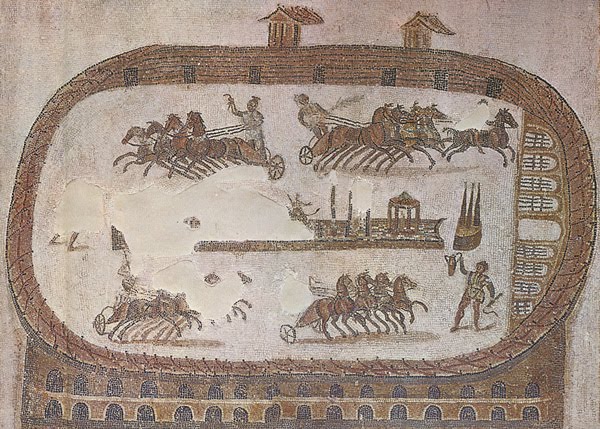
7. Her suffering and death. This is an account of a witness, “ . . . they marched from the prison to the amphitheater (see picture at the top of this post) joyfully as though they were going to heaven with calm faces, trembling, if at all, with joy rather than fear. Perpetua went along with shining countenance and calm step, as the beloved of God, as a wife of Christ, putting down everyone’s stare by her own intense gaze.”

They tried to dress her in the garb of a pagan priestess, but she resisted and they relented. At which point she sang Psalms.

Along with the others, she was forced to run a gauntlet before the gladiators and to be whipped on her back. The narrator tells us, “And they rejoiced at this that they had obtained a share in the Lord’s sufferings.”

Perpetua was stripped naked, but when the crowd saw that she was so young, she was allowed her clothing. Then they unleashed a wild cow on her, and it would have had horns for sure. The animal charged and tossed her and she fell on her back. “Then sitting up she pulled down the tunic that was ripped along the side so that it covered her thighs, thinking more of her modesty than of her pain. Next she asked for a pin to fasten her untidy hair: for it was not right that a martyr should die with her hair in disorder, lest she might seem to be mourning in her hour of triumph.”

After this she was allowed to go back to the gate, suffering from her wounds. She spoke to some Christians nearby, “You must all stand fast in the faith and love one another, and do not be weakened by what we have gone through.”

Then they were all brought out to the middle of the arena. They gave each other the kiss of peace before they each had their throats cut. Perpetua was the last one. “She screamed as she was struck on the bone; then she took the trembling hand of the young gladiator and guided it to her throat.” And she died.[Translation from Musurillo, The Acts of the Christian Martyrs (Oxford 1972)]

Now let’s look at –

Three characteristics of faithfulness

 – that stand out to me as I think of Perpetua.

1. She was not ashamed of Jesus. Jesus said in Mark 8:38, “For whoever is ashamed of me and of my words in this adulterous and sinful generation, of him will the Son of Man also be ashamed when he comes in the glory of his Father with the holy angels.”

She was fearless in her confession of her faith in Jesus. And so as Jesus said in Matthew 10:32, “everyone who acknowledges me before men, I also will acknowledge before my Father who is in heaven.” This is a promise she can certainly claim.

If she could do this in such a difficult situation, how much more should we be challenged and encouraged to have no shame of our Lord in our situations in life where there is no risk to life and limb, but rather to boldly acknowledge our faith in him to others?

2. She rejoiced in suffering. Jesus said in Matthew 5:11-12, “Blessed are you when others revile you and persecute you and utter all kinds of evil against you falsely on my account. Rejoice and be glad, for your reward is great in heaven . . .”

Her only wrong was being a Christian, but she was killed as a criminal. And yet she rejoiced after the sentence was handed down; when she was whipped she counted it joy to suffer as Jesus had; and she sang songs just before her death.

If she could do this in such a difficult situation, how much more should we be challenged and encouraged to “rejoice in the Lord always” as Paul says in 1 Thessalonians 5:16, we who are not suffering such persecution? Yet how often do we complain and grumble about our comfortable lives?

3. She gave up her earthy life for Jesus. Jesus said in Matthew 10:37-39, “Whoever loves father or mother . . . son or daughter more than me is not worthy of me. . . Whoever finds his life will lose it, and whoever loses his life for my sake will find it.”

This is a strong theme in this story. She gave up her son. She gave up her father and family. She gave up her life. She loved Jesus more than all these. And so, as Jesus said, she will find eternal life in the age to come.

If she could do this in such a difficult situation, how much more should we be challenged and encouraged to give up our earthly lives for the cause of the kingdom, even if in much smaller ways than she did? Often our chief concern is how busy we are with the activities and the enjoyment of this earthly life. But we too are called to give up our earthly lives.

__________

May we all be challenged and encouraged this morning to follow God with greater boldness in our faith, greater joy and thanksgiving in our lives, and greater sacrifice on our part for God’s kingdom.

William Higgins

Read Full Post »

In my title today I am echoing the form of some of the Proverbs, especially in chapter 30. And I do want to share some Scriptural wisdom with you today. I want to give us all some encouragement this morning to work at any relational tensions and conflicts we might have in our lives and in our congregation. And I am sharing this precisely at a time when I am not aware of any such concerns among us, so you can be sure that I have no particular situation in mind.

Working at good relationships is really important for any congregation, because when we don’t attend to our relationships it makes it quite difficult to be focused on doing the work of the Lord together. But when we do attend to these things and live in loving and healthy relationships with each other we can focus on doing the Lord’s work, and we will be the kind of people that God can use to do his work.

So here are 5 things in the area of conflict and broken relationships that amaze and bring joy, certainly to God and also to me as your pastor.

The first is –

Someone who truly confesses their wrong to another

If you have done wrong to someone, it is very tempting to be defensive. Maybe you think they have done worse to you before, or they deserved it – or whatever. And our culture would encourage you to make excuses and to evade responsibility. There is an epidemic of this. No one wants to admit their wrongs or take responsibility for them.

Instead of this, when you wrong someone, the Christian way is to freely and fully confess your wrong to the other person. Jesus said, “So if you are offering your gift at the altar and there remember that your brother or sister has something against you (that is, you have wronged her or him), leave your gift there before the altar and go. First be reconciled to your brother or sister, and then come and offer your gift.” – Matthew 5:23-24

Jesus teaches us to go to the one we have wronged. Don’t wait for them to come to you, or for the situation to blow up. Go to the one you have wronged. And go with the goal of being reconciled; of making things right, as Jesus said in v 24.

And this can’t happen if you don’t confess your wrong. You have to take responsibility for your words and actions.

The example of the prodigal son is instructive. He had wronged his father terribly. And so he came and said to him, “Father, I have sinned against heaven and before you. I am no longer worthy to be called your son.” – Luke 15:21. He took full responsibility for his actions. He humbled himself. And he was willing to accept the consequences of his behavior.

And as we see in this story, true and heartfelt confession has the power to heal people; and it has the power to heal relationships. The father forgave him and they were able once again to have a relationship. They were able to start off anew.

A second thing that amazes and bring joy is –

Someone who takes their concern to the person who wronged them

If in the first case you were the one who wronged another, in this case you have been wronged.

Jesus said in Matthew 18:15, “If your brother or sister sins, go and point out their fault, just between the two of you.” (NIV) Go to them in private, so that they can hear you and you can hear them and you can sort through the issue.

Now there is no doubt that this is hard to do. We most often prefer not to do this because we are conflict avoiders. We prefer to let the relationship wither rather than work hard to keep things right. And what a shocking indictment of our lack of love for one another this is!

But not only this, our conflict avoidance becomes an idol for us because it is more important to us than doing what Jesus teaches us. So in reality, we love neither God nor our neighbor.

When we don’t deal with things face to face we end up harboring resentment in our hearts which is poison within us. Or we might also be more active by spreading gossip. That is, instead of going to the person who wronged us, we go to everyone else and tell them about the wrong and how bad the person is. So not only is your relationship with the person damaged or destroyed, other people’s relationships with the person are damaged or destroyed.

It may seem risky, and it may be hard, but there is no other way if you want to maintain the relationship and be faithful to God. Take your concern to the person who wronged you.

A third thing that amazes and brings joy is –

Someone who can deliver a good admonition

Admonition means “counsel or warning against fault or oversight.” In Matthew 18:15 it is translated – “point out their fault.” (NIV)

But how do we do this rightly so that its good admonition? Here are some keys:

Restoration is the goal. We go to “win them over” – Matthew 18:15 (NIV). Paul calls it “restoring” them in Galatians 6:1. We need to speak in a way that it can be received and have a positive outcome.

Mercy is necessary. We don’t go to condemn the person, judge them and put them down. As Jesus taught us in Luke 6:37-42 it is fine to take the speck out of someone else’s eye, but we must make sure we don’t have a log in ours; that is, a lack of mercy.

Humility is required. We have to be humble because we know that we are only forgiven sinners. We are not better than the person we go to. Paul says, “Take care that you yourselves are not tempted” Galatians 6:1 (NRSV). We too could fall into sin again, if we are not careful.

Gentleness is key. Paul says, “If anyone is caught in any trespass, you who have the Spirit should restore such a one in a spirit of gentleness” – Galatians 6:1 (NRSV). There is no place for harshness.

When we do all this, we are giving what Proverbs 15:31 calls “life-giving reproof”; admonition that can truly bless and help someone.

A fourth thing that amazes and brings joy is –

Someone who can hear and receive admonition

If going to another person with an admonition is hard, I think it is equally or perhaps more hard to be admonished; to receive admonition. Its hard because we don’t like to admit that we have done wrong. And we don’t like it if someone else points this out.

That’s why the book of Proverbs makes the point that it is scoffers (those who mock, deride, show contempt to others) who do not receive reproof – Proverbs 9:8; 15:12. And we don’t want to be scoffers!

It tells us that “he who hates reproof is stupid” – Proverbs 12:1. And we don’t want to be stupid! And it says, “He who is often reproved, yet stiffens his neck (is stubborn or arrogant and won’t listen) will suddenly be broken beyond healing” – Proverbs 29:1. They will not receive the life-giving help that admonition can bring. And we don’t want to be in this position!

Proverbs also gives us positive encouragement to receive admonition, by pointing out that there are many benefits to it:

  • Proverbs 13:18 – “whoever heeds reproof is honored.”
  • Proverbs 15:5 – “whoever heeds reproof is prudent.”
  • Proverbs 10:17 – “whoever heeds instruction is on the path to life”
  • Proverbs 15:31 – “The ear that listens to life-giving reproof will dwell among the wise”
  • Proverbs 15:32 – “he who listens to reproof gains intelligence.”

Receiving admonition is not a sign of weakness; it is a sign of wisdom and maturity. That’s because the wise person wants to grow and be more faithful to God in every area of life, and so they are able to hear from another about their faults and any wrongs they may have done. And that’s why Proverbs 9:8 says, “Reprove a wise person and they will love you.” They will appreciate what you have done for them.

And so let’s be open to this, even if it is not done exactly correctly in your eyes (not tactfully or in a fully sensitive way). No, no. Listen for what God is saying to you through the person.

A fifth thing that amazes and brings joy is –

Someone who doesn’t judge by appearances

Jesus said to the Jewish leaders who wrongly judged him, “Do not judge by appearances, but with right judgment” – John 7:24. And we should not judge each other by appearances. That is, don’t come to conclusions about someone else when you don’t know all the facts, when you have just overheard something or seen something that could be interpreted in various ways, or heard a rumor from a third party.

Never come to conclusions about someone else based on these things. How many relationships have been damaged or destroyed in this way! If there is a rumor or a question – find out the truth. Go to the person.

Leaders are especially vulnerable to this. And sometimes when there are issues that must remain private we can’t even say fully why some decision are made. But don’t judge by appearances. Have some trust and then if you need to, ask leadership any questions you have.

So here are five things that amaze and bring joy. Someone who:

  1. truly confesses their wrong
  2. takes their concern to the offender
  3. delivers a good admonition
  4. receives admonition
  5. doesn’t judge by appearances

The reason these qualities are amazing and bring joy is that they don’t come naturally to us. These are not our natural inclinations. These are a sure sign of God’s love working in our heart. They come from the Spirit of God working in us so that we both love God and do what he tells us, and we love our brothers and sisters as well.

William Higgins

Read Full Post »

Our topic today is witnessing for Jesus. And our text is Acts 1:8. “You will receive power when the Holy Spirit has come upon you, and you will be my witnesses . . . to the end of the earth.” The key phrase for us today is, “you will be my witnesses.”

The word witness (μαρτυς) has a legal background. It refers to “someone who helps establish the truthfulness of a matter by testifying firsthand about what was seen or heard.” (Dale Leschert)

In our passage, it refers specifically to the 12 apostles, who are the official witnesses of Jesus’ life, death and resurrection. They are the ones who saw these events and can give authoritative, firsthand testimony about them (Acts 1:21-22).

More broadly, of course, this can apply to any Christian who knows Jesus and has been touched by him. (Paul is also called a “witness” even though he didn’t meet the criteria above. He is a witness in an extended sense to “what you have seen and heard”; the specific revelation Jesus gave to him about the Gentiles – 22:15/20) As Jesus said to the man from whom he cast out a legion of demons, “Return to your home, and declare how much God has done for you.” – Luke 8:39

We each have something to say, a testimony about who Jesus is and what he has done in our lives. And this testimony helps establish the truthfulness of Jesus and the good news of the gospel to those who see and listen.

I want to share three things this morning on witnessing, and I begin my first point with a question. When was the last time you witnessed to someone? When was the last time you really communicated what you believe to another person? Now this question is often used to challenge people, and even by some to induce guilt. But I am using it to make a different point.

When was the last time you witnessed to someone?? The last time you said or did anything. So perhaps on your way to church with family, or something you said in Sunday school.

My point is that –

1. You are always bearing witness to what you believe about Jesus

We witness every time we speak and act. Everything you say and do at work. Everything you say and do at school. Everything you say and do with friends, neighbors, or new people you meet.

Witnessing has to do with how we are at home with our family, which can be hard, since we tend to hold ourselves to a lower standard at home.  Witnessing has to do with how we drive as others watch (I guess especially if we have Christian bumper stickers); it has to do with how we buy our groceries; how we tip our waitresses and waiters; how we deal with waiting in a line, or when you get poor service at a business.

It certainly has to do with what we say in our texts and Facebook posts. Each of us, if we are online, have a digital witness that we need to attend to. And it is amazing how many Christians have no awareness of this in the things they say and post.

We witness every time we speak and act. The real question is are you a good witness or not? Are you witnessing for Jesus, or some other set of values which is what you truly believe in, and what truly governs your life? Are you just going along with the world, or are you representing Jesus in your words and actions?

2. Witnessing has to do with any aspect of our faith

We sometimes think that witnessing only has to do with the specific activity of inviting someone to believe in Jesus – to invite them to receive the forgiveness of their sins; to receive new life from Jesus. And if you haven’t done this, then you haven’t witnessed.

Well, this simply isn’t true. We are a witness when we say and do things that have to do with any part of our Christian faith. For instance:

  • trusting God in hard times. Others see you speaking of your faith in God, and they see how you act differently than others who don’t have faith, and this is a witness to the truth of Jesus and the gospel.
  • worshipping God. When we worship we proclaim how good God is, and how he answers prayers and takes care of us, this is a witness to all who hear. The psalmist says of worship, “Sing to the Lord, bless his name; tell of his salvation from day to day. Declare his glory among the nations, his marvelous works among all the peoples!” – Psalm 96:2-3. As those who don’t know God (Gentiles/the nations) hear, they will be challenged by the truth of our faith.
  • loving an enemy. Others will see that you aren’t acting or speaking like everyone else, and that you are trying to follow Jesus and that he is indeed changing your life and filling you with love, grace and forgiveness.
  • speaking up for the poor, the weak and the vulnerable. Others will see and hear that you have the heart of Jesus and compassion and a concern for righteousness and justice. This is a witness to a different set of values than what is usual.
  • teaching kids lessons at VBS about God, even if it doesn’t involve specifically inviting them to trust in Jesus.

Yes – for sure – most of us need to be more courageous to also specifically invite people to faith in Jesus ; to encourage them to believe. For instance if others know that you are going through a hard time and that you are trusting God to take care of you, you can also encourage them to put their trust in God with their concerns. And if they are open, tell them how to do this. For sure we need the Spirit to help us in this, and as our verse says, it is the Spirit who helps us as we witness.

But we are also witnesses whenever we speak about or act on any part of our Christian faith.

3. It is our highest calling to be a witness for Jesus

We all have many roles in life. A parent, a boss, a teacher – whatever, we all have been called to do various things. But as Christians the highest role we have in this life is to be a witness for Jesus. And we should understand this and make sure that it has this place in our lives.

We represent Jesus. We are not our own in this world. We bear his name in all that we do. Like Paul says in 2 Corinthians 5:20 about himself, we too are “ambassadors for Christ.” So how we interact with others is not just important because we are called to obey God and do what is right. It is also important for the sake of our witness to Jesus.

What I am saying is that our role as a witness should have an effect on how we act in our relationships with others. It will place limits on what we say and do that people who are not representatives of Jesus don’t have to worry about.

We have to understand that we don’t just live for ourselves and our causes; we live for him and for the cause of the kingdom.

So in your role as a boss, when you are dealing with a worker who is rude or lazy, you may be well within your rights to go off on the person, to be impatient, to immediately come down hard. But your role as Christian witness will curb these things so that you can be a representative of Jesus, showing appropriate mercy and the fruit of the Spirit, even while you act to correct the situation.

In your role as a parent you need to discipline your kids and it may be acceptable practice more broadly to yell, or act in anger towards them when they do wrong. But your role as a Christian witness to your children will curb these things so that you can be a representative of Jesus, disciplining them in love and with grace. Embodying Christlikeness as an example to them.

In your role as a worker, when everyone else is working hard to find ways not to work hard or to take advantage of the business, your role as a Christian witness will lead you to work hard as unto the Lord and to be ethical and honest.

We have to have concern for what others see us saying and doing. And we have to be aware of the question, “Am I being a good witness to the truth of Jesus and the good news of the gospel.”

Now I am not saying that we are to simply be people pleasers, who never say or do anything that might upset someone. Paul has some rather bad things to say about this in Galatians 1:10. But I am saying what Paul says in Colossians 4:5, “walk in wisdom toward outsiders.” I am saying, let all your words and actions be truly and fully Christian – whether people like them or not. Because in either case you are being a good witness for our Lord.

What we absolutely don’t want is for our words and deeds to nullify what we profess about the truth of Jesus and the gospel. We don’t want to bear witness to Jesus with our profession of faith, but then have all the rest of what we say and do bear false witness that Jesus is not true and that the gospel in not powerfully transforming.

We want our whole life and all that we say and do to powerfully confirm the testimony we proclaim, that Jesus is alive and that he can save each one who comes to him in faith.

William Higgins

Read Full Post »

If any one is interested in this topic  here is a link – Presentations on same-sex practice and the Scriptures. I am giving a presentation today on this topic.

Read Full Post »

We are ending our series on Habakkuk today, with a message entitled ‘Habakkuk on the end.’

Let me begin by saying, it’s not unusual when prophets speak, for there to be more meaning than even they know in what they say. That’s because the Spirit is the one who speaks through them. Peter says in 2 Peter 1:21, “For prophecy never had its origin in the human will, but prophets, though human, spoke from God as they were carried along by the Holy Spirit.”

And Peter says in 1 Peter 1:10-11 that the prophets “searched and inquired carefully, inquiring what person or time the Spirit of Christ in them was indicating . . ..” That is, they did not always fully understand what the Spirit was doing through them. But now with the coming of Christ we have the benefit of hindsight.

This surplus of meaning can be seen in relation to various prophecies about the day of the Lord. These passages speak to specific acts of judgment by God in the time frame of the prophet. But they also point beyond this to the final day, which is also called the day of the Lord in the New Testament; the end of all things (e.g. 1 Thessalonians 5:2; 2 Peter 3:10)

Here is one example from Isaiah 13:6-7. “6Wail, for the day of the Lord is near; as destruction from the Almighty it will come! 7Therefore all hands will be feeble, and every human heart will melt.” This is specifically talking about a judgment on Babylon. But just from this small sample you can see how it becomes a picture also of the final judgment.

Habakkuk can be read in this way as well. Even though its most basic meaning is of a literal judgment on Babylon and the resulting salvation of Judah, that has already happened centuries ago – there can be more to it than that.

Hebrews 10:37-38

– reads Habakkuk in just this way. “37Yet a little while, and the coming one will come and will not delay; 38but my righteous one shall live by faith, and if he shrinks back, my soul has no pleasure in him.” He is quoting Habakkuk 2:3-4. The coming of the vision of judgment and salvation, or “the coming one,” according to the translation he is using, has to do with the second coming of Jesus. [The Greek Old Testament or LXX. Also in this translation the phrase, “Behold, his soul is puffed up; it is not upright within him” is rendered, “If he should draw back, my soul has no pleasure in him.” The author of Hebrews then puts this phrase after the phrase, “my righteous one shall live by faith.” He departs from the LXX by not having the “my” before “faith” although some LXX manuscript traditions do have this.]

So he sees in these verses a reference to the final judgment, not just the judgment of Babylon; and a reference to the salvation of all God’s people throughout the world, not just the righteous in Judah. And living by faith has to do with faithfully waiting for Jesus’ return (v. 36) in the interval of Jesus’ first coming and his promised return. This is the context of the broader passage here in Hebrews. [The word faith in Habakkuk 2:4 can mean faith or faithfulness. Also, in Greek the word faith means both trusting in God and God’s promises, and also faithfulness – faithfully continuing to believe and faithfully living according to the promise. The latter is emphasized here in Hebrews.]

If we read Habakkuk in this way, we get an idea of what will happen on the final day. So let me share with you five things we learn about the end of all things from Habakkuk.

1. On the final day all nations and peoples will be judged

Habakkuk said much about the judgment coming upon Babylon; the bulk of his book is about this. And this was literally fulfilled not long after his time. But this judgment on Babylon, like in Isaiah 13, points us also to the end-time judgment.

Habakkuk 2:3 also takes us in this direction. When it talks about the vision of judgment having to do with “the end,” well, this can have a double meaning – the end of Babylon for sure, but also, the end of all things. And as we just saw the author of Hebrews sees in this also a reference to the end of all things.

Read in this way, we can say that those who are like Babylon – arrogant (2:4,5), violent (1:9), greedy (2:5), those who are strong, but use their strength against the weak – to take advantage of, shame and kill them (2:6-17) – all of these will be judged. And just as with Babylon in the five woe oracles in chapter 2, they will receive as judgment, what they did to others. They will get from God what they gave to others. For instance they killed, and so they will be killed (2:10); they shamed others, and so they will be shamed (2:16).

2. On the final day all mouths will be silenced

As a part of the judgment on Babylon Habakkuk 2:20 says, “The Lord is in his holy temple; let all the earth keep silence before him.” There is a fulfillment of this just after Habakkuk’s day, when Babylon was judged.

Babylon had its idols who couldn’t even speak, but when the one, true God speaks and acts the result is that everyone has to be silent. And Babylon was silenced as it saw God’s judgment unfold against it.

But the language here yearns for a greater fulfillment; a time when this will literally happen, as it says over “all the earth.” It points us to what will happen on the final day. This will be God’s day. God will speak and act and there will be nothing that anyone can do. And as we see the greatness and righteousness of God revealed, and as we see the depth of our sin – there will be no excuses, no rationalizations – only the silent acknowledgement that God is right.

3. On the final day God’s people will be saved

Habakkuk mostly talks about waiting for the fulfillment of God’s promise to judge Babylon. It doesn’t say a lot about the salvation that Judah will experience when this happens. Although this was certainly expected. 

As he says in reference to the Red Sea deliverance, “you went out for the salvation of your people, for the salvation of your anointed” – 3:13. And this is what was pictured as about to happen in his day on Babylon. And he ends his book with a reference to “the God of my salvation” – 3:18. This is what he was waiting for.

And sure enough, just after Habakkuk’s time Judah did return from exile, like the children of Israel escaping Egypt, as is pictured in chapter 3. The fig tree did have fruit, and the fields did have a harvest, in contrast to 3:17.

  But as we saw, the author of Hebrews reads it also as a reference to the salvation that God’s people will experience when Jesus returns.

But there is more. Habakkuk 2:4, “the righteous shall live by his faith” and especially the phrase “shall live” can have a double meaning.

  • The most basic sense of “shall live,” and what the book focuses on is living life while waiting for the promise to be fulfilled. Their lives will be characterized by faithful waiting on God.
  • But it can also be read, not as waiting for the fulfillment, but as having to do with receiving the fulfillment. The phrase, “shall live” then means what is received when the promise is fulfilled – new life, salvation, God’s blessing.

“The righteous shall live by his faith” means that by faith they will receive the promise, which is new life; God’s blessing as they return to their land.

And this second, double meaning can also be read as pointing to the end time when God’s people will be raised from the dead. They “shall live” because of their faith in God’s promise.

Paul uses the double meaning of this verse. When he quotes Habakkuk 2:4 in Romans 1:17 and Galatians 3:11 it refers to what we receive when the promise is fulfilled. And he sees it as referring to God’s end-time promise to give his people new life by the Spirit. We “shall live” because by faith we receive the Spirit, the same Spirit who will raise us up on the final day (Romans 8:11).

4. On the final day evil will be fully defeated

Habakkuk 3 teaches us that God didn’t just defeat Egypt when he battled at the Red Sea. He defeated the spiritual powers behind Egypt. Habakkuk saw in this vision God fighting and overcoming the cosmic powers of chaos and evil –  “the sea,” “the rivers,” “the deep.”

And as we saw, the sea is pictured as a sea serpent or dragon. The word “sea” is Yamm, the name of a sea serpent. It had a tail – v. 13, and it was trying to devour the Israelites – v 14. But God crushed its head, so that it was laying down – 13, and then he trampled it with the horses of his chariot – v. 15.

This vision of what God did to Egypt is then what is forecast for Babylon, which was fulfilled. It will be defeated, along with the spiritual powers behind it.

But this serpent language continues on in the New Testament and is applied to Satan.  Revelation 20:2 talks about “the dragon, that ancient serpent, who is the devil and Satan.”

Well, God will defeat once and for all Satan and all the spiritual powers behind evil in this world. On the final day Revelation 20:10 tells us that God will throw the devil “into the lake of fire.” And then notice what Revelation 21:1 says. “Then I saw ‘a new heaven and a new earth,’ for the first heaven and the first earth had passed away, and there was no longer any sea.” No more chaos, turmoil and evil.

5. On the final day God’s glory will be everywhere

Habakkuk 2:14 says, “For the earth will be filled with the knowledge of the glory of the Lord as the waters cover the sea.” So the metaphor is that just like the waters cover every part of the sea, so the knowledge of God’s glory will fill the earth; it will be everywhere.

Now this was fulfilled in that when Babylon was judged and his people came back to their land, just as predicted by God’s prophets, all who heard of this exalted Yahweh and his power. “What an amazing God!”

But once again the language here yearns for a greater fulfillment, because it speaks of the whole earth and a filling that goes beyond what happened in the ancient world.

And indeed on the final day, when God’s goodness and righteousness is revealed everyone will actually know and worship Yahweh – all over the earth. Even those who have rebelled against him, who have scorned him will have to bend the knee and acknowledge his greatness.

William Higgins

Read Full Post »

We are moving forward in our study of Habakkuk today, looking at the topic of living by faith.

Habakkuk 2:3-4 – “For still the vision awaits its appointed time; it hastens to the end—it will not lie. If it seems slow, wait for it; it will surely come; it will not delay. . .. but the righteous shall live by his faith.”

Habakkuk 3:17-19 – “Though the fig tree should not blossom, nor fruit be on the vines, the produce of the olive fail and the fields yield no food, the flock be cut off from the fold and there be no herd in the stalls, yet I will rejoice in the Lord; I will take joy in the God of my salvation. God, the Lord, is my strength; he makes my feet like the deer’s; he makes me tread on my high places.”

Before we get to our topic, let’s remember where we’ve been:

  • Habakkuk complained that God was not doing anything about Judah’s sin. God answered that the Babylonians will be his instrument of judgment on Judah.
  • Then Habakkuk objected that the Babylonians are worse sinners than the Judeans. Will they prosper? Will they not be judged? God answered that they will be judged in due time, and this is laid out in some detail.
  • Then last week in chapter 3, Habakkuk prayed for God to bring this about. Seeing in a vision God’s judgment of Egypt at the Red Sea, he says of Babylon in 3:16, “I will wait patiently for the day of calamity to come on the nation invading us.” (NIV)

Now all of this is the background against which the core message of Habakkuk comes out – what living by faith means. God gives promises to his people. But there is an interval between the promise and the fulfillment. And faith has to do with this in between time, living between promise and fulfillment.

So I want to share with you five things we learn from Habakkuk about what living by faith means; living between promise and fulfillment.

1. It means trusting in God’s promises

Habakkuk 2:4 says it simply – “the righteous shall live by his/her faith.”

Even if God’s promise seems to tarry, we are not to give up, but we are to keep God’s promises before us. We are to faithfully and steadfastly trust in God and his word to us.

Habakkuk lived by his faith. He knew what was coming and it wasn’t good. But he chose not to focus on the bad that was present and that was coming. He chose to stay focused on the promise.

In the same way we are to move forward, even though we don’t see any evidence that God’s promises to us are coming true. As Hebrews 11:1 says, “faith is the assurance of things hoped for, the conviction of things not seen.”

Romans 4:18-21 are some very powerful verses about trusting in God’s promises. Here, Paul talks about the faith of Abraham. “In hope he believed against hope, that he should become the father of many nations, as he had been told, ‘So shall your offspring be.’ He did not weaken in faith when he considered his own body, which was as good as dead (since he was about a hundred years old), or when he considered the barrenness of Sarah’s womb. No distrust made him waver concerning the promise of God, but he grew strong in his faith as he gave glory to God, fully convinced that God was able to do what he had promised.”

Faith is not putting on rose-colored glasses. “Everything is just fine!” “There’s no problems here!” No, faith is seeing how bad things really are, yet still choosing to trust that God will come through for us. Abraham and Sarah really were too old to have a child, but they did anyway because of God’s promise.

2. It means waiting for God to act

Habakkuk was given a promise that God would act to save his people and judge Babylon for its violence and evil. Then the Lord said to him in Habakkuk 2:2, “If it seems slow, wait for it; it will surely come; it will not delay.” And this is what he resolves to do in Habakkuk 3:16. “I will wait patiently for the day of calamity to come on the nation invading us.” (NIV); and for the day when God will deliver Judah.

And while he waited things were really bad. Judah was invaded. The temple and city were to be destroyed. And many would be killed or taken captive to Babylon. This was the reality he was facing presently and for the foreseeable future.

And although we will not find ourselves in just these circumstances, we will have our share of difficult situations as well. And so like Habakkuk we have to learn patient waiting also.

As Peter reminds us, with God a thousand years is as a day (2 Peter 3:8). God’s timing is not ours. But his promise will come. As the Lord says in 2:3 the promise has “it’s appointed time.” And so we must wait for it.

3. Living by faith means praying for God to act

It is not doing nothing; it is not about being passive. It is doing that which counts the most – praying.

This is what Habakkuk did as we see in Habakkuk 3:2. “Lord, I have heard of your fame; I stand in awe of your deeds, Lord. Repeat them in our day, in our time make them known; in wrath remember mercy.” (NIV)

We talked about this last time. God, you have said “it will surely come; it will not delay” (3:2). Bring it to pass even now! Make a name for yourself even in our day! Do great deeds of deliverance and salvation even now!

Through prayer God allows us to be a part of the process of bringing his promises to fulfillment.

4. Living by faith means having joy even while we wait

Habakkuk 3:17-18 are some of my favorite verses in the whole Bible. “Though the fig tree should not blossom, nor fruit be on the vines, the produce of the olive fail and the fields yield no food, the flock be cut off from the fold and there be no herd in the stalls, yet I will rejoice in the Lord; I will take joy in the God of my salvation.”

Habakkuk is living in very difficult circumstances. God hasn’t acted yet, and there is no sign that the fulfillment is just over the horizon. But he chooses to have joy because he knows God will act.

This is an anticipative joy. You know by faith how the story will end, and thus you can already have a taste of that joy, even while waiting for it.

It is as Jesus said in Matthew 5:12. When you are persecuted and slandered, “rejoice and be glad for your reward is great in heaven.” Rejoice already, knowing how things will end, when God’s promises are fulfilled.

5. Living by faith means receiving strength from God to endure

I am using the NLT here of Habakkuk 3:19, “The Sovereign Lord is my strength! He makes me as surefooted as a deer, able to tread upon the heights.”

Even though things are bad, and that for the foreseeable future, God gives him strength. In fact, God is his strength. In all of the chaos and suffering of his day God gives him stability – he is surefooted like a deer.

And thus God makes him able to go through the most difficult terrain – climbing through the mountain heights.

And God can be our strength too, so that we can make it through the difficult path we have to walk, waiting for the fulfillment.

What about you?

How are you doing living by faith this morning? How are you doing living in the in-between time; between promise and fulfillment?

Maybe you are looking to God to take care of you and your needs in this life. And maybe things are really hard right now. And you wonder when  God is going to come through for you.

Or perhaps you are looking to the future and the life to come when all of God’s promises are fulfilled. And you  wonder if you can make it to the end so that you can receive these.

Whatever your situation I want to pray for you this morning . . ..

William Higgins

Read Full Post »

Today we are in chapter 3 of Habakkuk. This is a very interesting chapter and I hope that you will find that to be true.

By way of review we have already seen how Habakkuk complained that God wasn’t dealing with Judah’s sin. God’s answer was that he would raise up Babylon to judge Judah. Then Habakkuk complained that Babylon was a worse sinner than Judah, and that they should be judged as well. And God’s answer was that Babylon would indeed be judged in accordance with their sins. But that the righteous must wait for this salvation in faith.

Today we look at –

Habakkuk’s prayer

As we will see, this is a prayer for God to act to bring about his promise to judge Babylon and save his people.

“1A prayer of Habakkuk the prophet. On shigionoth.” Habakkuk 3 is a prayer in the form of a song, or Psalm.

  • The word here in v. 1, “Shigionoth,” may indicate a musical style (Similarly, Psalm 7:1).
  • It uses the word “Selah” several times, as in the Psalms. (Although its meaning is not known it seems to be musical).
  • And in v. 19 it ends with the phrase, “For the director of music. On my stringed instruments.”

He prays, “2Lord, I have heard of your fame; I stand in awe of your deeds, Lord. Repeat them in our day, in our time make them known, in wrath remember mercy.” We will come back to this prayer at the end, but for now I would just note how this sets up the main part of our text today, vs. 3-15.

Habakkuk has heard what God has done in the past; he is in awe of God’s deeds. And as he thinks of the current situation with Babylon invading Judah (v. 16), he has a visionary experience (v.7) where he sees God defeating another superpower that opposed his people – Egypt at the Red Sea. This is the context then, for when he prays here. God, do what you did to Egypt again in our day – in reference to Babylon.

vs. 3-15 are poetry, with many evocative images. I will try to briefly give you the outlines of what is happening. You may want to reference the handout. It has two main sections. The first describes –

God’s march to war

“3God came from Teman,  the Holy One from Mount Paran.” These are the regions of Edom and south of this. Geographically speaking, God is coming from the East toward Egypt.

“His glory covered the heavens and his praise filled the earth. 4His splendor was like the sunrise; rays flashed from his hand, where his power was hidden.” Here we have a description of a brilliant sunrise and rays of light filling the heavens and the earth.

But then the mood changes. “5Plague went before him; pestilence followed his steps. 6He stood, and shook the earth; he looked, and made the nations tremble. The ancient mountains crumbled and the age-old hills collapsed –  but he marches on forever.” All is not well plague and pestilence are coming. Judgment is coming

Now also, storm imagery comes to the fore, which carries through the rest of the poem. Here it is in the form of thunder that shakes even those things that seem permanent and immoveable – the mountains and hills. A great storm is brewing and continuing West toward the Red Sea.

“7I saw the tents of Cushan in distress, the dwellings of Midian in anguish.” This speaks of the effect of God’s march to war on those he passes by Midian and Cushan, on his way to the Red Sea. They are in distress and anguish. [Or if one holds that the Red Seal crossing took place through the Gulf of Aqaba, just West of Midian, then this would narrate the arrival of God at the Red Sea.]

These verses refer back to Exodus 14:24. The Israelites crossed the Red Sea at night. The Egyptians entered the Red Sea in the morning to pursue them. It was in “the morning watch,” as the sun rose, that the Lord came to fight against Egypt.

The next section of the poem describes –

God’s victory in battle

“8Were you angry with the rivers, Lord? Was your wrath against the streams? Did you rage against the sea when you rode your horses and your chariots to victory?” The prophet asks why God executed judgment on the deep waters – the rivers and the sea. The answer will come in vs. 12-15.

As we have seen before the waters and the sea represent evil and chaos. Specifically, the word “sea” is Yamm, which is the name of an evil sea serpent. Well, these forces of evil and chaos were incarnated in Egypt’s armies, as they sought to come through the Red Sea to destroy Israel. And God is pictured riding on the clouds as his chariot, or in this case, a great storm.

Next we have the battle scene. “9You uncovered your bow, you called for many arrows. You split the earth with rivers” God begins the fight. The arrows are his lightning bolts. The rain splits the earth with rivers. “10the mountains saw you and writhed.” They wanted nothing to do with God’s great power and this fight.

“Torrents of water swept by; the deep roared and lifted its waves on high.” Here God overpowers and defeats the deep. This may be a reference to the waters being forced to cover over the Egyptian armies to destroy them.

“11Sun and moon stood still in the heavens at the glint of your flying arrows, at the lightning of your flashing spear.” Like the mountains they wanted nothing to do with God’s fight with the deep; they stood still to avoid God’s arrows as they passed by into the deep; into the body of Yamm.

Next, we have the answer as to why God came to fight. “12In wrath you strode through the earth and in anger you threshed the nations. 13You came out to deliver your people, to save your anointed one.” He came to save his people from the Egyptian armies.

And then we have a number of statements that elaborate further on God’s victory over Yamm. “You crushed the head of the house of the wicked, laying him bare from tail to neck.” Some translations say here, the Hebrew is uncertain. But this is talking about a sea monster, who has a tail. (Similarly, Psalm 74:13-14 says, “You divided the sea by your might; you broke the heads of the dragons of the waters. You crushed the heads of Leviathan; you gave him as food for the creatures of the wilderness.”)  Yamm is the leader of the Egyptian armies, the house of the wicked. He is pictured here as being knocked senseless and exposed.

  “14With his own spear you pierced his head – when his warriors stormed out to scatter us, gloating as though about to devour the wretched who were in hiding.” Here it is clear that the Egyptian armies are the warriors of Yamm. In them Yamm came to “devour” the Israelites. But God used the deep waters – “his own spear” – to destroy its own army. He made the waters cover over and destroy the Egyptians. “15You trampled the sea with your horses, churning the great waters.” Again, God is on a chariot with horses trampling Yamm. This is also a possible reference to the walls of water coming down to destroy the Egyptian armies.

So all of this poetically describes what happened in Exodus 14. Israel came through the Red Sea on dry ground at night. But in the morning, when Egypt entered the Red Sea to pursue and destroy Israel, a great storm arose. Exodus 14:24 says, “the Lord in the pillar of fire and of cloud looked down upon the Egyptian army . . ..” And three things happened.

1) God “threw them into a panic” – vs. 24, 25. The lightening, thunder and wind caused the Egyptians to fear as they were in the midst of the sea.

2) God “clogged their chariot wheels so that they turned with difficulty” – v. 25. The great storm caused the chariot wheels to become bogged down in the mud so that they were unable to maneuver. (Also Psalm 77:16-20). Even though they were agraid they couldn’t get out.

3) God brought the waters down upon them, destroying them – vs. 26-28.

Habakkuk’s response

– to this vision is fear; fear at God’s mighty power. “16I heard and my heart pounded, my lips quivered at the sound; decay crept into my bones, and my legs trembled.”

Then he says, “Yet I will wait patiently for the day of calamity to come on the nation invading us.” After being reassured through this vision of God’s power to judge a superpower, Egypt, he knows that the judgment God has spoken of in chapter 2 will indeed come and Judah will be saved.

Praying for God to act

This is what the prayer in v. 2 is all about. “2Lord, I have heard of your fame; I stand in awe of your deeds, Lord. Repeat them in our day, in our time make them known, in wrath remember mercy.”

God, you did great and awesome things when you saved your people from Egypt. So he prays regarding such deeds, “repeat them in our day, in our time make them known.” Act now, just like you did then.

Even though you are judging Judah for their sins, “in wrath remember mercy.” Don’t let us perish under the Babylonians. Save us. This is his prayer and he waits calmly for it to come to pass.

I have always liked this passage. For a number of years I had it hanging in my office. I believe it speaks to our own situation. The people of God were unfaithful then, and the church is now. The people of God were overcome by their enemies then, and we are so often defeated by the evil one.

The church in America is weak, divided and ineffective. We are biblically illiterate and often don’t even know what Jesus teaches us, much less do we put it into practice. We have read how God worked by the power of his Spirit in the New Testament church, and how they did God’s will with courage and boldness. How lives were transformed and God’s kingdom was manifested.

We have heard of God’s fame in this, and we should be in awe of what he did. And so we should pray. Repeat this in our day. In our time make your deeds known. Act today like you did in the days of the apostles. Even though we have been unfaithful, “in wrath remember mercy.”

I invite you to make this your prayer as we end today – “2Lord, I have heard of your fame; I stand in awe of your deeds, Lord. Repeat them in our day, in our time make your deeds known, in wrath remember mercy.”

William Higgins

Read Full Post »

Heading: 1 A prayer of Habakkuk the prophet. On shigionoth.

Hearing and awe: 2 Lord, I have heard of your fame; I stand in awe of your deeds, Lord. Repeat them in our day in our time make them known, in wrath remember mercy.

God’s march to war:

A. God comes from the East: 3 God came from Teman,  the Holy One from Mount Paran.

B. As a sunrise: His glory covered the heavens and his praise filled the earth. 4 His splendor was like the sunrise; rays flashed from his hand, where his power was hidden.

B1. As a brooding storm: 5 Plague went before him; pestilence followed his steps. 6 He stood, and shook the earth; he looked, and made the nations tremble. The ancient mountains crumbled  and the age-old hills collapsed –  but he marches on forever.

A1. The effect on those he passes by: 7 I saw the tents of Cushan in distress, the dwellings of Midian in anguish.

God’s victory in battle: 

C. Why did God attack?/God’s victory: 8 Were you angry with the rivers, Lord? Was your wrath against the streams? Did you rage against the sea when you rode your horses and your chariots to victory?

D. God’s weapons: 9 You uncovered your bow, you called for many arrows. You split the earth with rivers;

E. The mountains: 10 the mountains saw you and writhed.

F. Defeat of the waters/Egypt: Torrents of water swept by; the deep roared and lifted its waves on high.

E1. The Sun and moon: 11 Sun and moon stood still in the heavens

D1. God’s weapons: at the glint of your flying arrows, at the lightning of your flashing spear.

C1. Why God attacked/God’s victory: 12 In wrath you strode through the earth and in anger you threshed the nations. 13 You came out to deliver your people, to save your anointed one. You crushed the head of the house of the wicked, laying him bare from tail to neck. 14 With his own spear you pierced his head when his warriors stormed out to scatter us, gloating as though about to devour  the wretched who were in hiding. 15 You trampled the sea with your horses, churning the great waters.

Hearing and trembling: 16 I heard and my heart pounded, my lips quivered at the sound; decay crept into my bones, and my legs trembled. Yet I will wait patiently for the day of calamity to come on the nation invading us.

________________

NIV text; v. 13 italics – an alternate translation.

God’s march to war is in 3rd person, or 1st person; God’s victory in battle is in 2nd person.

C and C1 have the same elements – God’s wrath, the waters, your horses, salvation.

Underlined = 9 “you” statements – things that God did.

“heard” – v.2 and “heard” – v. 16 form an inclusion.


William Higgins

Read Full Post »

We are continuing on in the book of Habakkuk today and for the whole month of June.

Remember with me last time how Habakkuk complained that God wasn’t doing anything about Judah’s sin; about the powerful who were preying upon the weak; about injustice and oppression. Then God answered him that he is raising up the Babylonians to be his instrument of punishment on Judah.

Today we will cover the second interaction between the prophet and God – another complaint and God’s answer.

There are a number of verses to look at today so I will just briefly comment on them as we read through it. There are also some translation issues in this passage that I will not get into, but you can refer to the handout regarding the text I am using.

Habakkuk’s second complaint

“12Are you not from everlasting, O Lord my God, my Holy One? You shall not die. O Lord, you have ordained them as a judgment, and you, O Rock, have established them for reproof.” Babylon is God’s instrument to judge and teach Judah regarding its covenant unfaithfulness.

“13You who are of purer eyes than to see evil and cannot look at wrong, why do you idly look at the treacherous and remain silent when the wicked swallows up the man more righteous than he?” He is saying, since you are a holy God with pure eyes – why do you look without acting, and why do you remain silent when Babylon, who is more sinful than Judah, judges and destroys Judah?

Then we have a poetic picture of the situation, of all the nations that Babylon is overtaking.

People as prey: “14You make people like the fish of the sea, like crawling things that have no ruler.” There is an allusion here to the Genesis account of creation. It is as if humanity has been displaced from having dominion to the place of being like the fish and animals that are hunted, here by the Babylonians.

Net/dragnet: “15He brings all of them up with a hook; he drags them out with his net; he gathers them in his dragnet so he rejoices and is glad.” Babylon is the fisherman.

Net/dragnet: “16Therefore he sacrifices to his net and makes offerings to his dragnet; for by them he lives in luxury, and his food is rich.”

People as prey: “17Is he then to keep on emptying his net and mercilessly killing nations forever?” Will Babylon keep on destroying? God, will you not judge them??

Habakkuk waits

“2:1I will take my stand at my watchpost and station myself on the tower, and look out to see what he will say to me, and what he will answer concerning my complaint.”

God’s answer: Judgment is coming

“2And the Lord answered me: ‘Write the vision; make it plain on tablets, so he may run who reads it. 3For still the vision awaits its appointed time; it hastens to the end—it will not lie. If it seems slow, wait for it; it will surely come; it will not delay.’”

He is to write the vision down and then to wait for it to come to fulfillment, which it surely will.

Then we have the beginning of the vision.

The arrogant: “4Behold, his soul is puffed up; it is not upright within him.” Talking about Babylon.

The righteous: “but the righteous shall live by his faith” or faithfulness. In contrast to the arrogant, God’s people are to trust in God’s promises and remain faithful to God – as they wait for the vision to come to pass; as they wait for God to act to save them.

The arrogant: “5Moreover, wine is a traitor, an arrogant man who is never at rest. His greed is as wide as Sheol; like death he has never enough. He gathers for himself all nations and collects as his own all peoples.” Babylon conquers and wants more and more, but never has enough. Like an alcoholic wanting more drink, or Sheol always taking in more and more of the dead.

And then our passage ends with five woes on Babylon. This is the vision that will surely come to pass. A woe came from a funeral setting, for grieving the dead. It was used in oracles of judgment, perhaps because there will be grieving by those who are judged. In each of these their evil is described and there is a reversal that will take place. It begins – “6Shall not all these take up their taunt against him, with scoffing and riddles for him, and say:”

1. They are judged for taking the goods of others. “Woe to him who heaps up what is not his own – for how long? – and loads himself with pledges! 7Will not your debtors suddenly arise, and those awake who will make you tremble?” It is as if they borrowed all the items they stole and now owe them back with interest.

“Then you will be spoil for them. 8Because you have plundered many nations, all the remnant of the peoples shall plunder you, for the blood of man and violence to the earth, to cities and all who dwell in them.” With killing and violence against the earth and destruction of cities they have plundered. So, they will be plundered.

2. They will be judged for killing others to make themselves secure. “9Woe to him who gets evil gain for his house, to set his nest on high, to be safe from the reach of harm! 10You have devised shame for your house by cutting off many peoples; you have forfeited your life. 11For the stone will cry out from the wall, and the beam from the woodwork respond.” Even the material they unjustly took to build their empire will cry out against them. Those who have killed, will be killed.

3. They will be judged for building an empire through killing. “12Woe to him who builds a town with blood and founds a city on iniquity! 13Behold, is it not from the Lord of hosts that peoples labor merely for fire, and nations weary themselves for nothing?” All their work to be great and honored, will be burned, it will come to nothing. (Jeremiah 51:58).

“14For the earth will be filled with the knowledge of the glory of the Lord as the waters cover the sea.” In the end, only God’s glory will be left over all the earth. (Isaiah 11:9).

4. They will be judged for violence that shamed people. “15Woe to him who makes his neighbors drink – you pour out your wrath and make them drunk, in order to gaze at their nakedness! 16You will have your fill of shame instead of glory. Drink, yourself, and show your uncircumcision! The cup in the Lord’s right hand will come around to you, and utter shame will come upon your glory! 17The violence done to Lebanon will overwhelm you, as will the destruction of the beasts that terrified them, for the blood of man and violence to the earth, to cities and all who dwell in them.”

They have violently judged others and put them to shame by this. Specifically they destroyed the ancient forests of Lebanon and its animals. For this they will be violently destroyed and shamed.

5. They will be judged for idolatry. “18What profit is an idol when its maker has shaped it, a metal image, a teacher of lies? For its maker trusts in his own creation when he makes speechless idols! 19Woe to him who says to a wooden thing, Awake; to a silent stone, Arise! Can this teach? Behold, it is overlaid with gold and silver, and there is no breath at all in it. 20But the Lord is in his holy temple; let all the earth keep silence before him.”

An idol is not real. So it is silent; it cannot speak or teach. You can only speak to it. The opposite is true of Yahweh. He is real. And he speaks. And everyone must be silent before him. In this case, all people must be silent before him and learn from him as this judgment unfolds.

A summary of God’s answer. Yes, it is true. Babylon is a worse sinner than Judah. But God will judge Babylon as well for all the evil they do. The righteous must faithfully wait, trusting in God’s promise of this.

And this is what happened. The empire of Babylon was overcome and destroyed some 60 years after God’s promise given here to Habakkuk.

We will look at the theme of the righteous living by faith in the weeks to come, but for now let’s end with some –

Lessons

 – on the theme of God’s judgment. 1. True justice does not always take place on this earth. The wicked often prosper, even at the expense of the righteous – as in this case with Babylon and Judah in our verses. When you look at the world and think that things are not as they should be you are right.

But for everyone, there comes a time for justice; a time of reckoning. Galatians 6:7 says, “we will reap what we sow.” Matthew 16:27 says, the Son of Man is coming and “he will repay each person according to what he or she has done.”

God will see to it that justice reaches every single person who has ever lived. As I said, it reached the people of Babylonia 60 years later – at least in part. And true justice will come in its fullness on the final day.

This is a comfort to the righteous, who suffer injustice – knowing that all things will be made right some day. And it should cause fear to those who do evil.

Getting even more specific, 2. God will judge superpowers for their sins. Babylon was the superpower of its day. And in our verses, it is condemned for a number of things:

  • for being arrogant (2:4-5)
  • for being greedy for more and more wealth and power (2:5)
  • for the pursuit of glory at the expense of shaming others (2:15-17)
  • for trust in and glorification of military might  (1:16)
  • for taking the goods of other smaller nation and then living in luxury (2:6, 8, 9; 1:16)
  • for building its empire by “cutting off many lives” (2:9-10)
  • for killing others for its own sense of security (2:9-10)
  • for violence against the earth, for instance, cutting down the ancient forests of Lebanon and killing its animals (2:17).

We live in the superpower of our day. Now the US is not the same as Babylon was – but there are some parallels. What does this mean for us as God’s people; God’s nation, the church – living as exiles in the midst of this country?

3. God really does punish evildoers. Today many are not comfortable talking about God as “punishing” evildoers. We don’t want God to seem mean or vindictive.

But what we need to understand is that if there is to be justice in the world, then there must be a time of reckoning for all.

And this does not conflict with our call to love our enemies. In fact, it enables us to love our enemies. We can set aside our desire to punish our enemies; to make them pay, and rather act in mercy and love toward them – precisely because we know that God will take care of issues of justice in his own time. As Romans 12:19 indicates, we do not need to seek vengeance because, “vengeance is mine, I will repay, says the Lord.”

William Higgins

Read Full Post »
« Newer Posts - Older Posts »